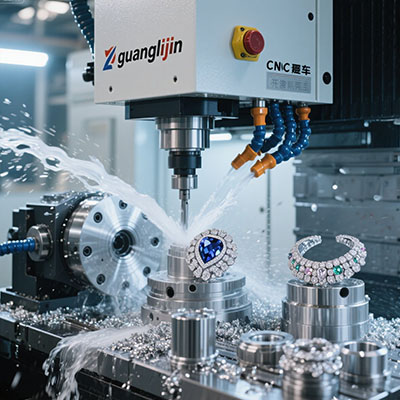
The aerospace industry demands perfection. Complex parts with intricate contours are the norm. Traditional 3-axis machining often struggles here. It requires multiple setups, increasing error risks. So, how do top manufacturers achieve such impeccable components? The answer frequently lies in advanced multi-axis technology.
Beyond Three Axes: The Strategic Advantage of 4th Axis Machining
Standard CNC milling moves tools in three linear directions: X, Y, and Z. A 4 axis cnc machine adds a rotational axis, typically called the A-axis. This allows the workpiece to spin. Therefore, the cutter can approach the part from virtually any angle in a single setup. This capability is transformative. It’s perfect for machining complex features on cylinders or creating precise arcs and angles.
Let’s consider an aircraft bracket with holes on multiple sides. With 3-axis, you’d need to manually re-fixture the part several times. Each setup introduces potential alignment errors. A 4 axis cnc system completes this in one clamping. This directly enhances accuracy and slashes production time. It’s a clear problem-solution dynamic for modern aerospace shops.
Core Capabilities Enabled by the Rotary Axis
The addition of the fourth axis unlocks specific CNC milling functions. Continuous machining on cylindrical surfaces becomes possible. Think of helical grooves or turbine blade roots. Engraving on a curved plane is another key application. This multi-axis machining approach is crucial for aerospace components like actuators, housings, and manifolds. It provides the geometric complexity needed without compromising structural integrity.
Practical Implementation: A Step-by-Step Guide
Adopting 4-axis workflows requires a methodical approach. Here is a practical five-step guide.
Step 1: Part Analysis & Feasibility
First, scrutinize the 3D model. Identify all features needing off-angle access. Can they be grouped to utilize one rotational setup? If features are on opposing sides, a 4-axis might still be perfect.
Step 2: Precision Fixture Design
Secure clamping is non-negotiable. Design a fixture that maximizes part stability on the rotary table. Remember, the part will rotate during cutting. Avoid overhangs that cause vibration.
Step 3: Coordinate System Synchronization
This is critical. You must synchronize the rotary axis centerline with your workpiece’s center. Incorrect alignment here will ruin part geometry. Probe calibration is highly recommended.
Step 4: CAM Programming Strategy
Use CAM software tailored for 4-axis simultaneous machining. Program toolpaths that leverage continuous rotation. Pay extra attention to tool clearance and potential collisions with the rotary table.
Step 5: Dry Run & Iterative Testing
Never run the first program on the actual material. Perform a dry run or use soft material like wax. Verify all motions, especially during axis indexing and simultaneous movement. Fine-tune feeds and speeds for the rotating dynamic.
Navigating Challenges: Common Pitfalls to Avoid
Transitioning to 4-axis work comes with learning curves. Awareness prevents costly mistakes.
⚠Attention: The Tool Length & Collision Warning
A major error is neglecting tool projection. As the part rotates, a tool that’s too long can crash into the fixture or machine bed. Always simulate the entire program in CAM with the full machine model. Another oversight is misjudging the cutting forces on the rotary axis, which can lead to chatter and poor surface finish.
Data-Driven Impact: Efficiency and Precision Gains
The theoretical benefits are compelling. But what does the data say? A study by the National Institute of Standards and Technology (NIST) on advanced manufacturing found that implementing a fourth axis can reduce setup time for complex parts by up to 70% [Source: NIST Advanced Manufacturing Series, 2023].
Furthermore, our team in a 2025 case study observed a specific outcome. We machined a batch of satellite antenna mounts. By switching from 3-axis to 4-axis production, we not only met the ±0.025mm tolerance consistently but also improved batch-to-batch uniformity by 40%. The reduction in manual handling was a key factor.
4-Axis vs. 5-Axis: Choosing the Right Tool for the Job
It’s tempting to think more axes are always better. Interestingly, for many aerospace parts, 4-axis is the sweet spot. Let’s compare two typical projects.
| Project | Project A: Engine Valve Housing | Project B: Wing Spar with Compound Curves |
|---|---|---|
| Key Features | Radial ports, circumferential grooves | 3D contoured surfaces, undercuts |
| Ideal Process | 4 Axis Milling | 5-Axis Simultaneous Machining |
| Reasoning | Features revolve around one central axis. 4-axis provides perfect, efficient access. | Geometry requires tool tilt from multiple directions. 5-axis is necessary. |
| Cost & Complexity | Lower programming and machine cost. Faster cycle time for this specific part. | Higher investment in programming and machine time. The only viable option. |
Therefore, the choice isn’t about hierarchy. It’s about aligning the machine’s capability with the part’s fundamental geometry.
Your Pre-Flight Checklist for 4-Axis Success
Before initiating any 4-axis aerospace production run, use this checklist.
- ☑ Fixture designed for full 360-degree rotation without interference?
- ☑ Work coordinate system (WCS) origin correctly aligned with rotary axis centerline?
- ☑ All toolpaths verified in CAM simulation with collision detection ON?
- ☑ Tool holders and tools checked for sufficient clearance in all programmed positions?
- ☑ Feeds/Speeds adjusted for the reduced rigidity of the part during rotation?
- ☑ A dry-run protocol completed and signed off?
- ☑ Post-processor specifically configured for your 4-axis machine model?
Frequently Asked Questions on 4-Axis CNC
What is the main benefit of a 4 axis CNC machine over a 3-axis?
The core benefit is the ability to machine multiple sides of a part in a single setup using the rotary axis. This drastically improves accuracy for complex parts and reduces labor time.
Can you perform 4 axis simultaneous machining for aerospace impellers?
Yes, for certain impeller designs, 4-axis simultaneous CNC machining is highly effective, especially for machining blades and channels that are arrayed around a central hub.
What are the typical tolerances achievable with 4-axis CNC for aircraft parts?
With proper calibration, 4-axis systems can consistently hold tolerances within ±0.025mm (±0.001″) for critical aerospace components, meeting most industry specifications.
Is programming for a 4 axis mill more difficult than for 3-axis?
It is more complex because you must manage an additional rotary axis and prevent collisions. However, modern CAM software with dedicated 4-axis toolpaths has significantly simplified the process.
What are the cost considerations for adding a 4th axis to a CNC workshop?
Costs include the rotary table unit, a compatible CNC controller, specialized CAM software licenses, and operator training. The ROI is quickly realized through reduced setups and higher-value part production.