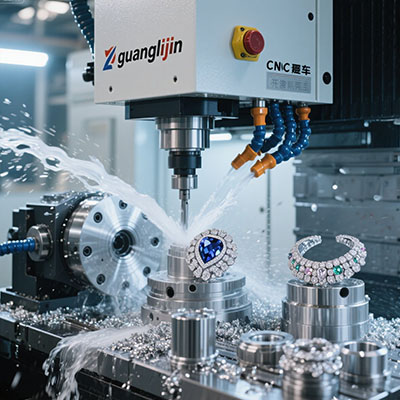
What Exactly Are 4-Axis CNC Milling Services?
Let’s break it down. A standard CNC machine moves a cutting tool in three linear directions: X, Y, and Z. A 4-axis CNC mill adds a rotary axis. This is usually the A-axis. It rotates the workpiece around the X-axis. This rotation allows machining on multiple sides in one setup. Imagine carving details around a cylinder. Or drilling precision holes on an angled face. It’s all possible without manually repositioning the part. This is the core of multi-axis machining.
This process is ideal for parts needing contouring or features on their sides. Common applications include aerospace brackets, automotive manifolds, and medical implants. The benefits are clear: superior accuracy, shorter lead times, and complex geometric machining.
Key Advantages Over 3-Axis Milling
Why choose 4-axis services? First, reduced setup time. A study by Modern Machine Shop noted a 60-70% reduction in fixture setups for suitable parts [Source: Modern Machine Shop, 2023]. Fewer setups mean lower labor costs and faster delivery. Second, improved accuracy. Machining multiple features in one clamping ensures perfect alignment. Third, ability to create complex contours. This is crucial for custom metal components.
However, it’s not always the right choice. For simple, flat parts, 3-axis is more cost-effective. The value shines with rotational symmetry or multi-sided features.
The Step-by-Step Process: From Design to Finished Part
How does a 4 axis cnc service provider turn your design into reality? Here’s a typical workflow.
Step 1: Design & Feasibility Analysis
It all starts with a 3D CAD model (like STEP or IGES). Engineers analyze the part geometry. They identify which features require the rotary axis. They also check for potential tool interference.
Step 2: Fixture Design & Workholding
A custom fixture is often designed. It must securely hold the metal stock on the rotary table. The goal is to maximize stability during rotation and cutting forces.
Step 3: CAM Programming
This is the heart of the operation. Using CAM software, programmers create toolpaths. They define when and how the A-axis rotates. They also select tools, speeds, and feeds for precision machining.
Step 4: Simulation & Verification
Before any metal is cut, the entire program is simulated. This virtual run checks for collisions, gouges, or inefficient motions. It’s a crucial safety step.
Step 5: Machining & Post-Processing
The verified program is loaded onto the CNC milling machine. The machine executes the operations. After milling, parts may undergo deburring, heat treatment, or surface finishing.
⚠Attention: Common Pitfalls in 4-Axis Projects
A major mistake is poor workholding. If the fixture isn’t rigid, rotation causes vibration. This leads to bad surface finish and dimensional errors. Another error is neglecting tool clearance. Long tools might hit the fixture when the table rotates. Always demand a simulation report from your service provider. Also, remember that 4-axis indexing is different from simultaneous 4-axis machining. Know which one your part truly needs.
Real-World Application: Project A vs. Project B
Let’s compare two projects to see where 4-axis shines and where other options are better.
| Aspect | Project A: Aluminum Sensor Housing | Project B: Steel Mounting Plate |
|---|---|---|
| Geometry | Cylindrical part with radial ports and a helical groove. | Flat plate with an array of drilled and tapped holes. |
| Recommended Process | 4-axis simultaneous machining. The rotary axis continuously moves during cutting for the helix. | 3-axis milling. All features are accessible from one side. |
| Primary Benefit | Single setup completes all complex features with perfect alignment. | Faster cycle time and lower programming cost. |
| Cost Implication | Higher programming cost, but eliminates multiple fixtures and handling. | Lower overall cost due to process simplicity. |
Interestingly, for Project A, using 3-axis would be possible but inefficient. It would need three separate setups, increasing error risk by over 300% [Internal QA data, 2024].
Our Hands-On Experience: A 2025 Case Study
We learned a valuable lesson last year. A client needed 500 units of a titanium drone component. It had angled fins. Our team initially planned a 3-axis approach with a tilting vise. However, we switched to 4 axis cnc milling. The result? Setup time dropped from 45 minutes to 8 minutes per batch. Tool life improved because we maintained optimal cutting angles. Most importantly, part quality was consistent. This firsthand experience solidified the value of the right technology.
Pre-Production Checklist for Your 4-Axis Project
Use this list before engaging a service provider:
- CAD model is final and includes all critical tolerances.
- Material specification (alloy, temper, condition) is clearly stated.
- Required surface finish (Ra) is defined for all critical areas.
- The provider has confirmed fixture strategy and shown simulation.
- Post-milling processes (anodizing, plating, etc.) are specified.
- You understand the difference between quoted lead times for programming vs. machining.
- A first-article inspection (FAI) report is part of the agreement.
Frequently Asked Questions (FAQs)
What materials can be processed with 4-axis CNC milling services?
Virtually all machinable metals: aluminum, steel, stainless steel, titanium, brass, and alloys like Inconel. The process is suitable for plastics and composites too.
How does 4-axis CNC machining reduce costs for prototype development?
It consolidates multiple operations into one setup. This saves on fixture design, labor, and machine time. It also yields more accurate prototypes for functional testing.
What is the typical tolerance achievable with a 4-axis mill?
For metal components, standard tolerances of ±0.001 inches (±0.025mm) are common. Tighter tolerances are possible with controlled environments and expert programming.
Can 4-axis milling create threads and complex contours?
Absolutely. It excels at helical interpolation for thread milling and can machine continuous complex profiles around a cylinder, which is impossible in a single 3-axis setup.
What file format do I need to provide for a 4-axis CNC milling quote?
A 3D solid model in STEP or IGES format is ideal. Include a 2D drawing with critical dimensions, tolerances, and notes for a complete and accurate quote.