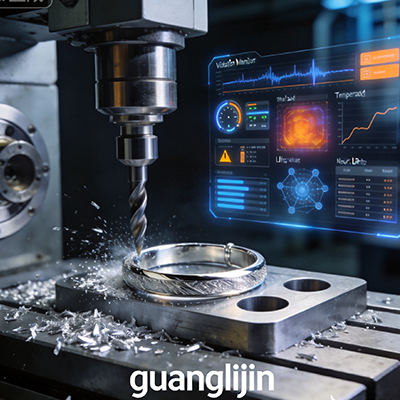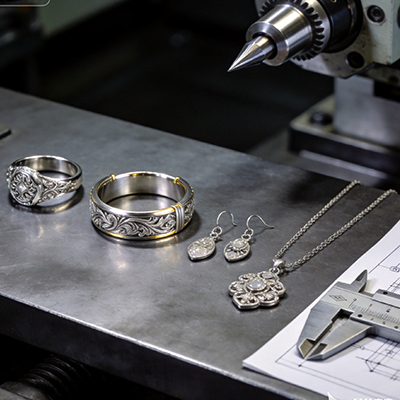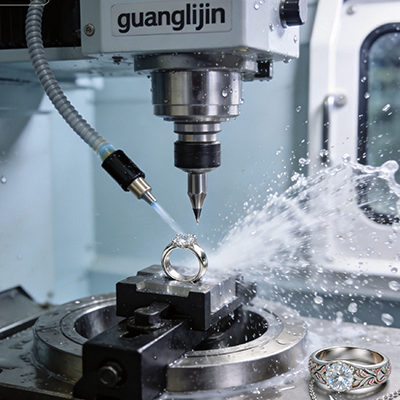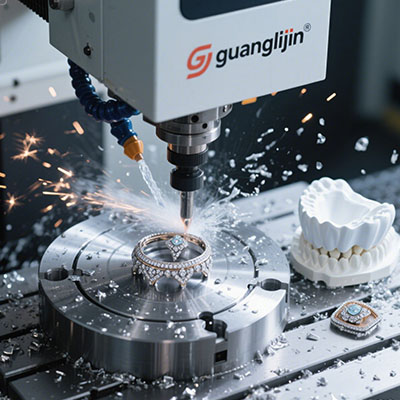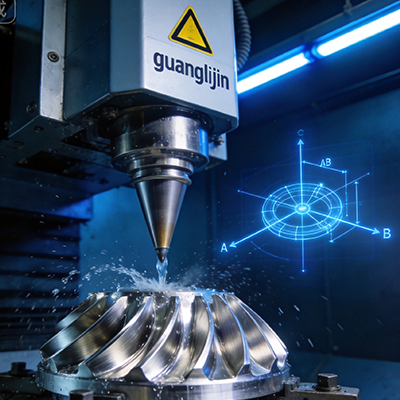
A 5 axis CNC machine for jewelry should solve a clear access problem. It may reach sloped ring faces, recessed settings, or curved surfaces with fewer manual setups. Yet extra motion does not prove fine detail or a good finish. Before buying, test the actual design, material, and holding method that your workshop will use.
Start with the Jewelry Feature
Choose one part that is hard to make today. Mark its thin walls, deep pockets, and faces that need work from several angles. State whether the output is a wax pattern or a finished metal piece. Those routes have different cutting loads and later steps. Keep that choice clear in the quote.
Small jewelry milling also depends on the tool holder. A cutter tip may reach a setting while the holder strikes its rim. Show the full tool assembly in the CAM model. If the supplier uses a longer tool to gain access, ask how they will check deflection and the resulting surface.
Understand What the Axis Count Means
Autodesk describes positional machining as three linear axes, X, Y, and Z, combined with two rotary axes. The rotary pair sets a working angle for cutting. [Source 1: Autodesk, Fusion for Manufacturing, positional machining description.] This configuration can support angled features without making every cut a simultaneous motion problem.
A useful scale reference comes from Roland DGA: its DE-3 engraver lists a 305 × 230 mm table. [Source 2: Roland DGA, DE-3 specifications, Work Table Size.] That is a separate engraving model, not a specification for the machine in your quote. Measure usable fixture space rather than assuming all compact equipment has similar capacity.
Compare Indexed and Simultaneous Routes
Indexed cutting can suit a ring with several distinct working faces. Continuous tool tilt may help when the cutting angle must change along a surface. Neither route removes the need for a sound fixture. Ask the supplier to show why continuous motion improves your part and whether the simpler route meets the same drawing.
| Project decision | Project A: Indexed cutting | Project B: Continuous tilt |
|---|---|---|
| Working angle | Set before each cutting section | Changes during the cut |
| Likely application | Separate angled faces | Curves needing changing access |
| Proof required | Position and setup repeatability | Motion, clearance, and finish |
Run a Five-Step Buying Trial
- Freeze the drawing. Mark final dimensions, material, and finish allowances. Give each file a revision.
- Review access. Show the cutter, holder, blank, clamps, and rotary travel limits in the simulation.
- Prove the hold. Load a sample blank and check that it stays firm without bending thin sections.
- Cut the sample. Use approved tooling and a supervised procedure. Record settings and any manual work.
- Inspect the finished result. For wax, assess the later casting too. Repeat the setup with a new blank.
A Ring Case Worth Testing
Consider an illustrative signet ring with a sloped face and a recessed side motif. An indexed approach may reach both areas with short tools. If the recess has a hidden wall, continuous tilt may still not solve access. The test should expose that limit before anyone treats extra axes as a complete answer.
While researching this guide, I compared Autodesk’s motion description with a compact engraver’s dimensional sheet. The contrast was useful: axis capability and usable part space answer different questions. That document review led to a simple buying rule. Ask for both an access demonstration and a finished sample from your design.
⚠ Attention: Do not treat commanded resolution as finished-part accuracy. Do not assume a wax-capable machine can cut precious metals. Confirm the exact material approval, tool range, and machine limits. Keep the fixture in every clearance check, including rapid travel between cutting areas and moves used for tool changes.
Questions Before You Request a Quote
Is a multi-axis jewelry mill always better?
No. It is useful when its motion solves an access or setup issue in your work. A flat pendant may need much less. Compare accepted parts, setup time, and operator effort. More capability can be worthwhile, but only if the shop can use it reliably and support the added programming work.
Can the same machine cut wax and gold?
Only when the specific model and configuration support both materials. Ask the maker for written guidance and a sample in the intended alloy. Do not transfer wax cutting settings to metal. Check extraction, chip recovery, tools, and workholding as part of the metal process before committing to production.
What belongs in the equipment quotation?
For a 5 axis CNC machine for jewelry, include software, post processor, tools, fixtures, training, and service. Ask which items were used for the sample. State your expected batch mix and finish standard. A complete configuration is more useful than a base-machine price without the means to repeat the demonstration.
Checklist
- Part and alloy are defined.
- Holder access is proven.
- Fixture and tool paths are reviewed.
- Finished samples meet the drawing.
- Repeat setup results are recorded.
- The quote includes the complete working configuration.