When Two Worlds Collide: Precision Engineering Meets Art
Imagine a ring light as a feather yet strong enough to handle immense pressure. Or a pendant with the complex lattice of a satellite component. This is not science fiction. It’s the new frontier in jewellery making.
Aerospace engineering demands extreme precision and material mastery. These same principles are now revolutionizing custom adornment. The result? Pieces that are incredibly durable, detailed, and futuristic.
The Core Challenge: Translating Aerospace Rigor to Wearable Art
The main problem is simple. How do you make jewellery that feels like a spacecraft part? It must be geometrically complex, use advanced metals, and be flawlessly finished.
Traditional jewellery techniques often fall short. Hand forging titanium is incredibly difficult. Lost-wax casting can lose micro-details. The solution lies in adopting aerospace’s digital toolkit: CAD and CNC machining.
This approach guarantees accuracy to within microns. It allows for designs with internal channels or precise interlocking parts. Basically, it makes the impossible possible.
Case in Point: The Turbine Ring Project
We had a client in 2024 who wanted a ring based on a jet engine turbine. The design had swirling, undercut blades. Interestingly, hand carving was completely out of the question.
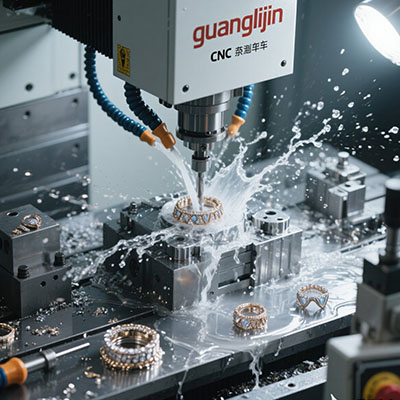
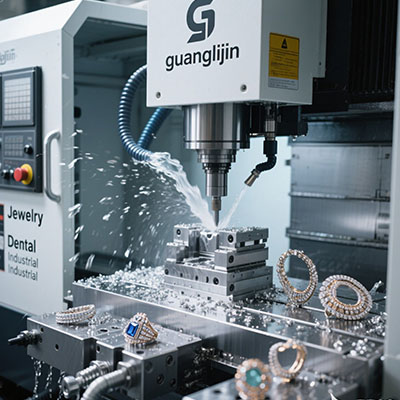
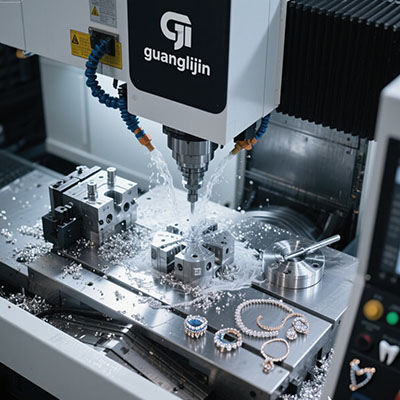
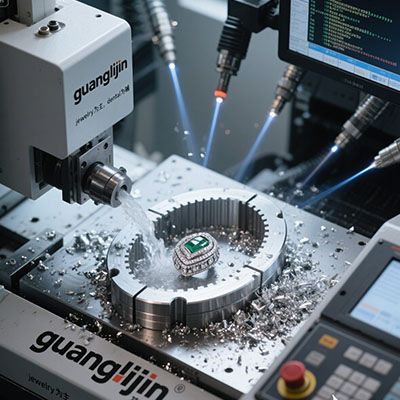
Our solution used 5-axis CNC milling directly on aerospace-grade titanium. This allowed us to machine the complex undercuts in one setup. The finish was a perfect matte, achieved through abrasive blasting—a technique straight from the aerospace playbook.
Material Matters: Aerospace Alloys in the Jewelry Box
This fusion isn’t just about shape. It’s about substance. Think titanium, stainless steel 316L, and even Inconel. These metals are chosen for their strength-to-weight ratio and biocompatibility.
A 2022 study in the *Journal of Materials Engineering* showed Grade 5 Titanium has a tensile strength over 900 MPa. That’s roughly three times stronger than sterling silver. This data point is crucial for designing thin, strong pieces.
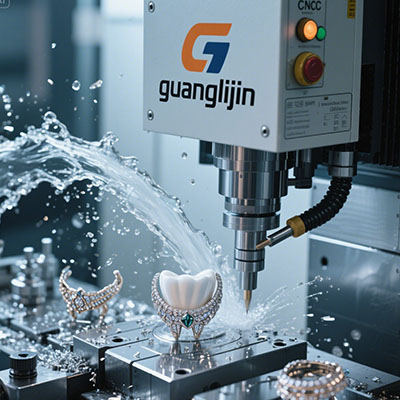
However, these materials are tough. They quickly wear down standard tools. Therefore, successful jewellery making with them requires specialized CNC cutters and coolants, borrowed from aerospace workshops.
Project Showdown: Direct Milling vs. Hybrid Approach
Not every aerospace-inspired piece follows the same path. Your project’s goals determine the best method.
| Project A: Direct Metal CNC Milling | Project B: Hybrid (CNC Wax + Casting) |
|---|---|
| Best for one-off, ultra-precise pieces. | More economical for small batches. |
| Superior strength from a solid metal block. | Allows for traditional precious metals like gold. |
| Higher machine time cost. | Slight potential for detail loss in casting. |
| Minimal material waste for the final part. | Enables more organic, sculptural forms. |
5-Step Guide to Your Aerospace-Inspired Piece
Ready to launch your project? Follow this guide.
Step 1: Define the “Why”
Is it about lightweight comfort? Structural spectacle? This core idea will guide every technical choice, from metal to machining strategy.
Step 2: Advanced CAD Modeling
This goes beyond simple shapes. Use surface modeling for fluid aerodynamics or parametric design for repetitive lattice structures. Engineering software like Fusion 360 is ideal.
Step 3: Strategic CAM Programming
Here, the CAD model becomes machine instructions. Toolpaths must be optimized for hard metals. This step prevents tool breakage and ensures a perfect finish.
Step 4: Precision Machining & In-Process Control
The CNC machine executes the program. For critical features, in-process probing might be used—just like in aerospace—to verify dimensions mid-production.
Step 5: Aerospace-Grade Finishing
Forget just polishing. Think tumbling, electrochemical etching, or PVD coating. These techniques create unique, durable surfaces that tell a story of technology.
⚠ Attention: Common Pitfalls to Avoid
⚠ Attention: Ignoring Stress Concentration.
A sharp internal corner in your design acts like a crack starter. In aerospace and jewellery, this is a critical failure point. Always use fillets (rounded corners) in high-stress areas, even if they’re hidden. A 0.5mm radius can prevent breakage.
Another major mistake is overlooking thermal management. Machining titanium generates heat. Without proper coolant, you can ruin the material’s properties and the tool. Partner with a shop that knows this.
Pre-Flight Checklist for Your Project
- ✅ Is the CAD model designed for manufacturability (DFM)?
- ✅ Has the metal choice been validated for wearability and skin contact?
- ✅ Are all critical dimensions and tolerances clearly communicated?
- ✅ Is the CNC vendor experienced with both jewellery and hard metals?
- ✅ Has the post-processing and finishing plan been finalized?
Related Q&A: What Makers Are Searching For
Q: What are the best metals for lightweight, strong custom rings?
A: Aerospace-grade titanium (Grade 5 or 23) and 316L stainless steel are top choices for their high strength-to-weight ratio and durability.
Q: How to achieve a matte or bead-blasted finish on CNC metal jewellery?
A: This is done post-machining using an abrasive blasting cabinet with fine glass beads or aluminum oxide media, a common aerospace finishing technique.
Q: Can you use CNC machining to make detailed geometric jewellery patterns?
A: Absolutely. CNC is perfect for precise geometric, fractal, or lattice patterns. It’s the ideal method for the jewellery making of complex architectural pieces.
Q: What is the typical tolerance achievable in precision jewellery CNC work?
A> With modern CNC mills, tolerances of ±0.025mm (or ~0.001″) are standard, allowing for incredibly tight-fitting components and fine detail.
Conclusion: The Sky is Not the Limit
Aerospace solutions elevate jewellery making to an engineering art form. They bring unmatched precision, material innovation, and a narrative of exploration to every piece.
this high-tech approach often makes bespoke pieces more accessible. Digital files allow for perfect reproduction or scaling. The future of custom jewellery is here, forged in the same fires as the machines that fly us to the stars.