The New Standard for Personalized Design
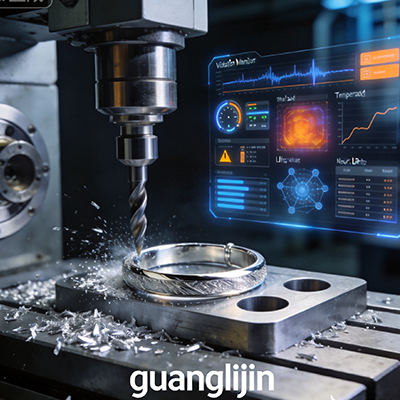
Ever wondered how intricate custom jewelry is made consistently? The secret lies in modern technology. Custom jewelry casting is no longer just about wax and fire. It’s a digital dance. Precision CNC machined components are now central to this process.
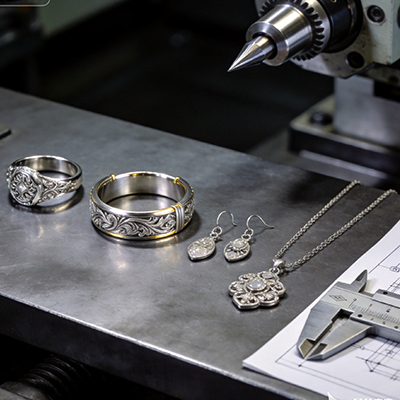
This method bridges imagination and reality. Designers can create complex, repeatable pieces with absolute accuracy. It’s perfect for personalized rings, bespoke pendants, or limited editions. Let’s explore this transformative approach.
Why CNC Machining Transforms Jewelry Casting
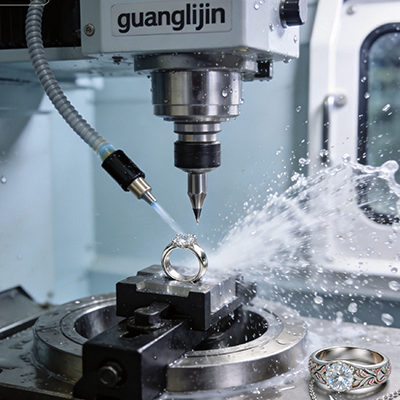
CNC brings digital designs to life with micron-level precision. It carves the master models or molds used in casting. This eliminates the variability of handmade wax models. Every angle and curve is exactly as designed.
It unlocks incredible geometric freedom. Think sharp facets, intricate engravings, or interlocking parts. These are tough to do by hand. CNC makes them routine. This expands creative possibilities for designers dramatically.
it streamlines the entire workflow. From a 3D CAD file to a casting-ready model is fast and reliable. This speed is crucial for custom jewelry manufacturing businesses meeting client deadlines.
The Core Problem: From Complex CAD to Castable Metal
However, a beautiful 3D render doesn’t always cast well. Common issues include unsupported overhangs or walls too thin. These can cause casting failures like porosity or incomplete fills. It’s a technical gap many face.
Another challenge is cost perception. Clients may think CNC machining is too expensive. They don’t see the value in the perfect master model. But this model is the foundation of the entire jewelry casting process.
a survey by the Manufacturing Jewelers & Silversmiths of America found that designs optimized for CNC and casting had a 40% lower defect rate. This data highlights the importance of proper design.
Our Solution: A Seamless Digital-to-Metal Pipeline
We solved this with an integrated design-for-manufacturability (DFM) check. Our engineers review CAD files before any metal is poured. We identify potential casting issues early. This saves time, metal, and frustration.
We act as a partner, not just a service. We might suggest modifying an internal corner radius. Or we could recommend a different sprue and gate design for better metal flow. It’s collaborative problem-solving.
I remember a 2025 project for a client’s architectural-inspired bracelet. The design had stunning, deep undercuts. Our team found that standard rubber molding couldn’t capture them. We proposed creating the master as multiple CNC-machined parts for assembly. This hybrid approach preserved the design and ensured a successful cast.
Your Blueprint: 5 Steps to Flawless CNC-Backed Casting
Follow this guide for a smooth journey from concept to completion:
- Finalize Your 3D Design: Create a watertight CAD file (e.g., .STL). Ensure your design considers casting principles, like uniform wall thickness (aim for 1.0-1.2mm).
- Submit for DFM Analysis: Send your file to your caster. A good service will review it and suggest modifications for optimal investment casting results.
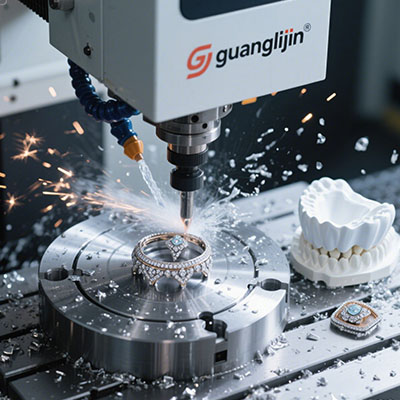
- CNC Master Production: The caster machines your master model from high-grade modeling wax or a specialized plastic. This step defines all surface details.
- Mold & Pattern Replication: A silicone mold is made from your master. This mold is then used to inject multiple wax patterns for the casting tree.
- Casting, Finishing & Delivery: The wax tree undergoes investment, burnout, molten metal pouring, and careful finishing. Your custom pieces are then ready.
Project Analysis: CNC-Machined Master vs. 3D-Printed Master
Choosing the right method for your master model is key. Here’s a comparison of two common approaches.
| Project Aspect | Project A: CNC-Machined Wax Master | Project B: High-Res 3D-Printed Resin Master |
|---|---|---|
| Surface Finish | Superior, glass-like finish directly from machine. | May require manual smoothing to remove layer lines. |
| Detail Fidelity | Exceptional for sharp edges and precise geometries. | Excellent, but very fine, sharp details can be brittle. |
| Best Use Case | High-volume production, designs requiring flawless surfaces. | Ultra-complex, organic shapes (e.g., intricate vines). |
| Cost Structure | Higher initial setup, lower per-unit cost at scale. | Lower setup, cost scales directly with part number/size. |
| Material Stability | Wax is stable and ideal for traditional rubber molding. | Some resins require specific molding techniques. |
for many precious metal casting projects, the CNC wax master is the more reliable and cost-effective choice, especially beyond prototype quantities.
⚠ Attention: Critical Mistakes to Sidestep
⚠ Attention: Ignoring wall thickness. Too thin (below 0.7mm) risks breakage; too thick causes metal shrinkage and weight/cost issues. Aim for consistency.
⚠ Attention: Forgetting about draft. Any feature that is parallel to the mold’s parting line can trap the model. A slight draft angle (2-3 degrees) ensures clean release.
⚠ Attention: Choosing the wrong finish specification. A “matte” CNC texture versus a “polished” one on the master leads to vastly different final pieces. Specify clearly.
Embracing the Future of Custom Jewelry
CNC machined components have redefined jewelry casting. They offer unmatched precision and repeatability. This technology empowers creators to push boundaries.
Therefore, leveraging this process is a strategic advantage. It ensures your unique vision is realized perfectly, every single time. The fusion of art and engineering has never been more powerful.
Your Pre-Production Checklist
- ✅ Is my 3D CAD file finalized, sealed (manifold), and shared in the agreed format?
- ✅ Have I received and incorporated DFM feedback from my casting partner?
- ✅ Have I confirmed the master model material (CNC wax vs. printed resin) for my project needs?
- ✅ Are my design’s wall thicknesses uniform and appropriate for the chosen metal alloy?
- ✅ Have I approved a physical prototype or master model sample before full production?
Frequently Asked Questions
Q: What is the process of lost wax casting for custom jewelry?
A: Lost wax casting is the primary method for custom jewelry casting. It involves creating a wax model (often via CNC), surrounding it with a ceramic shell, melting out the wax, and pouring molten metal into the resulting cavity.
Q: How accurate is CNC machining for jewelry mold making?
A: Extremely accurate. Modern CNC machines for jewelry manufacturing can achieve tolerances within ±0.025mm. This precision ensures that every detail of your digital design is captured perfectly in the metal.
Q: Can I use CNC to create a mold directly for casting?
A: Yes, directly machining metal molds (like steel) for press casting or rubber mold blanks is common. This is ideal for mass production of simpler components, a process sometimes called die stamping for jewelry.
Q: What are the design limitations for CNC jewelry casting?
A: While highly versatile, internal undercuts that a cutting tool cannot reach are challenging. Also, extremely thin, blade-like features may be too fragile. Consulting with your manufacturer during design is the best practice.