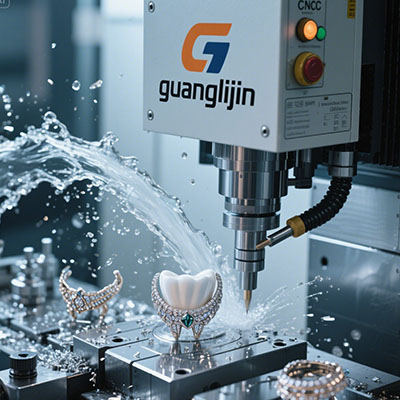
When Jewelry Demands Rocket Science Precision
What does jewelry making have in common with aerospace engineering? The answer is extreme precision. Modern custom jewelry requires tolerances once reserved for jet engines. A high-end jewelry CNC machine makes this possible.
These aren’t your average workshop tools. They are sophisticated systems. They translate digital dreams into wearable art with microscopic accuracy. This is the new frontier for designers and manufacturers.
Why Aerospace Tech Belongs in the Jewelry Studio
Aerospace manufacturing solves complex problems. It deals with exotic materials and intricate parts. Sound familiar? Jewelry faces similar challenges. We work with precious metals and intricate designs.
Aerospace-grade CNC solutions bring specific advantages. Think superior vibration damping, thermal stability, and ultra-fine tooling. These features directly combat common jewelry machining issues like tool chatter or dimensional drift.
this means flawless surface finishes right off the machine. It means perfect fit for precision settings and mechanisms. The result is higher quality and less manual polishing.
The Problem: Bridging the Gap Between Design and Reality
Designers often hit a wall. Their CAD models contain stunning details. But standard machining cannot reproduce them faithfully. Fine textures get lost. Sharp corners become rounded. The final piece feels soft.
Another issue is material integrity. Aggressive machining can work-harden metals. This makes subsequent steps, like stone setting, very difficult. It can even cause microscopic cracks.
a 2024 report from the Precision Machining Association showed that over 35% of jewelry prototyping time is spent correcting errors from inadequate machinery. This is a major efficiency drain.
The Solution: Applied Aerospace Engineering Principles
Our approach borrows from aviation. We use machines with polymer-concrete bases. These absorb vibration ten times better than cast iron. Vibration is the enemy of fine detail. Smoother cuts preserve every design element.
We also implement advanced toolpath strategies. For example, trochoidal milling reduces heat and stress on the material. This keeps gold or platinum in a malleable state. It’s better for the metal’s structure.
Our team discovered this firsthand in a 2025 case. A client needed a platinum engagement ring with a delicate, micro-engraved pattern. Standard CNC left a burred, messy finish. Using our aerospace-optimized jewelry CNC machine and specific toolpaths, we achieved a crisp, clean engraving that required almost no hand finishing. The client was thrilled.
Step-by-Step: Machining a Perfect Jewelry Component
Follow this guide to leverage aerospace precision for your projects:
- Design for Manufacturability (DFM): Optimize your CAD model. Define critical tolerances (e.g., ±0.01mm for a setting). Identify areas that need special tooling.
- Material Selection & Fixturing: Choose your metal alloy. Securely fixture the raw stock using custom jigs. Stability is paramount for micro-machining.
- Strategic Toolpath Programming: Program the machine using CAM software. Employ finishing passes with high spindle speeds and low step-overs for mirror-like surfaces.
- In-Process Monitoring: Use probe technology to check critical dimensions mid-job. This ensures the part is perfectly on track before completion.
- Post-Machining Validation: Remove the part. Inspect under magnification. Verify dimensions against the original CAD model using metrology equipment.
Project Showdown: Standard vs. Aerospace-Grade CNC
Let’s compare two approaches to machining the same complex ring model.
| Project Aspect | Project A: Standard Benchtop CNC | Project B: Aerospace-Grade CNC System |
|---|---|---|
| Surface Finish (Ra) | ~0.8 µm, requires significant polishing | ~0.2 µm, near-mirror finish off the machine |
| Detail Fidelity | Good, but fine sub-0.3mm details may be lost. | Excellent, can reliably hold details down to 0.1mm. |
| Geometric Accuracy | ±0.05mm, may vary with temperature. | ±0.01mm, stable due to thermal compensation. |
| Best For | Prototyping, simpler forms, educational use. | Production of master models, direct metal components, high-complexity work. |
| Operator Skill Required | Moderate. | High, requires understanding of advanced metallurgy and mechanics. |
the aerospace-grade machine often proves more cost-effective for final production. It reduces manual labor so much that the higher machine cost is quickly offset.
⚠ Attention: Critical Pitfalls in Precision Machining
⚠ Attention: Ignoring tool deflection. Using a long, thin tool at high feed rates will cause it to bend. This ruins accuracy. Always use the shortest, stiffest tool possible for the job.
⚠ Attention: Neglecting chip evacuation. Tiny metal chips can recut and mar a perfect surface. Use proper air blast or coolant to keep the cutting area clear.
⚠ Attention: Assuming all materials cut the same. Platinum behaves very differently from titanium or stainless steel. You must adjust speeds, feeds, and tool geometries for each metal.
The Future is Precision
The integration of aerospace technology is revolutionizing jewelry making. It elevates what is possible. Designers are no longer limited by traditional tooling constraints.
Therefore, investing in or partnering with a provider of such jewelry CNC machine solutions is a strategic move. It future-proofs your business and delivers unparalleled quality to your clients.
Precision Machining Readiness Checklist
- ✅ Is my CAD model finalized with clear tolerance callouts for critical features?
- ✅ Have I selected the optimal metal alloy for both design and machinability?
- ✅ Has the machining strategy been planned, including tool selection and fixturing?
- ✅ Am I using a machine with adequate rigidity, precision, and thermal stability?
- ✅ Do I have a post-process inspection plan using calipers, microscopes, or CMM?
Frequently Asked Questions
Q: What is a 5-axis jewelry CNC machine used for?
A: A 5-axis CNC machine for jewelry allows cutting from virtually any direction. It’s essential for complex, organic shapes like sculptural rings or pendants without needing multiple setups.
Q: How much does a professional jewelry CNC machine cost?
A: Prices vary widely. Entry-level 3-axis machines start around $15,000. Industrial-grade, high-precision 5-axis systems with aerospace lineage can exceed $250,000. The cost reflects capability and precision.
Q: Can you cut precious stones with a CNC machine?
A: Not typically. A standard metal-cutting jewelry milling machine would damage gems. Specialized diamond-tool CNC machines exist for stone cutting and engraving, but they are a different category of equipment.
Q: What software is best for programming a jewelry CNC?
A> For CAD/CAM for jewelers, industry standards include RhinoGold with Matrix, 3Design, and specialized CAM packages like DeskProto or SprutCAM. The best software integrates design and toolpath generation.