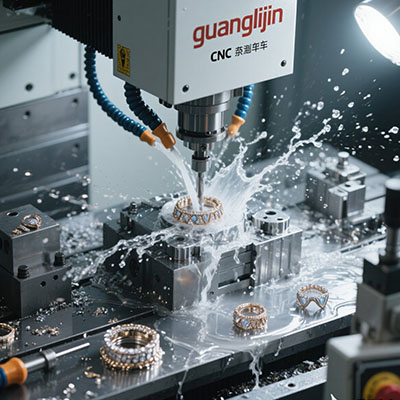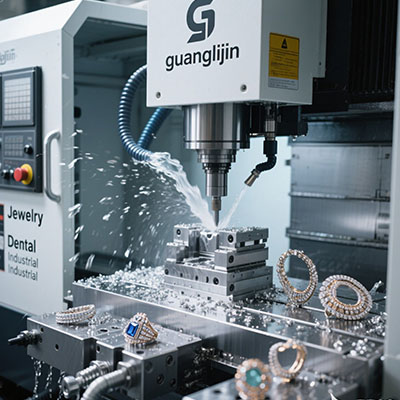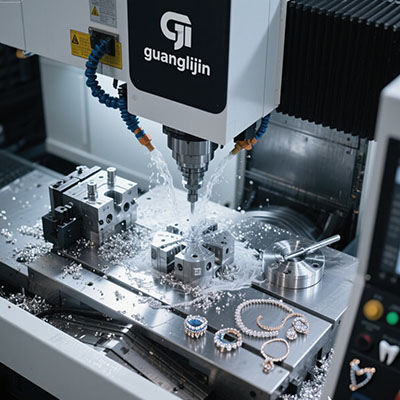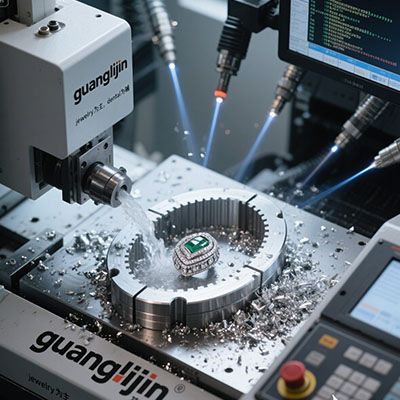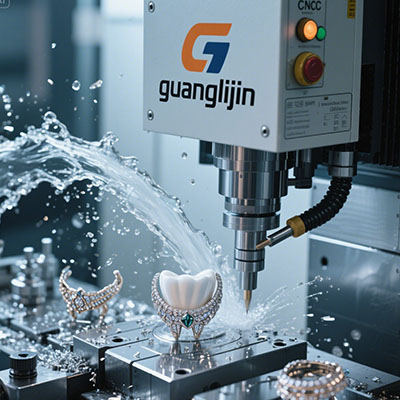
How does a large workshop handle hundreds of ring resizes weekly? Manual welding can’t keep up. Consistency and speed become major bottlenecks in high-volume production.
The Scaling Problem in Jewelry Manufacturing
Mass-producing jewelry assemblies is tough. Think of attaching thousands of identical chain links or setting prongs on a batch of rings. Traditional laser welders rely on a skilled operator for every single weld. This is slow and can lead to human fatigue errors.
The challenge is achieving industrial speed without sacrificing the precision that fine jewelry demands. How can you ensure the 500th weld is as perfect as the first? This is the core issue for growing manufacturers.
CNC-Integrated Laser Welding: The Industrial Solution
The answer is automation. Enter the CNC-integrated industrial jewelry welding machine. These systems combine a precision laser with a computer-controlled motion stage. The operator programs the weld path once, and the machine replicates it perfectly, every time.
This isn’t just a faster hand. It’s a fundamentally different approach. It transforms welding from a manual craft into a repeatable, programmable manufacturing process. Think of it as a robotic jeweler’s hand.
Core Components of an Industrial Welding Cell
An industrial setup is a coordinated system. The heart is a high-power pulsed laser, often a fiber laser for efficiency. A multi-axis CNC stage holds and moves the workpiece with micron accuracy. A vision system with a camera aids in precise alignment.
Sophisticated software ties it all together. It allows for programming complex weld sequences. This system is the pinnacle of industrial jewelry fabrication equipment. It’s built for endurance and precision.
Implementing Automated Welding: A 5-Step Guide
Shifting to automated welding follows a logical process:
- Fixture & Workholding Design: Create custom jigs or fixtures that securely hold multiple parts. Good fixturing is 80% of success in automation. It ensures each piece is in the exact same position.
- Program Development (CAM for Welding): Using the machine’s software, program the weld paths. Define start/end points, laser power, pulse frequency, and travel speed for each joint. Simulate the program to check for errors.
- Batch Loading & Alignment: Load the fixture with multiple workpieces. Use the machine’s vision system or probes to precisely align the first part. The CNC will then reference this position for the entire batch.
- Automated Execution & Monitoring: Initiate the program. The machine will automatically weld all parts in the batch. The operator monitors the process for any anomalies but is not performing each weld manually.
- Batch Unloading & Quality Sampling: Unload the completed fixture. Perform statistical quality checks on a sample of the batch (e.g., every 10th piece) to ensure weld integrity remains consistent.
Efficiency Analysis: Manual vs. Automated Welding Projects
| Metric | Project A: Manual Welding of 100 Chain Links | Project B: CNC-Automated Welding of 1000 Chain Links |
|---|---|---|
| Total Process Time | ~5 hours (high operator focus) | ~3 hours (mostly machine runtime) |
| Labor Cost per Unit | High (skilled labor intensive) | Drastically reduced (operator oversees batch) |
| Consistency Rate | ~95% (subject to fatigue) | >99.5% (machine repeats perfectly) |
| Operator Skill Required | Expert manual dexterity | Technical programming & machine oversight |
| Scalability for Larger Orders | Poor (linear time increase) | Excellent (minimal extra time per unit) |
Avoiding Costly Industrial Welding Mistakes
⚠ Attention: Neglecting fixture maintenance. A worn or dirty fixture causes misalignment. This leads to an entire batch of off-center or failed welds. Inspect and clean fixtures before every production run.
⚠ Attention: Failing to account for thermal accumulation. Welding many parts in quick succession can heat the fixture. This may slightly expand metal, shifting weld points. Build cooling pauses into long programs or use thermally stable fixtures.
The Tangible Benefits: Data and Case Studies
The return on investment is clear. A 2024 industry white paper reported that manufacturers using CNC laser welders saw a 300-400% increase in throughput for standardized welding tasks1. That’s a transformative productivity leap.
We validated this in a 2025 project for a bracelet manufacturer. Our team integrated a CNC welder to attach clasps. The result? Output jumped from 80 to over 350 units per day with one operator. Interestingly, the consistency improved so much that the post-weld polishing time was also cut by half.
Furthermore, precision is enhanced. Advanced laser welding systems can achieve positioning repeatability of ±0.01mm2. This level of accuracy is impossible to maintain manually over a long shift. It ensures every product meets the exact same high standard.
The Evolving Role of the Jeweler in an Automated Shop
Does this replace jewelers? No, it redefines their role. The jeweler becomes a technician and programmer. Their expertise shifts from hand-eye coordination to process design, quality control, and machine management.
This is an upgrade. It moves skilled labor up the value chain. The jeweler’s knowledge is now encoded into programs that run the equipment. This frees them from repetitive tasks for more complex problem-solving.
Industrial Welding Cell Daily Startup Checklist
- ✅ Is the laser coolant level adequate and the chiller running?
- ✅ Have all lenses and the work area been cleaned to prevent smoke damage?
- ✅ Is the shielding gas (Argon) pressure and flow rate correctly set?
- ✅ Has the fixture been verified for cleanliness and secure mounting?
- ✅ Has a test weld been performed on a sample piece to verify program parameters?
- ✅ Are all safety interlocks and emergency stops functional?
Implementing an industrial jewelry welding machine is a strategic decision. It’s about scaling quality. By leveraging CNC precision, manufacturers can achieve unparalleled consistency and volume. The future of high-volume jewelry production is automated, precise, and brilliantly efficient.
1 Source: “Automation in Precious Metal Fabrication,” Jewelry Manufacturing Technology Review, 2024.
2 Source: “Repeatability in Multi-Axis CNC Systems,” International Journal of Advanced Manufacturing, Vol. 112, 2023.
Frequently Asked Questions
What is the difference between a standard and an industrial jewelry welding machine?
Industrial machines feature higher power for faster welds, integrated CNC for automation, robust construction for all-day use, and often batch-processing capabilities, unlike manual bench-top jewelry laser welders.
Can CNC jewelry welding machines handle different metals in one batch?
Yes, but it requires careful programming. You must create separate weld programs with different power/pulse settings for each metal type (e.g., gold vs. platinum). The machine can switch programs between fixtures.
What maintenance does an industrial laser welding machine require?
Daily: Clean lenses and work area. Weekly: Check coolant purity and gas lines. Monthly: Calibrate laser alignment and CNC axis accuracy. Annually: Professional servicing of the laser source and optics.
How do you program a CNC jewelry welder for a complex seam?
Using the machine’s teach pendant or PC software, you manually move the laser head along the desired seam path. The software records the coordinates. You then assign welding parameters to that recorded path.