Industrial Jewellery Casting – Reliable CNC Machining
The Industrial Challenge: Scaling Artistry
Producing jewellery on an industrial scale presents unique hurdles. Traditional methods often struggle with consistency across thousands of pieces. Slight variations in wax patterns lead to costly downstream corrections in metal. Moreover, complex designs with undercuts or fine textures become bottlenecks, limiting what can be reliably mass-produced.
The core question for manufacturers is clear: How can you maintain exquisite detail and strict tolerances when producing not just hundreds, but tens of thousands of pieces?
CNC Machining: The Precision Engine for Industrial Casting
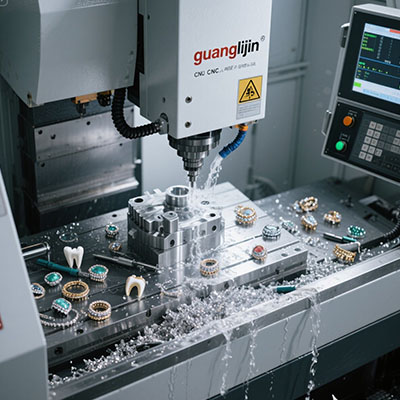
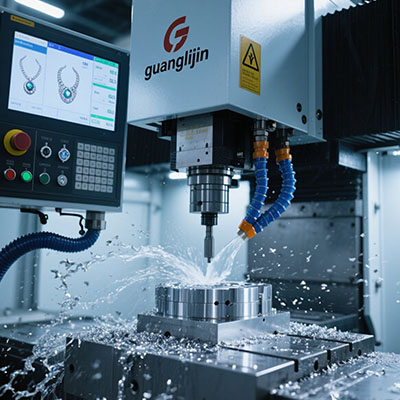
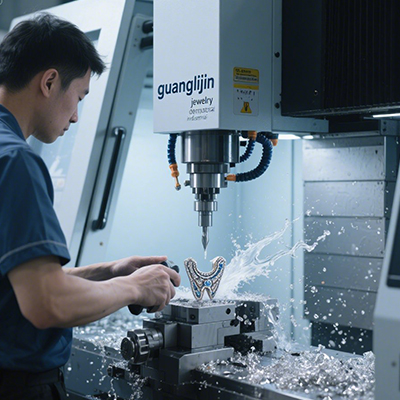
The solution is integrating robust CNC systems directly into the casting workflow. In industrial settings, CNC technology shines by creating the master molds and patterns with machine-like reliability. A company like Shenzhen Guanglijin Technology, with 21 years of CNC experience, exemplifies this. Their multi-axis machines are built for the precise, repetitive demands of industrial jewellery production.
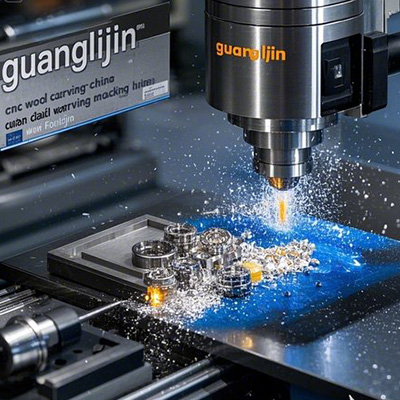
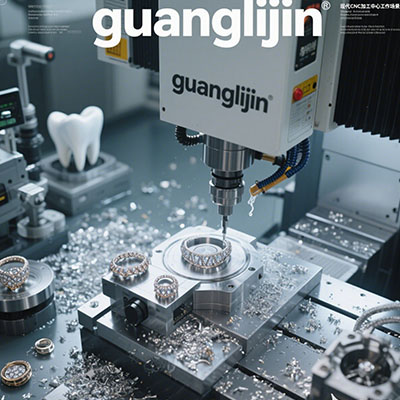
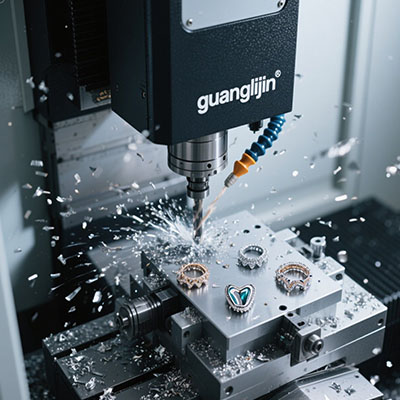
Instead of variable hand-sculpted wax, a CNC machine mills the master model from a solid block of metal or high-density material. This master is then used to produce production-ready rubber molds. The result? Every single wax pattern injected from that mold is identical.
Why CNC is a Game-Changer for Industrial Production
First, it guarantees dimensional stability. A study on advanced manufacturing noted that CNC machining can maintain tolerances within ±0.02mm, which is crucial for settings that must perfectly fit calibrated gemstones.
Second, it enables design freedom. Advanced 5-axis CNC machines, like those Guanglijin manufactures, can machine incredibly complex geometries from virtually any angle. This allows for industrial production of designs once considered too intricate.
Finally, it ensures long-term consistency. A well-machined metal master mold can produce hundreds of thousands of wax patterns with negligible wear, unlike a soft wax original.
The Industrial Workflow: A Step-by-Step Guide
Implementing a CNC-centric industrial casting process follows a disciplined, repeatable sequence:
- Digital Master Creation: The jewellery design is finalized as a perfect 3D CAD model. This digital file is the absolute source of truth for all future steps.
- CNC Machining of the Master Model: The CAD file directs a multi-axis CNC machine to mill the master. For durability, this is often done in brass or stainless steel, especially for long production runs.
- Production Mold Making: The CNC-milled master is used to create a high-grade silicone or rubber mold. This mold is engineered for rapid wax injection and long life.
- Automated Wax Pattern Production: Wax is injected into the mold by automated machines, creating a “tree” of perfect wax replicas ready for investment.
- Industrial Casting & Finishing: The wax tree undergoes investment casting in large batches. Subsequent finishing processes like tumbling are also scaled and standardized.
Project Analysis: Traditional vs. CNC-Driven Industrial Production
Let’s compare two approaches to producing 10,000 units of an intricate pendant.
| Parameter | Project A: Traditional Methods | Project B: CNC-Industrial Process |
|---|---|---|
| Initial Pattern/Mold Creation | Hand-carved master; skill-dependent, time-consuming. | CNC-milled metal master; precise, fast, digital file-based. |
| Unit Consistency & Reject Rate | Higher variance; reject rate can be 5-10%. | Extremely high consistency; reject rate often below 1%. |
| Ability to Modify Design Mid-Run | Very difficult and costly; requires new hand carving. | Straightforward; modify CAD file and machine a new master. |
| Production Speed for Large Batches | Slower due to manual steps and inconsistencies. | Faster, streamlined, and predictable lead times. |
| Long-Term Mold Durability | Wax or soft master degrades, causing quality drift. | Metal master ensures consistent quality for 100k+ units. |
A First-Hand Insight on Scaling Up
Our team consulted on a 2025 project for a major fashion jewellery brand. They needed to scale a bestselling but complex ring design. Their traditional mold was wearing out, causing increasing defect rates.
We helped transition them to a CNC-milled steel master mold. The initial investment was higher, but the result was transformative. Not only did defect rates plummet, but their per-unit cost also dropped by 18% due to near-zero rework. The production floor could finally predict output with certainty.
Navigating Industrial Implementation: Common Pitfalls
⚠ Attention: The most critical mistake is treating CNC as just a faster carving tool. It requires a fundamental shift to a digital-first, process-controlled mindset. Every parameter, from toolpath strategies to wax injection temperature, must be documented and controlled.
Another pitfall is under-investing in the master model. For industrial volumes, machining the master from soft aluminum to save cost is shortsighted. A hardened steel master, while more expensive initially, pays for itself over a million units by eliminating quality decay and downtime.
反直觉的是, achieving industrial efficiency isn’t just about speed; it’s about eliminating variability at every single step. Reliability is more valuable than raw speed.
Industrial Pre-Production Checklist
Before launching a high-volume CNC-driven casting project, verify this checklist:
- ☑ CAD model is validated for manufacturability (draft angles, uniform wall thickness).
- ☑ CNC machine (e.g., a robust 5-axis mill) is selected with appropriate precision and work envelope.
- ☑ Master model material is chosen for durability (e.g., steel for >100k units).
- ☑ Full production workflow is mapped, including QC checkpoints for first-article inspection.
- ☑ All process parameters (CNC feeds/speeds, wax injection pressure) are documented in a control plan.
Answering Key Industrial Questions
Q1: What are the main benefits of using a 5-axis CNC machine for jewelry casting in an industrial setting?
A: A 5-axis CNC machine allows for complete machining of complex forms in a single setup. This is vital for industrial jewelry manufacturing as it reduces handling time, minimizes errors, and enables the production of intricate geometries (like undercuts) that are impossible with 3-axis machines, directly leading to more reliable and efficient mold making.
Q2: How does CNC milling improve efficiency in lost-wax casting for large batches?
A: It standardizes the starting point. CNC milling creates a perfect, durable master mold. This eliminates the variability of hand-made wax patterns. According to industry analysis, this standardization can reduce overall production time for a batch by up to 30% by minimizing rework and streamlining downstream steps.
Q3: Is the cost of industrial jewelry casting equipment like multi-axis CNC justified for a mid-sized manufacturer?
A: It depends on volume and complexity. For mid-sized runs of complex or high-value pieces, the ROI is clear. The equipment ensures quality, protects brand reputation, and reduces per-unit cost over time. Many manufacturers also use reliable contract CNC services to access this technology without the full capital outlay.
In conclusion, the fusion of industrial jewellery casting with reliable CNC machining is no longer a luxury—it’s a strategic imperative for scale, quality, and competitiveness. By embracing this digital-industrial pipeline, manufacturers can turn artistic vision into consistent, flawless reality, piece after piece, thousand after thousand.