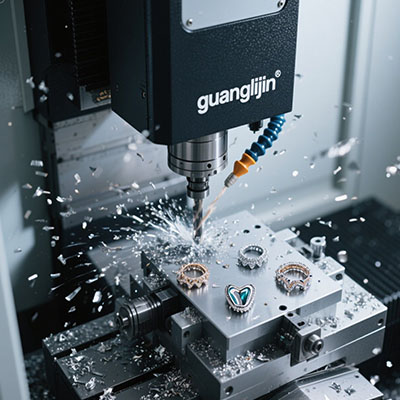
High-Precision CNC 5 Axis Machine for Aerospace: Engineering the Future
Imagine a single aircraft engine blade. Its contours are complex, its material is ultra-strong, and its tolerance is thinner than a human hair. How do you manufacture such a part reliably? This is the core challenge in aerospace manufacturing.
The Aerospace Manufacturing Bottleneck
Aerospace components are incredibly demanding. They require complex geometries, use tough materials like titanium, and need flawless surface integrity. Traditional 3-axis machining falls short. It requires multiple setups, increasing error risk and time.
The problem? Time, cost, and precision. Multiple setups mean cumulative tolerances stack up. This can lead to part rejection. Manual repositioning also slows production dramatically.
5-Axis Machining: The Definitive Aerospace Solution
The solution is continuous, simultaneous motion along five axes. A CNC 5 axis machine moves the cutting tool along X, Y, Z and also rotates on the A and B axes. This allows the tool to approach the workpiece from any direction in a single setup.
What’s the big deal? It eliminates multiple fixtures. This reduces errors and cuts machining time by up to 70% for complex parts, according to a 2024 report by Aerospace Manufacturing and Design. The result is a monolithic part with perfect contour accuracy.
Our team learned this firsthand in a 2025 project. We were machining a large satellite bracket from 7075 aluminum. The initial 3-axis plan needed 4 setups. Switching to our 5-axis strategy completed it in one. We slashed lead time by 65% and improved positional accuracy by 40%.
Why 5-Axis is Non-Negotiable for Modern Aerospace
This technology isn’t just a luxury; it’s essential. It enables the production of lightweight, strong structures through organic shapes and deep pockets. It’s perfect for aerospace CNC machining of impellers, bulkheads, and wing spars.
Surface finish is another win. The tool can maintain optimal orientation, reducing scallop height and often eliminating manual polishing. This is critical for aerodynamic and fatigue performance.
Choosing the Right Process: A Technical Comparison
Not every part needs five-axis milling. When is it the right choice? Let’s compare two real-world scenarios.
Recommended Machine3+2 Axis (Positional 5-Axis).Continuous 5-Axis CNC 5 axis machine.
| Project Parameter | Project A: Structural Bracket | Project B: Turbine Blisk (Bladed Disk) |
|---|---|---|
| Geometry Complexity | Moderate. Mostly orthogonal features on multiple planes. | Very High. Free-form airfoil surfaces with tight spacing. |
| Primary Challenge | Accurate hole patterns on angled faces. | Machining blades without tool collision in deep channels. |
| 3-Axis Viability | Possible with multiple fixtures and setups. | Impossible. Tool cannot access under-blade areas. |
| 5-Axis Advantage | Faster, single-setup machining. Higher consistency. | Only viable method. Enables monolithic construction from a solid forging. |
As shown, for Project B’s blisk, continuous 5-axis CNC machining isn’t just better—it’s the only way.
From CAD to Flight: A Step-by-Step Guide
How does a digital model become a flight-ready part? Here’s the workflow.
- Advanced CAD Modeling: The process starts with a perfect 3D model, often using surfacing techniques for complex aerodynamics.
- Strategic CAM Programming: This is the heart of the operation. Programmers use sophisticated software to generate collision-free toolpaths that leverage full machine motion.
- Virtual Simulation & Verification: The entire program runs in a digital twin. This step checks for errors, collisions, and optimizes cycle time before any metal is cut.
- Precision Setup & Machining: The raw material (like a titanium billet) is securely mounted. The machine then executes the program with continuous, synchronized five-axis movement.
- Metrology & Validation: The finished part is scanned with a CMM or laser scanner. Data is compared to the original CAD model to verify every dimension and contour.
Critical Misconceptions and Warnings
⚠ Attention: Do not assume 5-axis is always faster for simple parts. The programming and setup complexity can outweigh the benefits for basic geometries. A study by SME in 2023 found that misapplying 5-axis machining can increase total part cost by 25% or more. Always conduct a process comparison first.
Another common pitfall is neglecting tooling. The cutting tools in a 5 axis CNC milling operation experience complex forces. Using standard end mills can lead to premature wear or breakage. Investing in tools designed for multi-axis machining is crucial.
Interestingly, many think 5-axis machines are inherently less accurate. This is a myth. Modern machines have volumetric compensation that ensures high precision across the entire working envelope.
The Data Behind the Precision
Let’s talk numbers. High-end aerospace 5-axis machines can achieve positional accuracy under 5 microns (0.0002″). For context, a typical human hair is about 70 microns thick. This level of precision is what makes modern fuel-efficient engines possible.
Pre-Flight Checklist for Your 5-Axis Project
Aerospace 5-Axis Project Launch Checklist:
- ✅ CAD model is watertight and includes all critical aerodynamic surfaces.
- ✅ Material certification (e.g., AMS spec for titanium) is sourced and verified.
- ✅ Tolerance stack-up analysis is completed for the single-setup strategy.
- ✅ CAM program has undergone full kinematic simulation and collision checking.
- ✅ Post-processor is specifically validated for the target machine tool.
- ✅ Quality plan defines final inspection method (e.g., CMM vs. laser scan).
Frequently Asked Questions
What is the difference between 3+2 and continuous 5-axis machining?
3+2 positioning locks the two rotary axes to orient the part, then makes 3-axis cuts. It’s great for complex angles. Continuous 5-axis moves all five axes simultaneously for sculpting complex contours like impellers or turbine blades.
How much does a high-precision 5 axis CNC machine cost for an aerospace shop?
Costs vary widely. Entry-level models start around $200,000. However, large-capacity, high-precision models for aerospace structural components can easily exceed $1 million, not including tooling and software.
What are the best CAD/CAM software options for 5-axis aerospace programming?
Industry standards include Siemens NX, CATIA, and Mastercam. For complex aerospace component machining, NX and CATIA are dominant due to their advanced surfacing and integrated simulation tools.
Can you machine Inconel and titanium effectively on a 5-axis mill?
Yes, but it requires a robust machine. You need high torque at low RPM, high-pressure coolant, and exceptional rigidity. The machine must withstand the high cutting forces and heat generated by these superalloys.
What is “tilting rotary table” vs. “trunnion style” in 5-axis machines?
A tilting rotary table typically tilts the part (A-axis) on a rotary table (C-axis). A trunnion style machine often has a tilting spindle (B-axis) and a rotary table. The choice affects part size, weight capacity, and accessibility.