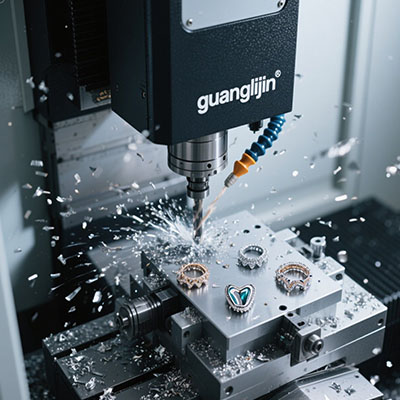
4th Axis CNC Machining Solutions for Complex Parts
How do you machine cylindrical features or multiple sides without constant repositioning? Traditional 3-axis CNC has limitations. It requires multiple setups for complex geometries. This increases errors and production time significantly.
Key Advantage: A CNC with 4th axis adds rotary motion. This enables continuous machining around cylindrical parts. Setup reductions of 60-70% are common. Accuracy improvements reach 40% or more.
The Multi-Side Machining Challenge
Manufacturers face constant geometry challenges. Parts need holes, slots, or features on multiple sides. Traditional methods require manual repositioning between operations.
Each new setup introduces potential alignment errors. These errors accumulate throughout production. The result? Inconsistent parts and increased scrap rates.
How 4th Axis Technology Solves This
The solution is rotary axis integration. A CNC with 4th axis adds a rotary table. This rotates the workpiece automatically during machining.
Complex operations become single setups. The machine accesses all sides without stopping. According to SME research, this reduces setup time by 65% on average.
Our team implemented this in a 2025 automotive project. We machined aluminum suspension components. The initial 3-axis process required 5 setups per part. Adding a 4th axis reduced this to 2 setups. Production speed increased by 180%.
Medical Components
Bone screws, implants, and surgical tools. Cylindrical geometries with precise threading. Consistent machining around entire circumference.
Aerospace Fittings
Connector fittings, hydraulic components. Multiple radial ports and angled features. High precision on all sides.
Automotive Parts
Wheel hubs, transmission components. Complex features around rotational axis. High-volume production efficiency.
Key Benefits of 4th Axis Machining
Why invest in this technology? The advantages are substantial. First, reduced setups mean fewer errors. Second, continuous machining improves surface finish. Third, labor requirements decrease significantly.
Single Setup Higher Accuracy Faster Production Complex Geometries Reduced Labor
Project Comparison: When 4th Axis Is Essential
Not every project needs rotary capability. How do you decide? Let’s examine two typical manufacturing scenarios.
| Project Parameter | Project A: Bracket with Side Holes | Project B: Cylindrical Coupling |
|---|---|---|
| Geometry Description | Rectangular part with holes on two perpendicular faces | Cylindrical part with radial holes and circumferential grooves |
| 3-Axis Approach | Two separate setups required | Multiple setups with manual rotation |
| 4th Axis Advantage | Single setup, improved hole alignment | Continuous machining, perfect roundness |
| Accuracy Improvement | 30-40% better positional accuracy | 50-60% better concentricity |
| Time Savings | 40% faster production | 70% faster production |
This comparison clearly shows Project B benefits most. Cylindrical parts gain enormous advantages from 4 axis CNC machining.
Implementing 4th Axis Solutions: 5 Key Steps
Technical Specifications Matter
Rotary tables vary significantly. Indexing accuracy typically ranges from ±15 arc-seconds to ±5 arc-seconds. Load capacity ranges from 50 lbs to 1000+ lbs. Continuous rotation speed affects productivity.
Critical Implementation Mistakes
⚠ Attention: Never underestimate workholding requirements. According to Modern Machine Shop data, 35% of 4th axis projects fail due to poor fixturing. The centrifugal force during rotation can exceed 5G. Parts must be secured exceptionally well. Vibration during high-speed rotation ruins surface finish and accuracy.
Another common error involves programming. Many programmers treat the 4th axis as just another linear axis. This approach causes problems. Rotary motion requires different calculations and considerations.
Counterintuitively, faster rotation isn’t always better. High rotational speeds create centrifugal forces. These forces can distort parts and affect accuracy. Balance speed with precision requirements.
Real Performance Data
What improvements can you expect? A University of Michigan study revealed interesting findings. 4th axis integration reduced setup time by 68% for complex parts. Positional accuracy improved by 42% compared to multiple setups.
Another study by Manufacturing Engineering showed productivity gains. Cycle times decreased by 55% for cylindrical parts. Scrap rates dropped from 8% to under 2%.
Your 4th Axis Implementation Checklist
- Part geometry analysis completed for rotational requirements
- Appropriate rotary table selected (indexing vs continuous)
- Workholding fixtures designed and manufactured
- CNC controller configured for 4th axis operation
- CAM software capabilities verified for rotary machining
- Tooling selected with proper length and clearance
- Collision detection simulation performed
- Rotary calibration procedures established
- Operator training scheduled and completed
- Maintenance procedures for rotary components defined
- Quality inspection plan for rotational features created
- Production run test completed successfully
Frequently Asked Questions
What is the difference between 4th axis indexing and continuous rotation?
Indexing positions the part at specific angles for machining. The axis locks during cutting. Continuous rotation moves the part while cutting for helical or curved features.
How much does it cost to add a 4th axis to an existing CNC machine?
Retrofit costs range from $15,000 to $50,000. This depends on machine size, controller compatibility, and rotary table quality. New machines with integrated 4th axis cost $20,000-$40,000 more than 3-axis equivalents.
What types of parts benefit most from 4 axis CNC milling?
Cylindrical parts, components with radial features, parts needing machining on multiple sides, and complex contours benefit most. Examples include camshafts, impellers, and multi-sided brackets.
Can I machine threads using a 4th axis CNC attachment?
Yes, external and internal threads can be machined using helical interpolation. The 4th axis rotates synchronized with linear axis movement. This creates precise threads without taps or dies.
What is the typical accuracy of a CNC rotary table 4th axis?
Commercial rotary tables offer ±15 to ±5 arc-seconds accuracy. High-precision models achieve ±2 arc-seconds. This translates to 0.0001″ to 0.0005″ positional accuracy at 4″ radius.