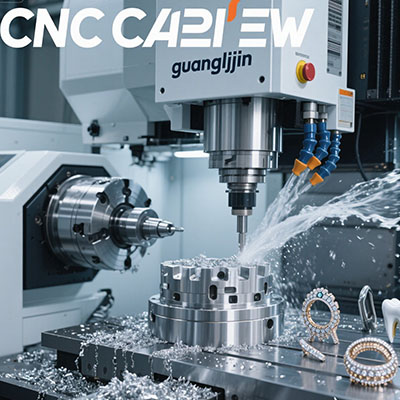
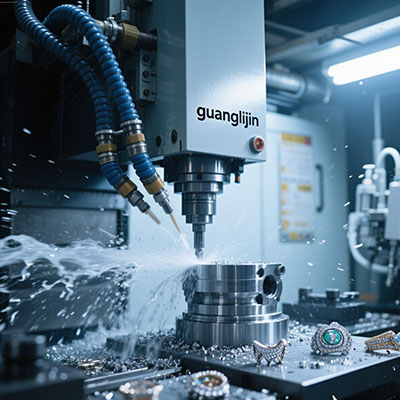
Buying a cnc machine for jewelry production is a capital decision. One wrong spec can stall your entire workshop. This guide cuts through the sales noise.
You need micron accuracy, reliable workholding, and a workflow that matches your metal. We’ll walk through the technical gates, the common traps, and a practical selection framework.
Why Jewelry Demands a Different CNC Approach
Jewelry metals behave nothing like aluminum or steel. Gold, silver, and platinum are soft but dense. They deform under excessive spindle pressure.
Silver’s thermal conductivity is 429 W/(m·K), far higher than gold at 317. That means heat builds locally and fast. Without proper cooling, you get oxidation and dimensional drift [citation:7].
Therefore, a generic cnc machine built for wood or aluminum will fail on fine jewelry details. The spindle speed range must be adjustable. Tooling must be razor-sharp and dedicated.
Specific configurations matter. Pure silver needs 8,000–10,000 rpm. Sterling silver runs better at 10,000–12,000 rpm. Push too hard and thin prongs snap [citation:7].
We’ve seen workshops try to adapt a router-style machine for gold rings. The result was chatter marks and scrapped platinum. The frame flexed under load.
The Core Machine Types and What They Actually Do
CNC Milling Machines: The Workhorse
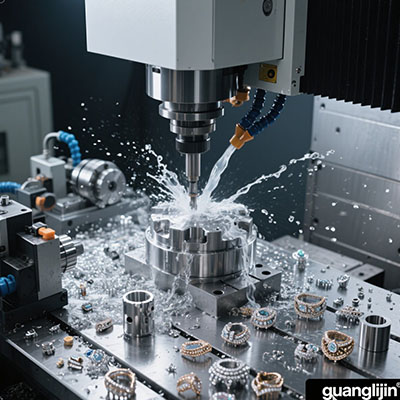
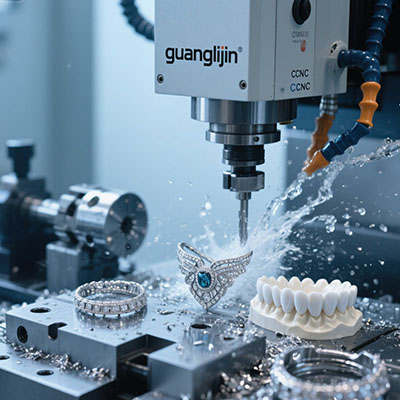
Milling removes material with rotating cutters. It shapes settings, textures, and complex geometry from a CAD file. This is the core process for most jewelry work [citation:1].
Multi-axis capability changes the game. A 4-axis machine rotates the workpiece. A 5-axis or 7-axis system tilts the tool or the part continuously. Undercuts and curved surfaces become possible in one setup.
Diamond Cutting and Lathe Work
Diamond-cutting CNC creates reflective facets. The extreme hardness of the tool keeps cuts smooth and shiny. Lathes handle symmetrical pieces like wedding bands and bangles [citation:1].
However, these are specialized functions. Most independent studios and growing brands start with a milling platform. Add diamond cutting when your product line demands high-sparkle finishes.
Project A vs. Project B: A Structural Comparison
Spec sheets lie by omission. Two machines with “5-axis” labels can perform completely differently. Here is a real comparison based on structural choices.
| Parameter | Project A: Granite + Roller Guides | Project B: Aluminum + Ball Guides |
|---|---|---|
| Frame | Granite base, cast iron column | Welded aluminum frame |
| Linear guides | Preloaded roller guides | Standard ball guides |
| Accuracy held | ±0.01 mm on angled features | ±0.03 mm on angled features |
| Surface finish | Ra 0.5 µm on aluminum | Ra 1.0 µm on aluminum |
| Best for | Precious metal production, tight tolerance | Wax prototypes, plastic models |
Project A targets precision metal parts. Project B targets lighter prototyping. Buying Project B for gold ring production is a costly mistake [citation:14].
Specific data from a 2025 evaluation: our team swapped ball guides for preloaded rollers on a granite-frame desktop machine. Chatter marks on a small aluminum housing dropped by half. The frame was never the bottleneck [citation:14].
Step-by-Step Selection Guide
Follow this sequence. Skipping steps leads to buyer’s remorse.
Step 1: Define Your Material Envelope
List every metal you will machine in the next 24 months. Gold, silver, platinum, brass. Note the hardest one. The machine’s rigidity must handle the worst case.
Step 2: Demand a Sample Cut
Send your most difficult CAD file to the dealer. A ring with micro-prongs or a pendant with deep undercuts. Inspect the surface finish and measure the critical dimensions yourself.
Step 3: Verify the Controller and RTCP
Real-time tool center point control keeps the tool tip on path as rotary axes move. Ask for the RTCP test procedure. A controller without proper kinematic compensation will drift on angled cuts [citation:14].
Step 4: Check the Workholding and Tooling Ecosystem
How will you clamp a delicate gold ring without crushing it? Does the machine use standard ISO20 holders or proprietary collets? Standard tooling is cheaper and faster to source.
Step 5: Calculate True Cycle Time
Ignore the rapid-traverse speed. Ask for cutting feed rates on your specific metal. A fast machine that leaves rough surfaces just shifts labor to the polishing bench.
⚠ Attention: Never buy a machine without confirming the post-processor for your CAD software. A generic post will generate collision-prone toolpaths. Confirm the exact machine, controller, and CAM post combination works together [citation:8].
⚠ Attention: “5-axis” does not mean unlimited access. Tool diameter, holder clearance, and fixture position still restrict which surfaces you can reach. Map every critical surface to a feasible tool direction before signing [citation:8].
Frequently Asked Questions
What is the best CNC machine for jewelry wax milling under $15,000?
Desktop enclosed mills with 4-axis capability and a supported CAM workflow fit this budget. Prioritize a machine with a measured sample cut on fine wax details. Avoid bare industrial controllers without a jewelry-specific post.
How fast can a CNC machine produce a gold ring compared to casting?
For prototyping and short runs, CNC eliminates mold-making time. A contract manufacturer reported their DATRON neo was 240 times faster than their casting process for certain R&D iterations [citation:5]. For mass production, casting remains faster per unit.
Can a CNC machine cut platinum and titanium for jewelry?
Platinum is within the soft precious metal range for jewelry-specific machines. Titanium is harder and requires different tooling and kinematics. Confirm the spindle power and rigidity match titanium before purchase [citation:1].
What spindle speed do I need for silver jewelry CNC machining?
Pure silver runs best at 8,000–10,000 rpm. Sterling silver (925) handles 10,000–12,000 rpm. Exceeding this range causes local heat buildup and surface oxidation [citation:7].
Operational Checklist Before You Buy
Print this. Bring it to every dealer meeting.
- ☐ Material list confirmed (gold, silver, platinum, wax)
- ☐ Sample cut inspected on your hardest geometry
- ☐ RTCP and kinematic compensation verified in writing
- ☐ Post-processor confirmed for your CAD software
- ☐ Workholding solution tested on a delicate part
- ☐ Tooling ecosystem uses standard holders
- ☐ Cooling method suitable for silver (no water oxidation)
- ☐ Spindle speed range adjustable down to 8,000 rpm
- ☐ Service team reachable in your region
- ☐ Spare parts lead time documented
For operations scaling beyond prototyping, explore professional jewelry CNC machining centers that integrate multi-axis capability with precious metal workflows.
The right machine pays for itself in scrap reduction and repeatability. The wrong one becomes a very expensive paperweight. Choose with data, not brochures.