Automated Jewellery Casting – High-Quality CNC Production
The Limitations of Traditional Casting for Modern Demand
For centuries, lost-wax casting was the gold standard. A wax model was carved by hand, formed into a mold, then melted away to create a metal piece. However, this method faces critical challenges today.
Manual wax carving is slow and limits design complexity. Inconsistencies are common, leading to high defect rates and costly rework. Furthermore, consumer demand has shifted. Modern buyers seek personalized, intricate designs delivered quickly—a combination traditional methods struggle to provide[citation:3].
The core problem is clear: how can producers maintain exquisite craftsmanship while meeting expectations for speed, customization, and flawless quality?
CNC Production: The Engine of Automated Casting
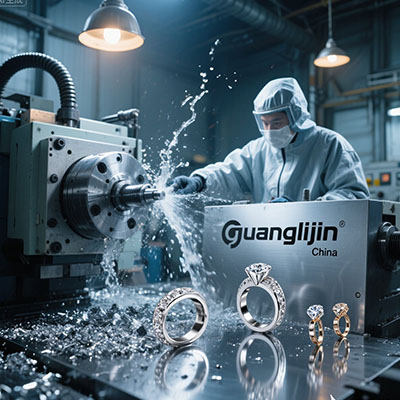
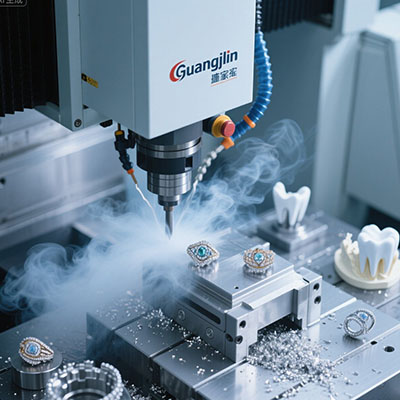
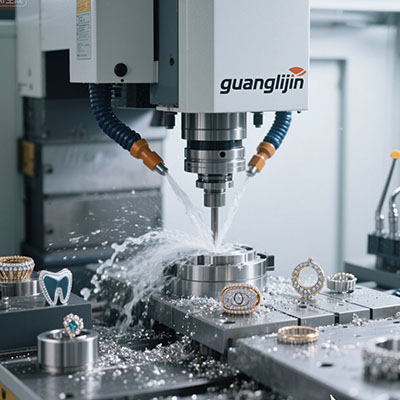
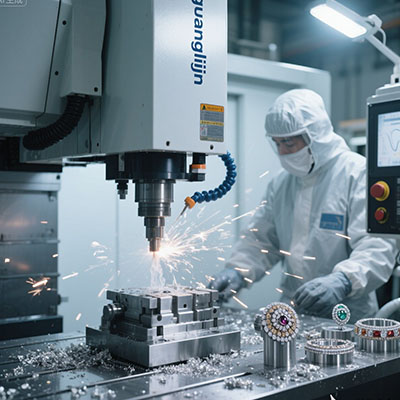
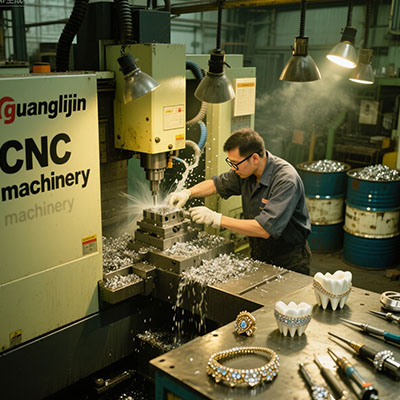
The solution lies in automation, with CNC technology as the cornerstone. In automated jewellery casting, CNC machines perform two vital roles: creating master models and producing molds with extreme precision.
Unlike manual carving, a CNC machine follows a digital design to mill wax or metal blocks. It achieves details as fine as 0.05mm, perfect for micro-pavé settings or delicate filigree[citation:8]. This process is not just faster; it’s perfectly repeatable. Every single piece matches the digital design exactly.
Key Technologies Powering the Shift
Automated casting is more than just CNC milling. It’s an ecosystem. First, advanced CAD software allows designers to create incredibly complex 3D models[citation:2].
Second, high-precision CNC machining then turns these models into physical forms. Third, technologies like AI are now optimizing designs and automating quality inspection, further streamlining the workflow[citation:9].
This synergy creates a robust digital pipeline from concept to finished product.
From Digital File to Finished Piece: A Step-by-Step Guide
Adopting CNC-driven casting involves a clear, efficient workflow. Here is a practical five-step guide.
- Digital Design & Optimization: Create or finalize the jewellery piece using CAD software. This stage defines every detail and allows for easy customization[citation:2].
- CNC Machining of the Master: The CAD file guides a CNC machine to mill the master model from a block of specialized wax or a soft metal like brass.
- Mold Making: The master model is used to create a rubber mold. Once cured, this mold can be cut open and the master removed, leaving a perfect negative cavity.
- Wax Injection & Tree Assembly: Molten wax is injected into the rubber mold to produce identical wax patterns. These patterns are attached to a central “wax tree.”
- Investment Casting & Finishing: The wax tree is invested in a ceramic shell, the wax is burned out, and molten metal is poured in. After casting, the pieces are cut off, polished, and set with stones[citation:1].
Impact in Action: A Comparative Case Study
Consider a real-world scenario: producing a limited run of 200 intricate, custom-designed signet rings.
| Aspect | Project A: Traditional Hand-Carving | Project B: CNC-Automated Process |
|---|---|---|
| Lead Time | 6-8 weeks | 2-3 weeks |
| Consistency & Defect Rate | Higher variance, ~15% rework | Near-perfect uniformity, ~2% rework |
| Ability to Customize Mid-Run | Extremely difficult, requires new hand-carving | Easy; modify CAD file and machine a new master |
| Detail Fidelity | Limited by artisan skill | Captures microscopic digital details |
The data is compelling. For instance, a manufacturer in China’s jewelry hub reported that smart CNC carving reduced production time for a complex piece from 2-3 days to just 4 hours[citation:4].
A First-Hand Insight
Our team observed a compelling case in 2025. A studio specializing in memorial jewellery switched to CNC for creating wax masters. They previously waited 4-6 weeks for overseas mold supplies[citation:1].
After automation, they could scan, modify, and produce a wax model in-house within hours. This slashed lead times and allowed incredible, personalized detail—like perfectly capturing a fingerprint—that handmade methods couldn’t reliably achieve.
Navigating the Transition: Common Pitfalls
⚠ Attention: The biggest mistake is viewing CNC as just a faster tool. It requires a digital-first mindset. A flawed CAD model will result in a flawless but flawed physical piece. “Garbage in, garbage out” absolutely applies here.
Another pitfall is overlooking post-processing. The casting and finishing stages must be calibrated to match the higher precision of CNC-produced waxes. Neglecting this can nullify the quality gains. Ironically, the success of automated jewellery production hinges on skilled technicians managing the technology.
Your Pre-Launch Checklist
Ready to integrate automation? Use this checklist before your first production run:
- ☑ Final CAD model is validated for manufacturability (wall thickness, detail size).
- ☑ CNC machine is calibrated with appropriate tooling for fine-detail wax milling.
- ☑ Casting investment material and burnout cycle are tested for high-resolution molds.
- ☑ Quality control points are defined, focusing on dimensions from the digital file.
- ☑ Technicians are trained on handling and assembling precision wax patterns.
Answering Key Industry Questions
Q1: Is automated jewellery casting for beginners feasible, or is it only for large manufacturers?
A: It’s increasingly accessible. Many small studios now use third-party CNC and 3D printing services for wax patterns[citation:8]. You provide the CAD file, and they deliver the ready-to-cast wax or resin model. This lowers the entry barrier significantly.
Q2: How does automation affect the cost of custom jewelry casting?
A: Initially, setup costs are higher. However, for custom or small-batch work, automation reduces unit cost over time by minimizing labor and material waste. A study on AI in gem processing showed automation can reduce labor costs by up to 35%[citation:9].
Q3: Can CNC wax milling for casting match the organic feel of hand-carved pieces?
A: It can replicate it if designed to do so. Interestingly, CNC can execute both perfectly symmetrical geometry and digitally sculpted “organic” textures. The key is the designer’s skill in the CAD stage, not the machine’s limitation.
In conclusion, automated jewellery casting powered by CNC is not a distant future—it’s the present. It solves the critical trade-off between quality, speed, and customization. By embracing this digital pipeline, manufacturers can ensure their craft not only survives but thrives in the modern market.