Automated Jewellery Making – High-Speed CNC Production
The Bottleneck of Modern Demand
Think about a popular, detailed ring design. Handcrafting each piece is slow. Skilled artisans are a scarce resource. Even minor inconsistencies can cause fitting issues for stones, leading to waste and delays[citation:8]. This manual bottleneck makes scaling production or offering rapid customization incredibly difficult.
Customers today expect both uniqueness and fast delivery. Traditional methods struggle to meet these twin demands of mass customization and efficiency. The pressure to innovate is immense.
High-Speed CNC: The Engine of Automation
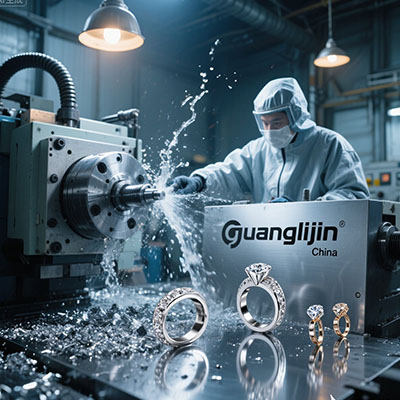
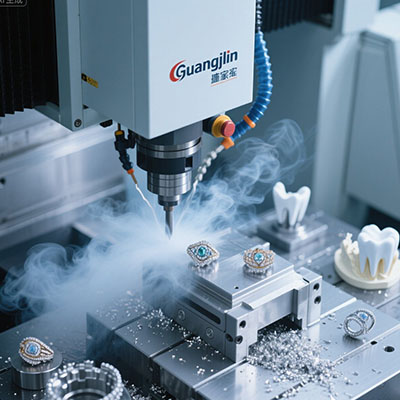
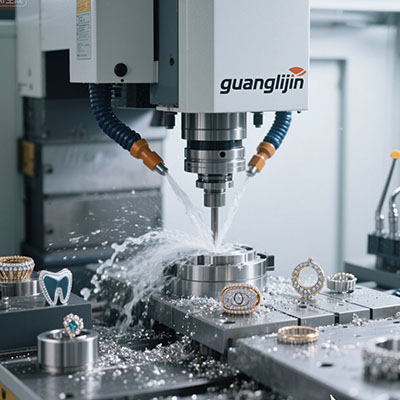
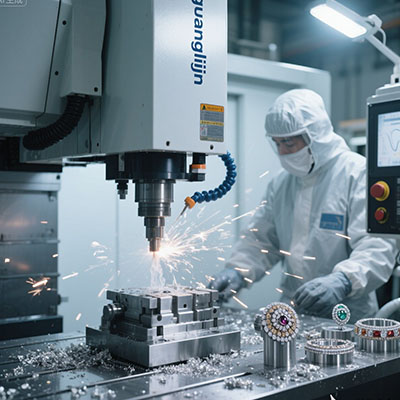
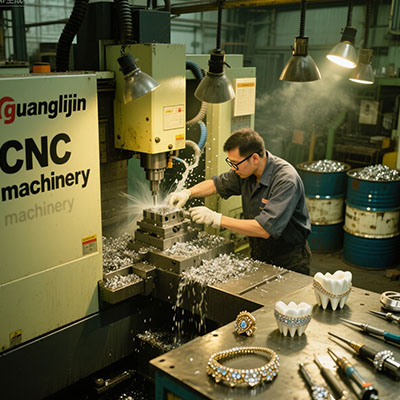
High-speed CNC machining provides the core solution. In automated workflows, CNC systems act as tireless digital craftsmen. They mill wax models, metal masters, or even final components directly from solid blocks with incredible speed and precision. This process is fundamental for streamlined investment casting and direct manufacturing[citation:1][citation:2].
Companies like Shenzhen Guanglijin Technology develop the multi-axis machines that make this possible. Automation transforms a digital file into a perfect physical part, repeatedly and without fatigue.
Key Drivers: Speed, Consistency, and Complexity
Why is this shift so transformative? First, it delivers dramatic productivity gains. CNC equipment can operate 24/7, vastly increasing output. Some systems report tripling batch production efficiency compared to manual methods[citation:7].
Second, it ensures unwavering consistency. Every piece is a perfect clone of the CAD model. This eliminates costly variations in stone setting or assembly.
Third, it unlocks profitable complexity</strong. High-speed 5-axis CNC can machine intricate undercuts and textures faster than ever, turning complex designs into commercially viable products.
The Automated Production Line: A Step-by-Step Guide
Building an automated CNC line involves integrating several key technologies. Here’s a practical five-step guide.
- Digital Design & CAM Programming: The piece is finalized in CAD software. Using specialized CAM software, toolpaths are generated. Advanced CAM automates much of this programming, drastically cutting setup time[citation:3][citation:5].
- High-Speed CNC Machining: The CAM file directs a high-speed CNC mill. These machines, often with automatic tool changers, rapidly carve the design from wax, brass, or silver, producing masters or direct patterns.
- Automated Pattern Replication & Assembly: The master is used to create durable molds. Automated wax injectors then produce pattern trees. Robotic arms can further assemble these trees for casting.
- Streamlined Casting & Devesting: The mold undergoes investment casting. Automated systems can handle the burnout and pouring processes. After casting, robots may assist in breaking the ceramic shell.
- Automated Finishing & QC: Initial finishing like tumbling can be automated. Computer vision systems then perform final quality checks, comparing the piece to the original digital specifications.
Project Analysis: Manual Studio vs. Automated Line
Consider producing 500 units of a detailed pendant with a personalized engraving.
| Parameter | Project A: Manual Studio | Project B: Automated CNC Line |
|---|---|---|
| Primary Labor | High-skilled artisans for carving, molding, and finishing. | Technicians for machine oversight, programming, and maintenance. |
| Production Lead Time | Weeks, due to sequential manual tasks. | Days; parallel, continuous automated processes. |
| Unit-to-Unit Consistency | Variations expected; “handmade” variance. | Near-perfect uniformity across all units. |
| Cost of Personalization | Very high; each custom engraving is a manual task. | Low; personalization is a simple digital file change. |
| Scaling Potential | Limited by artisan availability and training. | High; scaled by adding machine time or shifts. |
| Material Efficiency | Higher loss due to manual errors and filing. | Superior; precision machining minimizes waste. One case reported gold loss as low as 0.15%[citation:8]. |
A Real-World Speed Transformation: Our 2025 Insight
Our team consulted for a mid-sized manufacturer in early 2025. They landed a contract for 2,000 personalized bracelets with a complex geometric pattern. Their manual process was impossibly slow.
We implemented a cell with a high-speed 5-axis CNC and automated wax injector. The change was dramatic. Lead time dropped from 12 weeks to just 3. Interestingly, the speed didn’t hurt quality—the machine’s consistency actually reduced post-casting cleanup by 30%. The client could now profitably accept such large, customized orders.
Avoiding Automation Pitfalls
⚠ Attention: The biggest mistake is chasing speed without stability. A machine running at maximum velocity with poor toolpaths or fixturing will produce scrap faster. True high-speed production requires perfect CAM programming, rigid setups, and balanced process parameters. Reliability is more important than peak speed.
Another error is automating in a vacuum. Speeding up wax pattern production is pointless if the casting department is still manual. You must analyze and upgrade the entire workflow to avoid creating new bottlenecks. The goal is a balanced, end-to-end system.
achieving the highest overall throughput sometimes means not running every machine at its top rated speed. Optimizing the flow between stations for minimal downtime often yields better results than maximizing the speed of one isolated step.
Pre-Automation Readiness Checklist
Before investing in high-speed automation, verify your operation is ready:
- ☑ Designs are digitized in a stable, organized CAD library.
- ☑ Production volume and order consistency justify the capital investment.
- ☑ Technical skill exists (or is budgeted for) in CNC programming (CAM) and machine maintenance.
- ☑ The entire production flow is mapped to identify all bottlenecks, not just the first one.
- ☑ A pilot project is defined to test the integrated automated process on one product line.
- ☑ Material supply and post-processing (polishing, setting) are scaled to match the increased output.
Answering Top Questions on Automated Jewellery Making
Q1: Can high-speed CNC production truly handle delicate, intricate jewellery designs, or is it only for simple pieces?
A: It excels at intricacy. Modern 5-axis CNC machines with high-speed spindles are specifically designed for complex, delicate work[citation:3][citation:7]. They can achieve finer details and more consistent results on complex patterns than manual methods, making them ideal for detailed filigree, micro-pavé settings, and textured surfaces.
Q2: What is the real cost savings with automated jewellery making, considering the high machine price?
A: Savings come from scale and reduction in hidden costs. While the initial investment is high, the per-unit cost plummets for batch production. You save on skilled labor, reduce material waste significantly (gold loss can be cut in half)[citation:8], and virtually eliminate rework from inconsistencies. The ROI becomes clear with sufficient volume.
Q3: How does automation affect customization and personalization in jewellery manufacturing?
A: It makes mass customization feasible. Once the system is set up, changing a design—like adding a name or date—is just a digital edit[citation:8]. This allows for profitable production of unique or small-batch personalized items, which was economically challenging with purely manual labor.
Q4: Is automated CNC making suitable for a small jewellery studio, or only large factories?
A: It’s increasingly accessible. Smaller studios often start by outsourcing CNC work to specialized service bureaus. Furthermore, newer benchtop CNC systems and user-friendly software with pre-built libraries are lowering the entry barrier for smaller businesses[citation:7].
In conclusion, automated jewellery making through high-speed CNC production is the definitive path forward for a competitive industry. It masterfully solves the trilemma of speed, consistency, and complexity. By embracing this technological synergy, manufacturers can build a responsive, efficient, and creatively limitless future.