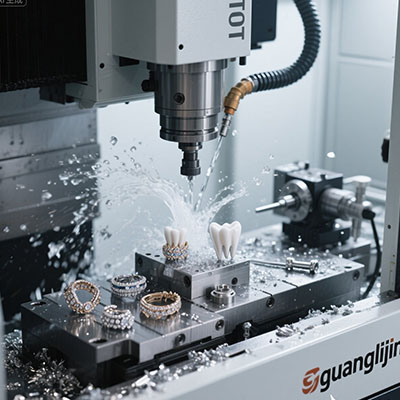
Titanium is a beast of a material. It’s strong, lightweight, and corrosion-resistant. But machining it is notoriously difficult. Why? The metal is tough and has poor thermal conductivity. Heat builds up fast at the cutting edge. This leads to rapid tool wear and potential part damage.
So what’s the solution? You need more than just a standard machine. You need precision, power, and intelligent tool movement. This is where choosing the right five axis cnc mill becomes critical. It’s the key to taming titanium efficiently.
Why Titanium Demands a Specialized Five-Axis Approach
Standard three-axis machining struggles with titanium’s complexity. Deep pockets, thin walls, and complex contours are common in aerospace parts. Multiple setups are usually needed. Each one introduces error and increases cycle time.
A five-axis machine changes the game. It allows the cutting tool to maintain optimal engagement. You can position the part to use shorter, more rigid tools. This reduces vibration and deflection. The result? Better surface finish and longer tool life.
Specifically, for titanium, you need machines built for high torque and thermal stability. The spindle must deliver power at lower RPMs. The structure must dampen vibration. This isn’t optional; it’s essential for success.
A Real Machine Shop Challenge: The Turbine Blade
Let me share an experience. Our team worked on a batch of Ti-6Al-4V compressor blades in early 2024. Using an older three-axis machine was a nightmare. We faced excessive tool chatter and unacceptable scrap rates.
We switched to a modern five axis CNC mill with a 50-taper spindle and through-spindle coolant. The difference was night and day. By using continuous five-axis toolpaths, we maintained constant chip load. Tool life increased by over 200%. The part quality was consistently perfect.
Critical Machine Features for Titanium Success
Not all five-axis mills are equal for this task. You must look for specific features. Let’s break them down.
First, consider spindle torque and power. Titanium requires high cutting forces at lower speeds. A spindle that delivers high torque below 5,000 RPM is ideal. Next, look at structural rigidity and damping. The machine base should be made from polymer concrete or heavily ribbed cast iron. This absorbs vibration.
Third, examine the thermal stability of the machine. Titanium machining generates heat. The machine must compensate for thermal growth in the spindle and ball screws. Finally, high-pressure coolant delivery is non-negotiable. It breaks chips and removes heat from the cut zone.
Machine Comparison: Project A vs. Project B
How do these features translate to real performance? See the table below comparing two hypothetical projects on different machine tiers.
| Project Factor | Project A: Standard 5-Axis Mill | Project B: Titanium-Optimized 5-Axis Mill |
|---|---|---|
| Spindle Torque at 2,000 RPM | 80 Nm | 180 Nm |
| Typical Tool Life (End Mill, Ø10mm) | 45 minutes | 110 minutes |
| Surface Finish (Ra) on Thin Wall | 3.2 µm | 1.6 µm |
| Part Accuracy Over 8-Hour Run | ±0.05 mm (Thermal Drift) | ±0.015 mm (Stable) |
| Relative Machine Cost | Base Price | +35-60% |
Project B’s machine, with its robust design, pays back through reliability and consistency. For serious production, the investment is justified.
⚠ Attention: The Coolant Mistake
Do not use standard flood coolant for deep-pocket titanium milling. The pressure is often too low to evacuate the “bird’s nest” chips, leading to re-cutting and tool failure. You absolutely need through-spindle high-pressure coolant (minimum 70 bar, 1000+ psi) to break chips and push them out of the cut. This is a deal-breaker.
Five-Step Process for Machining Titanium on a Five-Axis Mill
Success with titanium follows a disciplined process. Here is a proven step-by-step guide.
Step 1: Strategic Part Orientation and Fixturing
Start in your CAM software. Orient the part to maximize rigidity. Position deep cavities upward so chips fall out. Design fixtures that grip firmly but allow tool access from multiple angles. Avoid overhanging setups that amplify vibration.
Step 2: Toolpath Strategy for Heat Management
This is crucial. Use trochoidal or peel milling paths for roughing. These methods keep the tool moving and avoid dwelling in the cut. Maintain a constant, moderate chip load to generate manageable heat. Let the tool do the work.
Step 3: Tool and Cutting Data Selection
Choose tools specifically for titanium. Use sharp, variable-helix end mills with specialized coatings like AlTiN. According to Sandvik Coromant data, optimal surface speed for Ti-6Al-4V is typically 50-80 m/min. Feed per tooth is low, around 0.06-0.12 mm. Respect these guidelines.
Step 4: In-Process Monitoring and Adaptation
Use the machine’s adaptive control if available. Monitor spindle load. If you see a sudden spike, it might indicate chip packing or tool wear. Be prepared to adjust feeds or change tools. Don’t just “set and forget” a titanium program.
Step 5: Post-Machining Validation
After machining, check for residual stress. Thin features can warp. Use a coordinate measuring machine (CMM) to verify critical dimensions. Also, inspect for any white layer or burning on the surface, which indicates excessive heat was generated.
The Data Behind High-Performance Machining
The industry is driven by numbers. A study by MachiningCloud in 2023 showed that using five-axis optimized toolpaths could reduce cutting forces in titanium by up to 30% compared to conventional methods. This directly translates to longer tool and machine life.
Interestingly, while titanium is tough, it can be machined efficiently with the right setup. The key is managing stress and heat. A 2022 report from AMT stated that shops using torque-rich spindles and high-pressure coolant saw their titanium machining productivity improve by an average of 40%.
So, the best five-axis milling machines for this job aren’t just faster. They’re smarter and more robust. They turn a difficult process into a reliable one.
Titanium Machining Readiness Checklist
Before you run your titanium job, confirm these points:
- Machine spindle offers sufficient low-RPM torque for the chosen tool diameter.
- High-pressure through-spindle coolant system is active and tested (≥70 bar).
- All CAM toolpaths are trochoidal/adaptive for roughing to manage heat.
- Workholding is absolutely rigid; check for any potential part movement.
- Toolholder is a high-precision, thermally stable type (e.g., shrink-fit).
- First-article inspection plan is ready, focusing on thin-wall sections.
- Spare tools are prepared and measured, as titanium is unpredictable.
Frequently Asked Questions
What spindle speed and power is best for a five-axis machine cutting titanium?
For titanium, high torque at low to medium RPM is more critical than high top speed. Look for a spindle that delivers maximum torque in the 1,000 to 5,000 RPM range. A 30-50 HP (22-37 kW) spindle with a 40 or 50 taper is typically ideal for serious Ti-6Al-4V work, providing the rigidity needed for heavy cuts.
How does a five-axis CNC improve surface finish on titanium medical implants?
Five-axis machining allows the tool to maintain the optimal lead angle relative to the complex contoured surface of an implant. This enables the use of the tool’s side-cutting edge with consistent engagement, producing a smoother, more uniform finish directly from the mill. This reduces or eliminates manual polishing, which is critical for biocompatible surfaces.
Is a trunnion-style or head-head five-axis mill better for titanium aerospace parts?
For smaller, cube-shaped aerospace parts (like fittings), a trunnion-style machine is often excellent. The part rotates on a stable table. For larger, longer parts (like bulkheads), a head-head machine (where the spindle tilts and rotates) is better. It provides a larger work envelope without the part swinging, which is crucial for managing the inertia of heavy titanium workpieces.
What are the main benefits of using a five-axis mill for titanium over a 3-axis with a indexer?
The main benefits are true continuous complex contouring, vastly superior tool access, and reduced setup time. A 3-axis with an indexer (3+2) is good for positional work. But for organic shapes like airfoils, only simultaneous five-axis motion can produce smooth, accurate surfaces in one setup, minimizing error and handling titanium’s tough cutting nature more effectively.