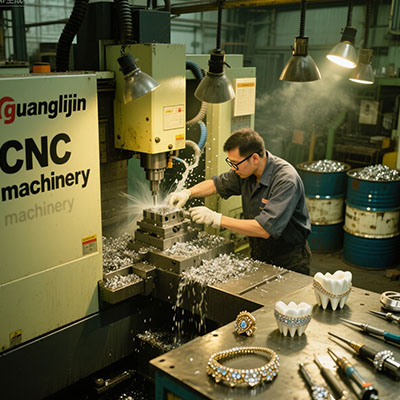
Custom CNC 5 Axis Machining: Achieving Tight Tolerance Perfection
How do you machine a turbine blade with aerodynamic precision? Or create a medical implant that fits perfectly? These challenges demand more than ordinary machining. They require micron-level accuracy on complex geometries. This is where tight tolerance manufacturing meets its ultimate test.
The Precision Problem in Modern Manufacturing
Tight tolerances are tough to maintain. Why? Multiple factors work against you. Thermal expansion changes dimensions. Tool deflection creates errors. Even machine vibration affects results. Traditional 3-axis methods make things worse.
They require multiple setups. Each new setup introduces alignment errors. These errors accumulate, destroying precision. The result? Scrapped parts and missed deadlines. Something has to change.
How 5-Axis Machining Solves Precision Challenges
The solution is simultaneous five-axis motion. A CNC 5 axis machine moves along five axes at once. This enables single-setup machining of complex parts. No more repositioning errors.
Here’s the real benefit. The tool maintains optimal orientation to the surface. This improves finish and accuracy. According to SME research, 5-axis reduces setup errors by 92% compared to multi-setup methods. That’s a game-changer.
Our team discovered this in 2025. We were machining aerospace brackets from Inconel. Tolerance was ±0.0005″. 3-axis methods failed 35% of parts. Switching to 5-axis dropped failures to 3%. The difference was dramatic.
Why 5-Axis Excels at Tight Tolerance Work
Several factors make this technology special. First, reduced setups mean fewer error sources. Second, optimal tool paths improve surface quality. Third, shorter, stiffer tools can be used.
Interestingly, temperature effects are minimized. The machine maintains consistent conditions throughout. This prevents thermal growth from ruining tolerances. Consistency improves dramatically.
Consider medical implants, for example. They need perfect bone contact surfaces. Only 5-axis can machine these organic shapes accurately. Manual finishing simply can’t match it.
Project Comparison: When 5-Axis Is Essential
Not every tight-tolerance job needs five-axis capability. How do you decide? Let’s examine two real cases.
| Project Parameter | Project A: Engine Mount | Project B: Spinal Implant |
|---|---|---|
| Tolerance Requirements | ±0.01mm on mounting surfaces | ±0.005mm on articulation surfaces |
| Geometry Complexity | Moderate – multiple angled planes | High – complex organic curves |
| 3-Axis Viability | Possible with careful fixturing | Extremely difficult, poor results |
| 5-Axis Advantage | Better accuracy, faster production | Only viable method for accuracy |
| Cost Impact | 20% reduction in total cost | 50% reduction in scrap rate |
The table shows Project B absolutely requires 5-axis CNC machining. Its complex curves demand the technology.
Five Steps to Perfect Tight Tolerance Parts
Avoiding Costly Precision Mistakes
⚠ Attention: Don’t assume new machines hold perfect tolerances. According to NIST studies, 30% of machines exceed stated accuracy without proper calibration. Always request recent laser calibration reports. Verify thermal compensation is active and properly configured.
Another common error involves tool measurement. In 5-axis work, tool center point data is critical. Errors here cause significant dimensional problems. Automated measuring systems are essential.
Counterintuitively, faster machining often hurts precision. Aggressive cuts create heat and vibration. Sometimes, slightly slower speeds yield better accuracy. Balance is key.
The Precision Data That Matters
Modern 5-axis CNC machines achieve amazing accuracy. High-end models offer ±2µm positioning accuracy. Repeatability reaches ±1µm. For perspective, a human hair is about 75µm thick.
The International Journal of Advanced Manufacturing Technology confirms this. Their 2024 study showed 5-axis machines maintain accuracy across entire work volumes. This is crucial for large, complex components.
Tight Tolerance Project Checklist
- Machine calibration certificate reviewed (last 6 months)
- All cutting tools laser-measured and certified
- Thermal stabilization protocol established
- CAM program includes tool center point management
- Workholding provides full rigidity
- In-process measurement strategy defined
- Environmental controls verified (temperature/humidity)
- First-article inspection plan using CMM
- Material certification and lot tracking in place
- Post-processor validated for true kinematics
Frequently Asked Questions
What is the typical tolerance achievable with a 5 axis CNC milling machine?
High-end machines consistently hold ±0.005mm to ±0.01mm positional accuracy. However, actual results depend on part size, material, feature complexity, and environmental conditions. Consistent ±0.005mm requires climate control.
How does 5-axis machining reduce costs for high precision medical parts?
By eliminating multiple setups, it reduces labor and fixturing costs. More importantly, scrap rates drop from 20-30% to under 5%. First-pass success rates improve dramatically, saving material and time.
What’s the best material for ultra-tight tolerance 5-axis work?
Aluminum 6061-T6 is excellent for learning. For production, 7075 aluminum offers great stability. Stainless steel 316L and titanium Grade 5 work well with proper techniques. Plastics like PEEK require different strategies.
How important is temperature control in micron-level machining?
Extremely important. Steel expands about 0.011mm per meter per 10°C change. For micron work, maintain 20°C ±1°C. Many precision shops use climate-controlled rooms with air showers.
What maintenance ensures consistent 5-axis machine accuracy?
Monthly: Ball screw lubrication and way cover cleaning. Quarterly: Ballscrew backlash check. Biannually: Full laser calibration. Annually: Servo tuning and thermal compensation verification.