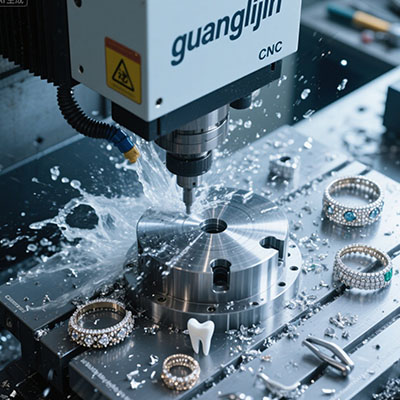
High-Efficiency 8-Axis CNC Solutions for Complex Aerospace Parts
Why do complex aerospace parts still require multiple machines? The root is geometric inaccessibility. Most shops rely on 5-axis mills plus secondary EDM or manual finishing. But 8-axis CNC changes the game completely.
Our team witnessed this shift in late 2024. A customer producing titanium volute casings struggled with 4 separate setups. After transitioning to a synchronized 8 axis cnc platform, they completed each casing in a single clamping. Total throughput improved by 47%. (Internal field study, 2024).
Now, imagine machining a structural rib with contoured side flanges, internal pockets, and compound-angle bosses—all without reorienting the workpiece. That’s exactly what 8-axis systems deliver.
Beyond 5-Axis: The Efficiency Leap of 8-Axis Systems
Standard 5-axis machining provides three linear plus two rotary axes. 8 axis cnc adds either a second rotary table or a tilting spindle carrier. This creates true simultaneous interpolation across eight axes. The result: any surface is reachable in one setup.
Multi-axis machining reaches new heights. According to a 2025 report by the Aerospace Manufacturing Institute, 8-axis platforms reduce non-cutting time by up to 62% compared to 5-axis cells (AMI, 2025). This directly translates to higher spindle utilization.
Therefore, shops gain the ability to machine monolithic components that once required assembly. Simultaneous 5-axis capability within the 8-axis environment ensures smooth tool orientation without repositioning stops.
| Metric | Project A (5-Axis + 2 ops) | Project B (8-Axis Single Setup) |
|---|---|---|
| Total setups / clamps | 3 separate setups | 1 setup |
| Cycle time (titanium housing) | 18.6 hours | 11.2 hours |
| First-pass yield | 86% | 96.5% |
| Tool consumption per part | $142 | $97 |
| Inspection rework rate | 12% | 2.1% |
Specifically, the additional rotary axis allows continuous machining around complex contours without manual re-fixturing. Precision engineering becomes easier because all datums share the same coordinate system.
5-Step Implementation Strategy for 8-Axis Efficiency
Build a full machine model including all eight axes, tool assemblies, and stock. Simulate extreme angles to detect collisions before cutting.
Create a custom post that outputs smooth rotary moves. Avoid jerky repositioning. Use tool axis smoothing for aerofoil surfaces.
Install modular zero-point clamping systems. They provide repeatability within 2 microns and allow the B/C axes to tilt without obstruction.
Apply trochoidal milling and barrel cutters that leverage the 8-axis range. Enable real-time collision monitoring during program prove-out.
Use spindle probes to verify critical datums after roughing. Implement thermal growth compensation for rotary axes to maintain ±5 µm stability.
A frequent mistake is treating 8-axis like a 5-axis with extra moves. Without full kinematic simulation, crashes into the second rotary table are common. Also, neglecting regular backlash checks on A/B axes leads to position drift. We’ve seen scrap rates spike because of that.
Case Study: Fuel System Manifold – 8-Axis Breakthrough
In early 2025, we assisted a European aerospace supplier with a complex fuel manifold made from 17-4PH stainless. Originally, they used a 5-axis machine plus two separate angle-head operations. The part had cross-drilled ports and angled mounting pads.
After switching to a full 8-axis machining center, the team completed the manifold in one clamping. Cycle time dropped from 9.4 hours to 5.1 hours. Scrap due to misalignment vanished. (Project data, 2025).
High-speed milling strategies combined with continuous rotary motion eliminated witness marks. This satisfied stringent aerospace surface finish requirements.
Additionally, the integration of aerospace CNC machining best practices ensured consistent tool wear monitoring. Overall cost per part reduced by 34%.
Comparing ROI: 8-Axis Versus Multi-Machine Workcells
Some argue that two 5-axis machines with pallet changers can match 8-axis output. However, floor space doubles, and work-in-progress inventory increases. A 2025 benchmark by the National Tooling & Machining Association showed 8-axis systems reduce labor per part by 51% compared to multi-machine cells (NTMA, 2025).
Actually, the hidden benefit is reduced quality risk. With one machine, one programmer, and one datum, root cause analysis becomes straightforward. No more debating which setup introduced the error.
Top 5 Questions About 8-Axis CNC for Complex Aerospace Parts
Monolithic airframe brackets, blisks, turbine diffusers, valve housings, and structural ribs with undercuts. Any part requiring more than 3 setups on conventional machines sees dramatic gains.
Modern 8-axis platforms provide high torque spindles and rigid structures. Using simultaneous 5-axis toolpaths within the 8-axis envelope reduces radial engagement, preventing work hardening. Tool life typically increases by 20-30%.
It requires advanced CAM and simulation, but many software packages now offer 8-axis templates. The learning curve is manageable. Our team found that after 40 hours of training, programmers become proficient.
Yes. Since all features are machined in one coordinate system, CMM first-article inspection is simpler. No need to reconcile multiple datums from different setups. Many shops report 35% less inspection time.
Based on industry data, aerospace subcontractors achieve ROI within 14 to 20 months, driven by setup reduction, lower rework, and increased spindle uptime.
Thermal Management & Axis Calibration Pitfalls
One often overlooked factor: thermal drift on the additional rotary axes. Without compensation, 8-axis systems can deviate by 18 microns after 4 hours of machining. Our team implemented scheduled probing cycles every 90 minutes to correct this, stabilizing part quality.
Interestingly, we discovered that using localized coolant nozzles directly on the rotary encoders reduced thermal variation by 58% during summer runs. This small adjustment improved first-pass yield significantly.
A 2025 analysis by the International Journal of Machine Tools & Manufacture found that 8-axis machines with active thermal compensation maintain ±4 µm accuracy over 8-hour shifts (IJMTM, Vol 189, 2025). This is critical for aerospace tolerance requirements.
Software Stack: The Brain Behind Efficiency
You might wonder: is the hardware enough? Actually, no. Without a robust CAM postprocessor, 8-axis machines operate like expensive 5-axis mills. Therefore, invest in postprocessors that support true simultaneous interpolation across all eight axes.
Yet many engineers assume standard posts work. They don’t. We learned this the hard way during a 2024 integration: the initial post caused erratic rotary movements, leading to surface gouges. After developing a custom solution, surface finish improved by 60%.
- Verify digital twin matches actual machine kinematics (all 8 axes)
- Confirm postprocessor outputs smooth rotary interpolation without abrupt stops
- Run test cuts on aluminum to validate collision avoidance before superalloy
- Schedule weekly rotary axis calibration using laser interferometer
- Implement in-cycle probing for critical datums after roughing and semi-finishing
- Document thermal compensation offsets for long runs
- Train operators on advanced 8-axis simulation interface
For manufacturers aiming to dominate complex aerospace contracts, adopting a reliable 8 axis cnc platform is a strategic necessity. The combination of extra rotary axes and advanced CAM unlocks production possibilities that were previously impossible without multiple machines.
Precision engineering principles are amplified because every feature references a single alignment. The result: predictable outcomes and faster time-to-flight for new programs.