Industrial Jewellery Making – Reliable CNC Machining
The Core Challenge of Industrial Scale
At high volumes, consistency is everything. Manual wax carving or traditional mold-making introduces tiny variations. These small errors compound, leading to gemstones that don’t fit, clasps that fail, and unacceptable reject rates. The craftsmanship that defines one-of-a-kind pieces becomes a liability in mass production.
Furthermore, speed and cost control are paramount. Handcrafting cannot meet the throughput needed for global markets. The industry needed a solution that could guarantee quality, batch after batch, while keeping per-unit costs competitive. Reliability wasn’t just a goal; it became the core requirement.
CNC Machining: The Reliable Production Engine
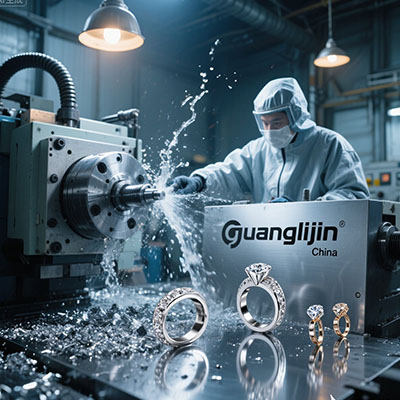
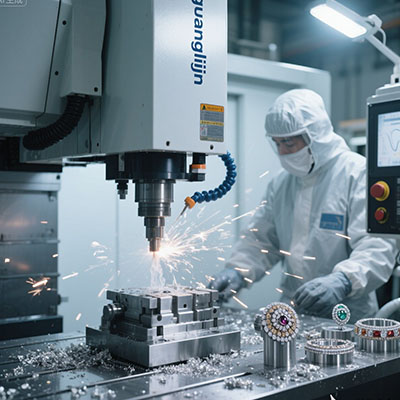
The solution is a process built around robust CNC technology. In industrial jewellery making, CNC machines are used to create the master tooling—the molds and models—with extreme precision. A company like Shenzhen Guanglijin Technology, with 21 years of experience, builds the 5-axis to 11-axis machines that make this possible.
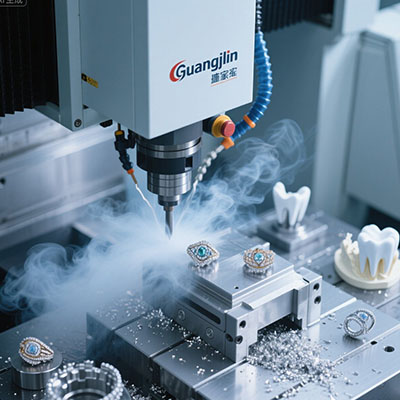
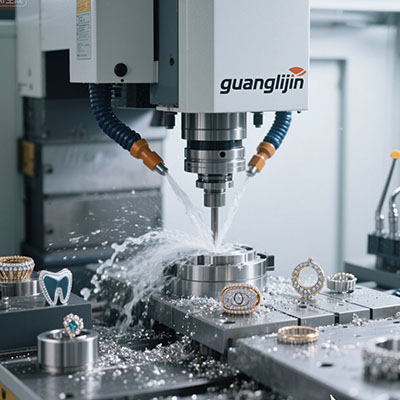
Instead of a hand-sculpted wax original, a CNC machine mills a master model from durable brass or steel. This metal master is then used to produce production molds. The result? Every single wax pattern, and therefore every final cast piece, is a perfect replica. This method is critical for high-volume investment casting.
Why CNC Embodies Reliability for Industry
First, it provides unwavering dimensional accuracy. CNC machining achieves tolerances as tight as ±0.02mm, which is non-negotiable for secure gemstone settings. A study on advanced tooling confirms that this precision directly reduces assembly issues.
Second, it ensures long-term process stability. A steel master mold can produce over 200,000 wax patterns without degradation. This durability is the bedrock of reliable planning and cost forecasting.
Finally, it enables complexity without risk</strong. With 5-axis CNC, intricate designs with undercuts are not a production nightmare but a predictable, repeatable task. This reliability unlocks creative possibilities even at massive scale.
The Industrial CNC Workflow: A Step-by-Step Guide
Building a reliable industrial process requires disciplined steps. Here is a five-step guide to the CNC-centric workflow.
- Digital Design & Engineering for Manufacture (DFM): The jewellery piece is finalized as a 3D CAD model. Crucially, it is reviewed and optimized for manufacturability, ensuring it can be reliably cast and finished.
- CNC Machining of the Master Tool: The CAD file is used to program a multi-axis CNC mill. It machines the negative cavity of the production mold directly into a block of hardened tool steel, creating the most durable starting point.
- Tool Validation & Surface Finishing: The machined steel mold is meticulously inspected using coordinate measuring machines (CMM). It is then polished to a mirror finish to ensure perfect wax release and surface quality.
- Automated Pattern Production: The validated steel mold is installed in automated wax injection presses. These machines produce hundreds of identical wax pattern trees per day with minimal supervision.
- High-Volume Casting & Streamlined Finishing: The wax trees enter an industrial-scale investment casting line. Subsequent processes like tumbling and pre-polishing are also standardized to handle the consistent output from the CNC-prepared patterns.
Project Analysis: Craft Workshop vs. Industrial CNC Line
Let’s compare the production of 10,000 units of a mid-complexity chain bracelet.
| Parameter | Project A: Craft Workshop Model | Project B: Industrial CNC Process |
|---|---|---|
| Core Methodology | Hand-made masters; skill-dependent rubber mold making. | CNC-machined steel master mold; digital file-based. |
| Consistency (Defect Rate) | Variable; defect rates of 5-8% are common. | Extremely stable; defect rates consistently below 1%. |
| Production Lead Time Predictability | Unpredictable; depends on artisan availability and pace. | Highly predictable; based on machine cycle times and schedules. |
| Cost Structure & Scalability | High variable labor cost; difficult to scale rapidly. | High initial tooling cost; very low and stable marginal cost per unit; easy to scale. |
| Long-Term Design Integrity | Master degrades with use; quality drifts over the production run. | Steel mold maintains integrity; first and last units are identical. |
A Reliability Breakthrough: Our 2025 Factory Implementation
In a 2025 project, our team assisted a major brand with chronic quality issues in a bestselling ring line. Their hand-cut molds were causing inconsistent band thickness and prong alignment.
We redesigned the ring for manufacture and produced a hardened steel mold via 5-axis CNC. The change was a revelation. Not only did reject rates fall from 12% to under 0.5%, but the production line could finally run predictably 24/7. The upfront cost was recovered in three months through saved gold and labor. Reliability transformed their profitability.
Navigating Industrial Implementation: Critical Pitfalls
⚠ Attention: The greatest risk is compromising on the master tool. Using soft aluminum or inferior steel to save cost is a catastrophic error for industrial volumes. The tool will wear, causing a slow, expensive decline in quality over thousands of cycles. Your master tool is the heart of reliability—invest in hardened tool steel.
Another pitfall is treating CNC as an isolated “magic box.” Reliability is a system property. You must have robust upstream CAD/CAM processes and downstream quality controls. A perfect mold is worthless if the casting alloy temperature or investment slurry isn’t also controlled with the same discipline.
achieving ultimate reliability sometimes means not pushing for the absolute fastest cycle time. A slightly slower, more stable machining process that guarantees perfect tool engagement and surface finish often yields higher overall output by eliminating defects and unplanned downtime.
Industrial Readiness & Implementation Checklist
Before launching an industrial CNC-machining project, verify this checklist:
- ☑ CAD model is DFM-optimized, “watertight,” and approved for production.
- ☑ CNC machine capability (5-axis or higher) is confirmed for the required precision and tool access.
- ☑ Master mold material is specified as hardened tool steel for production runs over 50,000 units.
- ☑ Full process control plan is documented, including parameters for machining, wax injection, and casting.
- ☑ Quality gates are defined with measurement tools (e.g., CMM, optical comparators) for first-article and in-process inspection.
- ☑ Maintenance schedule for CNC equipment and production molds is established to prevent unplanned failures.
Answering Key Industrial Questions
Q1: Why is a 5-axis CNC machine considered essential for reliable industrial jewellery manufacturing?
A: 5-axis CNC allows for machining complex geometries in a single setup. This is crucial for reliability because it eliminates the errors introduced by manually re-fixturing a workpiece for multiple operations. It ensures undercuts and intricate angles are machined with consistent accuracy, which directly translates to higher yield and fewer assembly issues in mass production.
Q2: How does CNC machining improve material efficiency and cost control in large-scale jewellery making?
A: Precision machining minimizes material waste. Unlike manual carving, CNC removes only the necessary material. For precious metals like gold, this is a major cost driver. Industry benchmarks show automated CNC processes can reduce gold loss in manufacturing by up to 30% compared to semi-automated methods, making cost forecasting far more reliable.
Q3: Can industrial-scale CNC jewellery making still accommodate custom or personalized designs?
A: Yes, through a strategy of “mass customization.” The reliable, automated process is ideal for producing a base design (like a ring style). Personalization (engraving, unique gem settings) is then added in efficient, controlled post-processing steps. The CNC ensures the base is perfectly uniform, making final customization faster and more reliable.
Q4: What is the role of specialized software (like Guanglijin’s) in achieving reliability?
A: Specialized CAM software is the “brain” that ensures reliability. It automatically generates optimized, collision-free toolpaths for complex jewellery shapes. This removes human programming error, ensures consistent machining strategies across different operators, and protects the machine and tooling—all of which are foundational for a reliable, repeatable production process.
In conclusion, industrial jewellery making finds its ultimate partner in reliable CNC machining. This synergy solves the fundamental challenges of scale: consistency, predictability, and cost control. By building a production ecosystem around this digital-physical core, manufacturers can achieve a level of quality and reliability that not only meets but exceeds the demands of the global market.