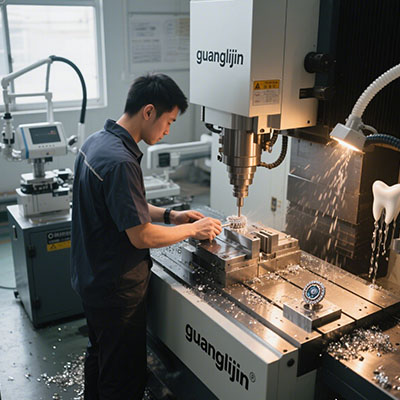
Aerospace parts rarely fail at the first feature. They fail at hour six, when the spindle is hot and the fourth axis has crept a few microns. Scrap appears. The lot gets rejected. This guide addresses stability as the central question. We show how to approach a buy horizontal 4 axis cnc decision for aerospace work, which design details predict stable output, and how to prove it with a sustained test.
Why Stability Beats Peak Specification
Spec sheets reward peak numbers. Spindle power at maximum. Rapid traverse rate. Tool change time. Those figures impress on paper. They say little about hour six of a titanium roughing cycle.
Stability is a different property. It is the machine’s ability to hold the same result from the first part to the last part of a shift. That requires thermal control, structural damping, and repeatable rotary motion. A machine can have modest peak numbers and excellent stability. The reverse is also common.
Therefore buyers should weight stability evidence above headline specifications. Ask for data from long runs. Ask how the machine behaves as it warms. Ask what the probing schedule looks like in production.
Our team reviewed an aerospace cell in 2025 where a horizontal platform held tolerance through a nine-hour run. The machine was not the fastest in the shop. It was the most consistent. Probe compensation every twenty parts caught drift before it became scrap.
Project A vs Project B: Stability Build Comparison
Two suppliers bought horizontal 4-axis platforms for structural work. Project A prioritized speed and peak power. Project B prioritized thermal control and repeatability. Their outcomes diverged over the first quarter.
| Factor | Project A — Speed-Focused | Project B — Stability-Focused |
|---|---|---|
| Spindle approach | High peak power, fast acceleration | Continuous power with active cooling |
| Thermal design | Basic compensation | Thermally symmetric structure, coolant through spindle |
| Fourth-axis drive | Belt-driven, fast indexing | Direct-drive or precision worm, repeatable |
| Probing | Manual, infrequent | Scheduled, in-process verification |
| Scrap rate (first quarter) | Higher, drift-related rejects | Lower, stable yield |
| Best fit | Short cycles, aluminum work | Long continuous aerospace cycles |
Project A delivered fast cycle times on aluminum brackets. Project B held tolerance through long titanium runs with less intervention. However, Project B cost more upfront and demanded a stricter probe schedule. The comparison forces a practical question: how long is your longest uninterrupted cycle?
Five Steps to Validate Stability Before You Buy
Do not accept a short demo. Do not trust a calibration certificate alone. Run this sequence with your alloy and your longest cycle.
Step 1: Demand a Sustained Cut Over Several Hours
Ask for a test that runs the machine at production load for at least four hours. Measure the same feature at the start and the end. A stable machine holds size. A drifting machine reveals itself over time. Short demos hide thermal behavior entirely.
Step 2: Verify Thermal Compensation and Spindle Cooling
Ask how the machine manages heat in the spindle and structural frame. Thermally symmetric column design reduces distortion as the machine warms. Active spindle cooling maintains temperature through long cycles. Aluminum expands about 23 microns per meter per degree Celsius . Aerospace tolerances rarely tolerate that shift.
Step 3: Measure Fourth-Axis Repeatability, Not Just Accuracy
Approach a feature from both directions and measure the difference. That is backlash. Then repeat the same move twenty times and measure spread. Small backlash can be compensated. Poor repeatability cannot. Aerospace true-position callouts depend on repeatability .
Step 4: Inspect Spindle Taper and Rigidity Under Load
Ask about taper size and bearing configuration. An HSK-A100 or CAT 50 taper delivers rigidity for tough alloys. Smaller tapers suit aluminum and light work. On used machines, inspect the taper for wear and check runout with a test bar. A worn taper produces poor finish and short tool life .
Step 5: Audit the Probing Schedule and Control Capability
Confirm the control supports simultaneous fourth-axis motion, not just indexing. Review the probing routine. Production shops often probe critical features every twenty parts or every two hours, whichever comes first. Confirm the schedule is documented and the operator training covers it. Without in-process verification, drift goes unnoticed until inspection rejects the lot.
Common Mistakes When Buying for Stability
⚠Attention: Do not evaluate stability on a short demo. Drift appears over hours, not minutes. A machine that passes a ten-minute test may fail a seven-hour production run. Demand a sustained load test.
⚠Attention: Do not skip warm-up on tight-tolerance work. A cold machine changes size as it heats. Run the full motion range before first article. Probe critical features on a fixed schedule.
⚠Attention: Never accept a machine without documented backlash and repeatability data on the fourth axis. A certificate covering linear axes alone tells you nothing about rotary behavior. Poor repeatability cannot be compensated.
Another quiet error involves workholding. Horizontal machines often use tombstone fixtures. A tombstone that flexes under heavy cutting defeats the stability advantage. Plan fixture stiffness for the actual cutting forces, not just the part envelope.
Frequently Asked Questions
What should I check when buying a horizontal 4 axis CNC for stable aerospace machining?
Prioritize thermal compensation, spindle cooling, fourth-axis repeatability, and probing capability. Request a sustained load test over several hours. Short demos cannot reveal thermal drift .
How stable is a horizontal 4 axis CNC over a long aerospace cycle?
A well-built machine holds tolerance through a full shift with scheduled probing. Drift over hours indicates thermal growth or rotary wear. Confirm behavior over a four-hour load test before purchase.
What tolerances can a stable horizontal 4 axis CNC hold?
Aerospace shops routinely target ±0.001 inch, with some features at ±0.0005 inch . Achievable results depend on thermal control, probing frequency, and machine rigidity. Request a test cut on your alloy .
How much does a horizontal 4 axis CNC cost for aerospace?
New mid-size horizontals start around $148,000–$162,000 for lighter builds . Large aerospace-class machines with HSK-A100 spindles and 750 mm pallets run $700,000 to $1,100,000 . Used units offer lower entry but carry inspection risk.
Why does my horizontal 4 axis CNC drift during long cycles?
Thermal growth in the spindle and structural frame is the usual cause. Active cooling, thermally symmetric design, and in-process probing reduce drift. Measure the same feature at the start and end of a long cycle to confirm .
Pre-Purchase Checklist
- ☐ Longest continuous cycle and hardest alloy documented
- ☐ Tightest tolerance and feature alignment requirement defined
- ☐ Sustained load test observed over four or more hours
- ☐ Thermal compensation and spindle cooling verified
- ☐ Fourth-axis backlash measured from both directions
- ☐ Fourth-axis repeatability tested over twenty cycles
- ☐ Spindle taper and bearing configuration matched to alloy
- ☐ Control supports simultaneous fourth-axis motion
- ☐ Probing schedule and in-process verification defined
- ☐ Workholding plan (tombstone or fixture) sketched for rigidity
- ☐ Used machine: taper, backlash, pallet changer, and records inspected
- ☐ Service access and spare spindle lead time confirmed