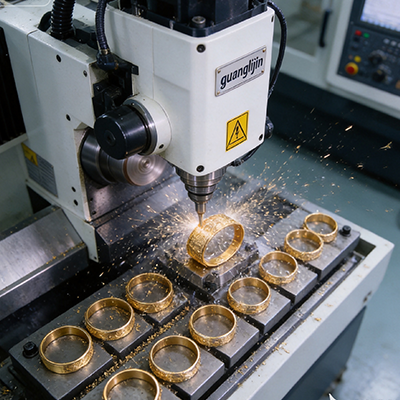
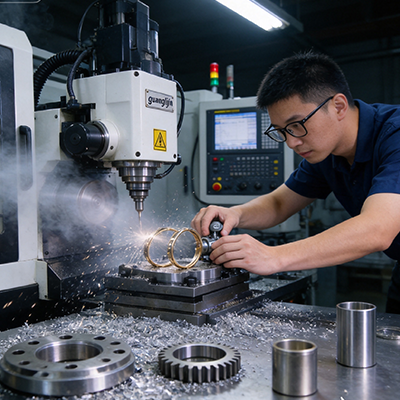
A desktop five-axis machine that holds tolerance is an engineering achievement. Small frames flex easily. Short travels leave little room for error. Heat builds fast in a compact envelope. Advanced solutions address all three problems at once. This guide covers the engineering choices that make a desktop cnc 5 axis platform reliable in precision work.
The Compact Machine Problem: Stiffness in a Small Frame
Stiffness scales with cross-section and mass. A desktop frame has less of both. The result is deflection under cutting load. That deflection shows up as chatter, dimension error, and poor surface finish.
Advanced desktop designs fight back with material choice. Granite bases offer high damping and thermal stability. Cast iron columns add mass where it counts. Polymer concrete fills hollow sections and absorbs vibration. Each choice trades cost against rigidity.
The rotary axes add another stiffness challenge. A small trunnion table must hold the part rigidly while rotating. Bearing preload and table structure decide whether the part stays put under load. Loose rotary bearings produce a rocking motion that no tool path can fix.
Therefore, the advanced desktop platform starts with structure. Frame material, rotary bearing quality, and linear guide preload set the ceiling for everything that follows.
Comparing Two Advanced Desktop Configurations: Project A vs. Project B
| Parameter | Project A: Granite, Preloaded Roller Guides | Project B: Aluminum Frame, Ball Guides |
|---|---|---|
| Frame | Granite base, cast iron column | Welded aluminum frame |
| Linear guides | Preloaded roller guides | Standard ball guides |
| Rotary axes | Preloaded angular contact bearings | Standard bearings, light preload |
| Controller | RTCP with kinematic compensation | RTCP basic, no kinematic model |
| Thermal design | Ballscrew cooling, spindle temperature sensor | No active thermal control |
| Accuracy on small aluminum part | ±0.008 mm | ±0.025 mm |
| Surface finish | Ra 0.4 µm | Ra 0.9 µm |
Project A spent more on structure and thermal control. That investment showed up in accuracy and finish. Project B saved money and delivered a machine suited to prototypes and non-critical parts. Advanced solutions are not for every buyer. They are for buyers whose parts demand the extra precision.
Kinematic Compensation in a Small Envelope
RTCP keeps the tool tip on path as the rotary axes move. On a desktop machine, the pivot distance is short. The error from missing RTCP is smaller than on a large machine, but it still matters. A 50 mm pivot distance with a 30-degree tilt shifts the tool tip by about 25 µm without compensation.
Advanced controllers add kinematic compensation on top of RTCP. The controller models the rotary head or table geometry and corrects for angular positioning error. That correction removes a source of error that basic RTCP cannot touch.
Collision checking belongs in the advanced package. A desktop envelope is tight. The spindle head and the table structure are close together. CAM simulation with the full machine model prevents crashes that a part-only check misses.
Our team tested a desktop five-axis machine in 2025 with and without kinematic compensation. The uncompensated machine showed 18 µm of error on an angled feature. Enabling kinematic compensation cut that error to 6 µm. The compensation function cost less than a single scrapped batch of precision parts.
Thermal Control on a Compact Platform
Small machines heat up fast. The spindle and ballscrews warm within an hour of continuous cutting. The light frame follows the heat quickly. Thermal drift appears sooner than on a large machine.
Advanced desktop solutions use several thermal strategies. Spindle temperature sensors feed the controller. Ballscrew cooling loops pull heat out of the screw. Frame materials with low thermal expansion reduce the effect of temperature change.
A warm-up routine is part of the thermal solution. Ten to fifteen minutes of spindle and axis cycling brings the machine to its working thermal state. Precision cuts follow the warm-up. Cutting cold parts on a cold machine invites drift mid-cycle.
Research on compact machine tools shows thermal error is a dominant part-error source when frame mass is low. Work published in Precision Engineering found that thermal compensation substantially reduced part deviation on small platforms. The desktop category benefits from the same discipline as full-size machines.
Step-by-Step: Commissioning an Advanced Desktop 5-Axis Machine
- Bolt the machine to a rigid bench. Level it after bolting. A flexible bench transfers vibration into the cut.
- Verify frame and guide preload. Check linear guide play and rotary bearing play with a dial indicator.
- Level the trunnion or verify the head. Sweep a dial indicator across the platter or test bar.
- Confirm RTCP and kinematic compensation. Run a test cut at two angles and measure the deviation.
- Map thermal drift. Cut a test part cold and again after a one-hour warm cycle.
- Apply thermal compensation. Load the coefficients and verify with a second test part.
- Test the CAM post and collision model. Machine a five-sided part and inspect it.
Tooling and Workholding for Small Five-Axis Parts
Small parts need small tools. A 3 mm end mill with 15 mm of overhang is stiff relative to its diameter. A 3 mm end mill with 30 mm of overhang is not. Keep tool overhang short. The Z-axis clearance on a desktop machine is limited, so short tooling fits naturally.
Workholding on a desktop trunnion is compact. A small vise or a fixture plate holds the part. The fixture must clear the table structure as it rotates. Check fixture clearance through the full range of tilt before cutting.
A zero-point clamping system speeds setup on repeat jobs. The fixture stays consistent between runs. That consistency reduces setup error, which is a large share of total error on small parts.
The desktop cnc 5 axis platform rewards careful tooling and workholding. The machine supplies stiffness and control. The tooling and fixture supply the rest.
Frequently Asked Questions
What makes a desktop CNC 5 axis machine “advanced” compared to a basic model?
Advanced models use granite or cast iron frames, preloaded roller guides, RTCP with kinematic compensation, and active thermal control. Basic models use aluminum frames and simpler controllers without those functions.
How accurate is an advanced desktop CNC 5 axis machine on small parts?
An advanced desktop machine with a granite base, preloaded guides, and thermal compensation holds ±0.008 mm to ±0.015 mm on small aluminum parts. The range depends on frame rigidity and thermal stability.
Why does a desktop CNC 5 axis machine need thermal compensation?
Small frames heat quickly and follow the temperature change. The spindle and ballscrews warm within an hour. Thermal compensation corrects the resulting tool tip drift so precision cuts stay on tolerance.
What is the benefit of kinematic compensation on a desktop CNC 5 axis machine?
Kinematic compensation models the rotary axis geometry and corrects angular positioning error. It removes error that basic RTCP cannot correct. Field testing showed error dropping from 18 µm to 6 µm on an angled feature.
How do I reduce chatter on a small desktop CNC 5 axis machine?
Bolt the machine to a rigid bench and level it. Keep tool overhang short. Check guideway and rotary bearing preload. Reduce servo gain if oscillation appears. Address structure before tuning the servo.
Advanced Desktop 5-Axis Solutions Checklist
- Confirm frame material: granite, cast iron, or polymer-filled sections.
- Verify linear guides are preloaded roller type or equivalent.
- Check rotary bearing preload with a dial indicator.
- Confirm RTCP and kinematic compensation are active.
- Bolt the machine to a rigid bench and level it.
- Run a warm-up cycle before precision cuts.
- Map thermal drift over a one-hour warm cycle.
- Keep tool overhang short for the part geometry.
- Check fixture clearance through the full tilt range.
- Test the CAM post and collision model on a five-sided part.