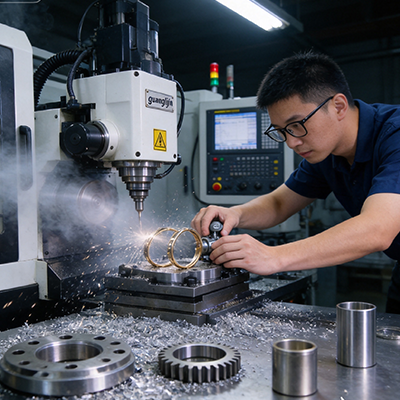
Buying a small 3-axis CNC machine is easy. Buying the right one is harder. The market is full of machines that look similar on paper. The differences sit in the frame, the spindle, the controller, and the support behind the sale. This guide covers the professional buying process for a small 3 axis cnc machine, from specification to acceptance.
The Spec Sheet Trap: Numbers Without Context
Every seller lists positioning accuracy and repeatability. Few list the test conditions. Accuracy measured in a climate-controlled room on a cold machine is not the same as accuracy on a shop floor after six hours of cutting.
Spindle power ratings have the same problem. A peak rating looks impressive. The continuous rating tells you what the spindle can do all day. For production work, the continuous rating is the number that matters.
Therefore, the professional buyer reads the spec sheet for what is missing. Test conditions, continuous ratings, and support details are the missing pieces. Ask for them before comparing prices.
Frame and Spindle: The Two Decisions That Matter Most
The frame decides rigidity. A cast iron column and base damp vibration better than a welded steel frame. Polymer concrete fills hollow sections and adds damping. A light aluminum frame rings under load.
For professional work, cast iron or polymer-filled frames are the safer choice. They cost more and hold tolerance better over time. A light frame may cut acceptable parts for a year and drift as the structure relaxes.
The spindle decides material capability. A water-cooled spindle holds torque through long cycles. An air-cooled spindle loses torque as the housing heats. For aluminum and brass production, the water-cooled spindle is the better investment.
Spindle taper matters too. An ER collet spindle handles small tools well. An ISO taper spindle handles larger tools and faster changes. Match the taper to the tooling you plan to use.
Comparing Two Buying Options: Project A vs. Project B
| Parameter | Project A: Cast Iron, Water-Cooled | Project B: Aluminum, Air-Cooled |
|---|---|---|
| Frame | Cast iron base and column | Welded aluminum frame |
| Spindle | Water-cooled, continuous 2.2 kW | Air-cooled, peak 2.2 kW |
| Controller | Industrial control with probing | Basic control, no probing |
| Accuracy on aluminum part | ±0.01 mm | ±0.03 mm |
| Torque after 4 hours | Stable | Reduced by 12% |
| Price | Higher by 25% | Lower |
| Best fit | Professional production of small parts | Hobby and light prototype work |
Project A paid more and got a machine built for production. Project B saved money and delivered a machine suited to light work. The professional buyer should know which category the shop falls into before comparing prices.
Controller Features Worth Paying For
The controller decides how fast the machine sets up and how reliably it repeats. Look for work offsets, tool length compensation, and a probing routine. These features save time on every job.
Rigid tapping is a useful feature for small parts with threaded holes. It saves a separate tapping operation. Not every small machine supports it. Check before buying if your parts need threads.
A USB or network file transfer is basic but important. A machine that requires manual data entry for every program wastes time. Confirm the file transfer method matches your workflow.
Our team helped a small shop evaluate three machines in 2025. Two had probing routines. One did not. The shop chose a machine with probing and cut setup time on repeat jobs by 40%. The probing routine paid for itself in the first month.
Step-by-Step: Buying a Small 3-Axis CNC Machine
- Define the part family. List materials, sizes, and tolerances. The part family sets the machine requirements.
- Check the frame construction. Prefer cast iron or polymer-filled frames for production work.
- Compare continuous spindle ratings. Ignore peak ratings for production. The continuous rating tells you the real capability.
- Confirm controller features. Work offsets, tool length compensation, probing, and file transfer.
- Ask for a test cut. Send a sample part or drawing. Measure the result before buying.
- Confirm support and spares. Local service, spare parts, and training hours belong in the deal.
Acceptance and First Cuts
Acceptance testing confirms the machine meets the spec. Cut a test part that includes the features your work requires. Measure it on a CMM or with precision instruments. Compare the result to the stated accuracy.
Run the machine for several hours before the final acceptance cut. Thermal drift appears over time. A machine that holds tolerance cold and drifts warm needs thermal compensation or a warm-up routine.
Record the acceptance data. The tram, backlash, and test cut results become the baseline for future maintenance. When the machine drifts later, the baseline shows how far it has moved.
Research on small machine tool performance shows that frame stiffness and thermal behavior dominate part error on compact machines. Work published on compact machining platforms supports that finding. The acceptance test should exercise both.
The small 3 axis cnc machine buying process rewards buyers who define the part family and test the machine on real work. The spec sheet is a starting point. The test cut is the proof.
Frequently Asked Questions
What should I look for when buying a small 3 axis CNC machine?
Cast iron or polymer-filled frame, water-cooled spindle with a strong continuous rating, controller with work offsets and probing, and a seller who offers a test cut on your material. Confirm local support and spare parts.
How much should I spend on a small 3 axis CNC machine for professional work?
Professional machines cost more than hobby machines. Budget for a cast iron frame, a water-cooled spindle, and an industrial controller. The price premium pays back through lower scrap and longer machine life.
Is a water-cooled spindle better than air-cooled on a small CNC machine?
A water-cooled spindle holds torque through long cycles. An air-cooled spindle loses torque as the housing heats. For production work, water-cooled is the better choice. For light prototype work, air-cooled is adequate.
What controller features matter on a small 3 axis CNC machine?
Work offsets, tool length compensation, a probing routine, rigid tapping if you cut threads, and a file transfer method that matches your workflow. These features save time on every job.
How do I test a small 3 axis CNC machine before buying?
Send a sample drawing or part. Ask the seller to cut it on the machine and measure the result. Run the machine for several hours before the test cut to check thermal drift. Record the results as your baseline.
Small 3-Axis CNC Buying Checklist
- Define the part family: materials, sizes, and tolerances.
- Confirm frame construction: cast iron, polymer-filled, or aluminum.
- Compare continuous spindle ratings, not peak ratings.
- Confirm controller features: offsets, probing, file transfer.
- Ask for a test cut on your material and measure it.
- Run the machine for several hours before the acceptance cut.
- Check thermal drift between cold and warm test parts.
- Confirm local service, spare parts, and training hours.
- Record tram, backlash, and test cut results as a baseline.
- Get the support commitment in writing before paying.