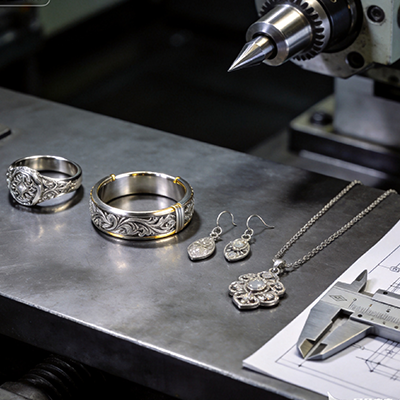
Buying a machine for aerospace work is a commitment measured in years. The part family will shift. The tolerances will tighten. The wrong platform locks a shop into a decade of workarounds. The cnc machine multi axis decision deserves the same rigor as the parts it will cut.
Why Aerospace Parts Force the Multi-Axis Question
Aerospace geometry rarely sits on one face. A structural fitting carries bores on four sides. A valve body has angled ports that intersect internal channels. A turbine component blends twisted surfaces with tight root geometry.
A 3-axis mill handles one face at a time. Each turn of the part introduces a new datum. Error stacks. A multi-axis platform rotates the part or the tool without releasing it. Datum integrity survives the whole operation.
Tooling data supports the shift. Multi-axis machining routinely achieves ±0.005 mm, and some aerospace suppliers report ±0.0005 inch on parts up to 48 inches . Those numbers require thermal control and a validated post-processor. Still, the mechanism is clear: fewer setups mean fewer error sources.
What Does a Multi-Axis Aerospace Machine Cost?
Price depends on platform type. A 5-axis machining center with a trunnion table starts around $150,000 and climbs past $400,000 with large travels and high-speed spindles. A mill-turn center with a B-axis head and twin spindles sits in the $300,000 to $700,000 bracket.
Swiss-type platforms carry their own range. Mazak’s SYNCREX 20/9 lists near $230,000 and reaches $350,000 fully equipped. The larger 38/9X starts near $300,000 and climbs toward $450,000 . Those prices exclude tooling, fixturing, CAM seats, and training.
Fictiv’s analysis notes that 9–12 axis turn-mill platforms carry a very high cost premium over 3-axis equipment. That premium is justified only when geometric necessity or volume economics demand it . Aerospace work often meets that test. General job shop work often does not.
Project Comparison: Two Buying Scenarios for Aerospace Parts
| Decision Factor | Project A: Small Aerospace Job Shop | Project B: Tier-One Aerospace Supplier |
|---|---|---|
| Part mix | Prototype brackets, simple fittings | Production housings, valve bodies, structural parts |
| Monthly volume per part | Low and variable | Medium to high, repeatable |
| Tolerance requirement | ±0.01 mm acceptable | ±0.005 mm or tighter |
| Setup count without multi-axis | 2–3 | 4–6 |
| Justification for multi-axis | Moderate — 5-axis center meets most needs | Strong — mill-turn or 9-axis platform eliminates multiple setups |
| Recommended platform | 5-axis machining center | Multi-axis mill-turn or Swiss-type |
| Budget range | $150,000–$250,000 | $300,000–$700,000 |
| Payback outlook | Uncertain without volume | 12–24 months at production volume |
Project A should not stretch for a nine-axis mill-turn. Project B should not settle for a 5-axis center if the part mix demands more. The test is whether the extra axes eliminate setups on parts the shop actually runs.
⚠ Attention: Buying Mistakes That Surface After Installation
⚠ Attention: The post-processor gets ignored during negotiation. A multi-axis machine without a validated CAM post is an expensive 3-axis machine with extra knobs. Confirm that your CAM vendor supports the specific machine model and control version. Ask for a demonstration of simultaneous multi-axis toolpath generation before signing.
⚠ Attention: Thermal stability is not on the specification sheet. Steel grows roughly 12 μm per meter per degree Celsius. Aluminum grows about 23 μm. A shop floor that swings five degrees across a shift will produce parts that drift. Verify the machine’s thermal compensation approach and measure your own floor before committing.
⚠ Attention: Axis count claims need scrutiny. A machine may count a bar feeder or sub-spindle indexer as an axis. Those axes position. They do not cut at the same time. Ask how many axes interpolate during a contouring move. That number matters more than the badge on the door.
Step-by-Step Guide: Buying a Multi-Axis CNC Machine for Aerospace
Step 1: Define the part family before looking at machines. Collect drawings for the next two years of expected work. Identify how many parts genuinely require four or more setups on a 3-axis platform. If that number is below 30% of the workload, the multi-axis premium is hard to justify.
Step 2: Request a sample cut on your most difficult part. Provide the drawing, material specification, and tolerance requirements. Require the builder or distributor to run the part on the exact model you are considering. Inspect the result with a CMM, not a caliper.
Step 3: Verify CAM support and post-processor availability. Contact your CAM provider. Ask whether a validated post exists for the machine model and control. Request a simulation demonstration with all active axes moving together.
Step 4: Audit the installation environment. Measure temperature variation on your shop floor across a full shift. Check foundation requirements and power quality. A machine rated at ±0.005 mm in a controlled lab will not hold that tolerance in an uncontrolled building.
Step 5: Negotiate training and service terms before signing. Operator training on multi-axis coordinate systems and recovery procedures is not optional. Service response time matters when a rotary axis faults during production. Get both in writing.
Frequently Asked Questions About Buying Multi-Axis CNC Machines
Q: How much does a multi-axis CNC machine cost for aerospace part production?
A: A 5-axis machining center starts around $150,000. A multi-axis mill-turn or Swiss-type platform ranges from $230,000 to $700,000 depending on size and configuration . Tooling, fixturing, CAM, and training add to the base price.
Q: How many axes should I buy for aerospace component machining?
A: Match the axes to the part print. A 5-axis center handles most contoured and angled work. A 9-axis mill-turn helps when parts combine turned and milled features with features on five or more faces. Buying more axes than the part mix requires wastes capital .
Q: Can a multi-axis CNC machine hold tight tolerances on titanium aerospace parts?
A: Yes, with thermal control and a validated post-processor. Suppliers report ±0.005 mm on difficult alloys and up to ±0.0005 inch on large parts . The qualifier is thermal control. Tolerance claims without temperature specifications should be treated with caution.
Q: What should I check before buying a used multi-axis CNC machine?
A: Check rotary axis backlash, linear scale accuracy, and spindle runout. Review maintenance records for calibration and thermal compensation service. Run a test cut on a representative part and inspect it with a CMM. A used machine without service history carries risk that the price discount may not cover.
Checklist: Multi-Axis CNC Machine Purchase Verification
☐ Part family analysis completed — at least 30% of workload requires 4+ setups without multi-axis
☐ Sample cut on your drawing inspected with independent CMM measurement
☐ Repeatability verified across three or more consecutive parts
☐ CAM post-processor validated for the specific machine model and control
☐ Shop floor temperature variation measured and documented across a full shift
☐ Thermal compensation system demonstrated and explained by the builder
☐ Operator training scope defined in writing — coordinate systems, recovery, daily checks
☐ Service response time and spare parts availability confirmed for your region
☐ Total cost calculated including tooling, fixturing, CAM seats, and training
☐ Payback model built on realistic part volumes, not best-case assumptions
The right multi-axis machine for aerospace work is the one that gets used on enough parts to pay for itself. Verify before you sign. Demand a sample cut. Check the post. Measure your floor temperature. The machine will be in your shop long after the purchase excitement fades. Precision that holds across a decade of aerospace work starts with a purchase decision made on evidence, not optimism.