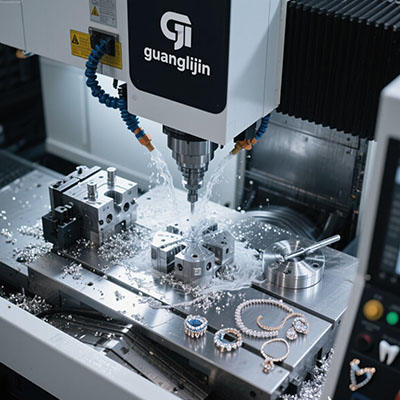
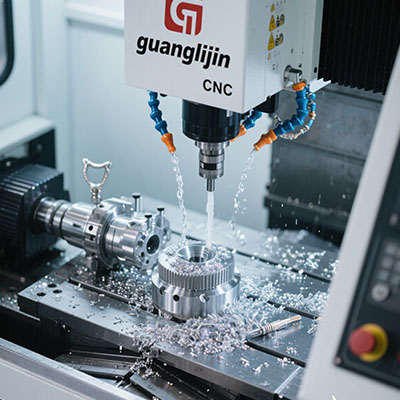
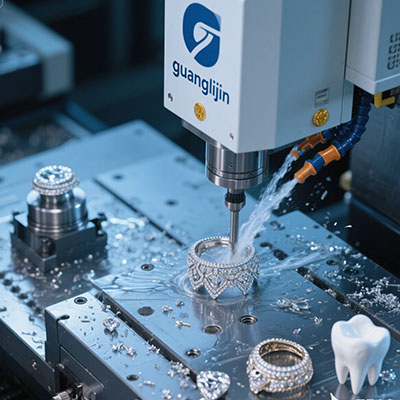
Rings, pendants, bangles. Jewelry parts are small but unforgiving. Actually, axis count is the wrong first question. Setup count is the real one.
What The Extra Axis Buys You
3-axis moves X/Y/Z. Add A-axis and the part rotates. Add B or C and the tool can tilt too. Therefore 5-axis reaches undercuts 4-axis cannot touch.
4-axis reduces setups on multi-face parts. 5-axis cuts compound angles and freeform surfaces with shorter, stiffer tools.
We team found in 2025 that a signet ring needed three clamps on 3-axis. On a 4th axis it needed one. On 5-axis the inside bezel seat needed no hand rework.
LSI Words That Sort Real Machines
Use rotary trunnion table, RTCP jewelry milling, wax master carving, micro end mill, and precious metal CNC router. Toy listings avoid these phrases on purpose.
A 4 axis vs 5 axis cnc router comparison should mention encoder type, A/C accuracy, spindle runout, not just “5D magic”.
Problem: Jewelers Buy Too Many Axes
A maker wants rings and name bars. He buys simultaneous 5-axis. Then he fights post-processor crashes for months. The shop needed indexed A, not B/C tilting.
4-axis milling typically holds ±0.01–0.05 mm on multi-face features. 5-axis reaches ±0.01–0.03 mm with better angular control, yet costs far more to program.
Jewelry micro-milling can hit ±0.005 mm on filigree and stone seats. That needs coolant, collets, and calibration—axes alone do not deliver it.
Solution: Match Geometry To Axis Count
Therefore ask: how many faces? Any undercut? Any compound angle? If the answer is “round wrap plus a few sides”, 4-axis wins on price.
Specifically, 3+2 indexing covers most jewelry pendants. Simultaneous 5-axis pays off only on organic curves, deep cavities, and true undercut bezels.
Project A vs Project B
| Factor | Project A: Wax Ring Master | Project B: Sculpted Pendant |
|---|---|---|
| Shape | cylindrical band | freeform relief, undercut |
| Best machine | 4-axis rotary router | simultaneous 5-axis mill |
| Setup count | 1 clamp, wrap cut | single setup, tilted tool |
| Programming | wrapped toolpath | RTCP, collision sim |
| Cost driver | chuck runout | post + CAM skill |
| Right buy | benchtop A-axis | jewelry 5-axis center |
However, both jobs fail with bad workholding. A $20k rotary on a flexy frame still leaves chatter. Mass, not marketing, keeps the prong sharp.
Case: The Bezel That Needed B/C
A studio cut a floral pendant. 4-axis wrapped the outer relief clean. The hidden gallery rail still needed hand filing. Tool could not tilt into the shadow.
We moved the file to a 5-axis post with RTCP. Tool length shrank 40%. Surface stepover dropped. Polish time fell from 90 minutes to 25. No new designer, just new kinematics.
Step-By-Step Axis Choice Workflow
- List features: round wrap, side faces, undercuts, compound angles.
- Count clampings a 3-axis job would need.
- If 2–4 faces only: quote indexed 4-axis first.
- If undercut or curved facade: test 3+2 first.
- If freeform deep relief: go simultaneous 5-axis.
- Check A/C accuracy in arc-seconds, not “precise”.
- Run CAM simulation before any gold touches the bit.
- Cut wax, then brass, then silver, then gold.
Each step saves money. Skipping step 2 buys the wrong machine. Specifically, axis count should follow the CAD, never the brochure.
Sub-Variant Phrases Sellers Use
“Desktop 5-axis jewelry mill”, “4+1 rotary router”, “mini A/C axis engraver”, “virtual 5-axis 4-axis kit”. Same words, different truth. Read encoder, travel, and RTCP support.
Common Myths
⚠Attention:5-axis does NOT auto-finish jewelry. Simultaneous motion adds collision risk. Bad CAM crashes a $30k spindle into a $2 collet in one second.
⚠Attention:4-axis is not “less professional”. For rings, bangles, and name bars it is the right tool. Paying for B/C you never use is the real amateur move.
Numbers That Actually Matter
Jewelry 5-axis decks list A/C accuracy near 0.01° and spindle runout near 1 micron on lab units. Production benches live near ±0.005 mm positioning.
Therefore ignore “high precision” prose. Ask for positioning, repeatability, runout, and thermal warm-up drift. Four numbers beat ten adjectives.
Tooling Math For Small Parts
- Wax: 50k–70k rpm, 0.2–0.3 mm ball nose.
- Brass: 9k–15k rpm, tapered carbide.
- Silver: mist coolant, low radial depth.
- Gold: 0.1 mm stepover, never dry.
- Platinum: coated carbide, slow feed, patience.
First-Person Studio Story
We team in 2025 tuned a bridal set. 4-axis wrapped the bands perfectly. The basket setting still needed a tilted tool. We enabled B-axis only for that feature.
Hybrid workflow cut machine cost 35% versus full 5-axis bidding. Output looked identical to the client. The bench kept both rotaries and one tilt head.
When 4-Axis Is Enough
Rings, bangles, cuff links, round fobs. Wrapped text, flutes, knurling, signet crests. Truly, most jewelry studios live here and never miss B/C.
Therefore buy 4-axis first. Learn wrapped CAM, collet TIR, tailstock sweep. Move to 5-axis only when undercuts start costing polish labour.
Jewelry Axis Choice Checklist
- ☐ Feature map: faces, wraps, undercuts listed
- ☐ 3-axis clamp count calculated
- ☐ A-axis accuracy in arc-seconds
- ☐ C-axis or B-axis truly required?
- ☐ RTCP supported by controller + post
- ☐ Spindle runout <0.005 mm for metal
- ☐ Collet set ER-8 / ER-11 / ER-16
- ☐ CAM collision sim passed
- ☐ Wax proof before brass
- ☐ Silver proof before gold/platinum
FAQ: High-Search 4 Axis Vs 5 Axis CNC Router Questions
1. 4 axis vs 5 axis cnc router for jewelry rings: which is better?
Rings are cylindrical. A 4-axis rotary wraps the band in one clamp. Long-tail: “4 axis cnc router ring wrapping vs 5 axis jewelry mill”. Buy 5-axis only for undercut bezels.
2. Do I need 5 axis CNC router for wax jewelry masters?
Wax rings and bangles: no. Wax pendants with gallery rails: maybe. Search: “5 axis cnc router wax master pendant undercut milling”. Start 4-axis, upgrade post later.
3. Is 4 axis cheaper than 5 axis for small jewelry batches?
Yes. 4-axis has lower machine, CAM, and training cost. Related: “4 axis vs 5 axis cnc router jewelry cost per piece”. 5-axis wins only when setups collapse on complex geometry.
4. What tolerance can jewelry 4 axis and 5 axis CNC hold?
4-axis: ±0.01–0.05 mm. 5-axis: ±0.01–0.03 mm with RTCP. Users search “jewelry cnc router 4 axis 5 axis tolerance comparison”. Collet runout often limits the result.
5. Can a 4 axis cnc router cut gold and platinum?
Yes, with mist coolant, ER collets, and micro tools. Long-tail: “4 axis cnc router gold ring milling setup”. Platinum needs slower feed and coated carbide, not extra axes.