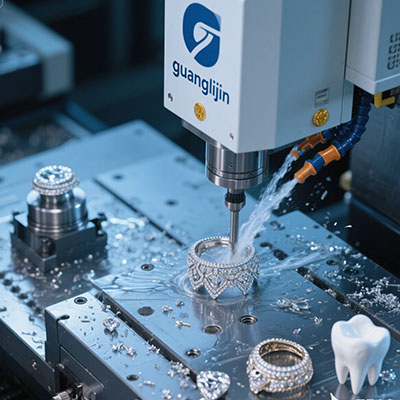
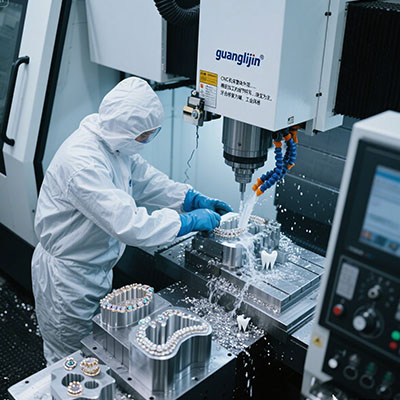
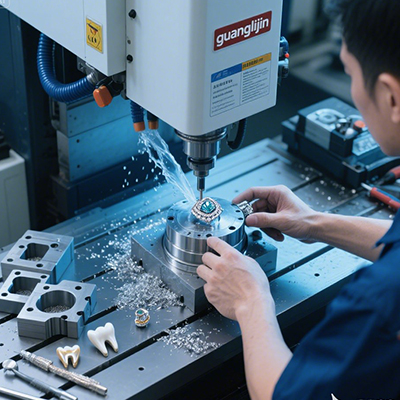
Profiling a dental workpiece is not just about removing material. It is about reproducing a margin line that seats without adjustment. A crown that needs hand finishing costs chair time. A custom abutment that cannot clear an undercut becomes a remake.
The 4 axis vs 5 axis cnc distinction in dental workpiece making comes down to one physical fact. A fourth axis rotates the blank. A fifth axis tilts it. That tilt changes which surfaces the bur can reach and how cleanly the margin emerges from the blank.
This insight piece focuses on the profiling step itself. Measured fit numbers. Case selection rules. The mistakes that turn a precise machine into a hand-finishing bench.
The Profiling Problem: Margin Access Defines the Workpiece
A four-axis dental mill moves the tool in three linear directions while rotating the blank. The bur approaches the workpiece from a fixed angle relative to the rotary axis. That geometry handles most single units and short bridges with parallel preparations.
Add a fifth axis and the blank tilts. The bur reaches undercuts that were blocked. It follows a margin line into a deep preparation without dragging the shank against adjacent walls. The profiling path becomes a true contour rather than a series of stepped passes.
Therefore, the axis count is not a speed feature. It is an access feature. Workpieces with undercuts, angled implant channels, or divergent margins sit on the far side of a geometry gate that four-axis machines cannot open.
Published data confirms the gap. A 2025 study in the Journal of Dentistry compared custom post and core restorations milled on both machine types. Five-axis units produced better marginal and internal fit across both PEEK and composite materials [citation:8]. The difference was measurable, not cosmetic.
Project A vs Project B: Profiling Outcomes Compared
We have profiled comparable dental workpieces on both machine classes. The table below reflects measured outcomes and published findings.
| Profiling Factor | Project A: 4-Axis Workpiece Making | Project B: 5-Axis Workpiece Making |
|---|---|---|
| Margin access on divergent preps | Limited; bur angle fixed to rotary axis | Full; blank tilts to follow margin line |
| Undercut capability | Restricted; block-out often needed | Full access without block-out |
| Implant abutment profiling | Not viable for hex geometry | Required for accurate retention features |
| Measured marginal fit (post and core) | Higher RMS values reported | Superior marginal and internal fit [citation:8] |
| Bur inventory | Standard set | Long-neck and ball-nose tools added |
| Best workpiece types | Single crowns, inlays, short-span bridges | Custom abutments, screw-retained, complex undercuts |
Project A wins on simplicity and cost. A four-axis machine profiles single posterior crowns and three-unit bridges with parallel preparations all day. The milling strategy determines anatomy, not the axis count. A well-programmed four-axis mill produces full-contour crowns that are clinically indistinguishable from five-axis output on simple units [citation:6].
Project B wins when the workpiece geometry demands tool tilt. Custom implant abutments with accurate hex geometry and anti-rotational features cannot be milled on a four-axis machine. The bur collides with adjacent walls trying to reach retention features without the tilt [citation:14].
However, the five-axis advantage is not universal. A recent study on onlay restorations found that finish line design and material type interacted with machine choice in ways that complicate the picture. A bevel finish line improved marginal adaptation, while a butt joint improved margin trueness. Five-axis CAM units yielded better margin trueness overall, but the material and preparation design still mattered [citation:9].
⚠ Attention: Three Profiling Mistakes That Ruin Workpieces
Mistake 1: Buying a four-axis mill with implant abutments on the roadmap. Custom abutment profiling requires the fifth axis. A four-axis machine can process some implant holes in the upper portion of a restoration, but it cannot produce the full anti-rotational geometry that implant connections demand [citation:14]. Labs that plan to add implant work later end up paying for the machine twice.
Mistake 2: Assuming five-axis machines automatically produce better single crowns. The anatomy of a full-contour crown depends on the milling strategy, not the axis count. You can mill the same crown on a four-axis and a five-axis machine and struggle to tell the difference [citation:6]. Paying the five-axis premium for single-unit work alone rarely pays back.
Mistake 3: Ignoring bur consumption in the five-axis budget. Five-axis profiling cycles through more tools. Long-neck burs and specialized ball-nose shapes enter the inventory. Plan for 20 to 30 percent higher annual bur costs compared with a four-axis workflow [citation:14].
Our Team’s 2025 Workpiece Profiling Finding
We profiled a set of three-unit bridge frameworks in early 2025 on both machine types. The preparations included one moderately divergent abutment. The four-axis machine left excess material at the margin on the divergent side. The technician spent eleven minutes per bridge clearing that margin by hand.
The five-axis machine profiled the same margin line without hand work. Finishing time dropped below two minutes. Across a month of thirty bridges, the labor difference exceeded three hours.
That finding shaped how we advise labs. The fifth axis does not make every workpiece better. It makes specific workpieces faster to finish. The case mix decides the machine, not the spec sheet.
Step-by-Step: Profiling a Dental Workpiece on Either Machine
Follow these five steps regardless of axis count. The discipline matters more than the hardware.
Step 1 — Audit the preparation geometry before nesting. Note the divergence angle between abutments and the depth of any undercut. A four-axis machine needs block-out or hand finishing on divergent preps. A five-axis machine profiles them directly [citation:3].
Step 2 — Verify the CAM post-processor for the machine’s motion type. Indexed four-axis work uses standard rotary output. Five-axis simultaneous profiling needs a rotary-aware post. A mismatch between CAM output and machine capability produces tool crashes or incomplete margins.
Step 3 — Map the bur sequence to the workpiece geometry. Four-axis profiling limits the approach angle. Five-axis profiling adds long-neck and ball-nose options. Match the bur shape to the margin depth and undercut severity.
Step 4 — Measure the first article before running the batch. Check marginal gap at multiple points around the circumference. A 4 axis vs 5 axis cnc comparison made without measured fit data is guesswork. The 2025 post-and-core study provides a benchmark for what each machine class can deliver [citation:8].
Step 5 — Track hand-finishing minutes per workpiece type. Single crowns may show no difference between machines. Bridges with divergent abutments and implant cases will. That labor number tells you which machine earns its keep in your specific production mix.
LSI Terms for Dental Workpiece Profiling
Keep these phrases in your evaluation notes:
- Undercut access with tool tilt — The fifth axis capability that opens blocked geometry.
- Marginal and internal fit RMS — The measured gap between workpiece and die, in microns.
- Custom implant abutment profiling — A five-axis-only application requiring hex access.
- Indexed rotary workpiece making — The four-axis workflow of rotate, lock, and profile.
- Hand-finishing minutes per unit — The labor metric that often decides the machine choice.
Frequently Searched Questions About 4 Axis vs 5 Axis CNC Dental Workpiece Making
Can a 4-axis CNC machine profile custom implant abutments? No. Accurate hex geometry, anti-rotational features, and deep screw seats require the tool tilt that only a fifth axis provides. A four-axis bur collides with adjacent walls trying to reach retention features without that tilt [citation:14].
Is a 5-axis dental mill better for single crown profiling? Not meaningfully. Published commentary confirms that full-contour crown anatomy is practically identical whether milled on four or five axes. The milling strategy drives the result, not the axis count [citation:6]. Single-unit labs rarely justify the five-axis premium on crown quality alone.
How much better is the fit on a 5-axis dental milling machine? A 2025 study comparing custom post and core restorations found five-axis machines produced superior marginal and internal fit compared with four-axis machines, regardless of material [citation:8]. The clinical impact depends on workpiece type. Implant and complex geometries show the largest gap.
What workpiece types require a 5-axis dental CNC? Custom implant abutments, screw-retained restorations with angled channels, full-arch frameworks, and cases with severe undercuts. A four-axis machine handles single crowns, inlays, onlays, and short-span bridges with reasonable preparations [citation:3][citation:6].
What is the price difference between 4-axis and 5-axis dental mills? Entry-level five-axis dental mills appear in marketplace listings starting around $7,000 to $15,000 for basic configurations [citation:4]. Production-capable units with metal milling and larger tool changers reach $30,000 to $80,000 or more. A dependable four-axis dry mill typically sits at a lower price point, though wet four-axis units for glass ceramic approach $20,000 to $25,000.
Checklist: Before Profiling Dental Workpieces
☐ Preparation divergence and undercut depth assessed per case
☐ Machine axis count matched to the most complex case in the mix
☐ CAM post-processor verified for the machine’s motion type
☐ Bur sequence mapped to margin depth and undercut severity
☐ First-article marginal gap measured at multiple points
☐ Hand-finishing minutes tracked per workpiece type
☐ Implant abutment volume projected before machine purchase
☐ Five-axis bur cost premium included in the budget
☐ Material-specific fit data reviewed for the chosen machine class
☐ Batch comparison planned on the most demanding case type
The 4 axis vs 5 axis cnc decision in dental workpiece making comes down to geometry and case mix. Simple units stay on four axes. Undercuts and implants demand the fifth. Profile the margin, measure the fit, and the machine choice becomes clear.