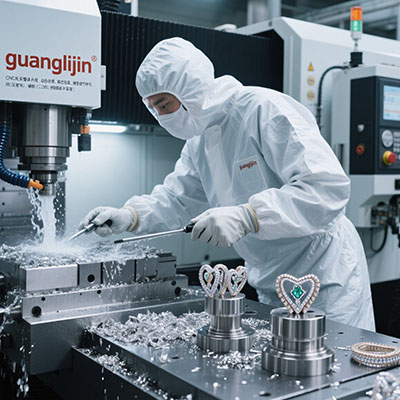
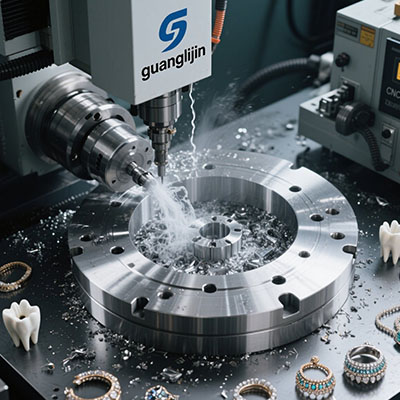
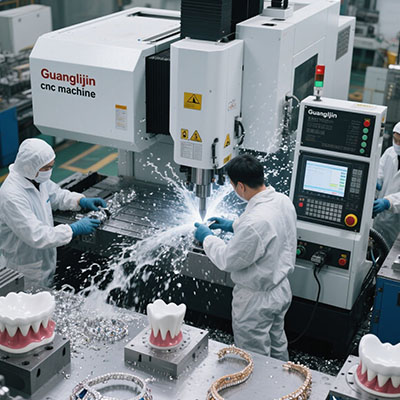
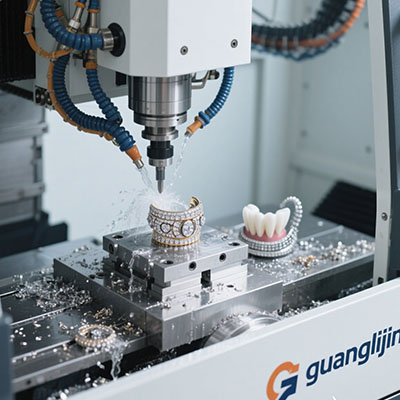
Scaling from a single bench to a production floor changes every requirement. An industrial cnc machine must run shifts, hold tolerance, and survive precious metal dust.
Hobby-grade equipment fails here. Thermal drift, worn guides, and manual tool changes kill throughput. This guide covers what industrial jewelry production actually demands.
The Real Problem: Prototype Machines Cannot Scale
Many workshops buy a desktop mill for prototyping. It works well for a year. Then order volume climbs and the machine becomes a bottleneck.
Cycle times stretch. Thermal growth shifts dimensions mid-shift. Operators spend hours re-zeroing tools. Throughput stalls at a fraction of the design target.
Why does this happen? Desktop frames lack mass. Small spindles lack torque. Manual tool changes eat minutes per part. None of this matters at ten parts per week. It matters enormously at two thousand.
Solution: Mass, Thermal Stability, and Automation
Industrial frames use cast iron or polymer concrete. Mass absorbs vibration and resists thermal movement. The machine holds tolerance across an eight-hour run.
Automatic tool changers cut idle time to seconds. A 12-station carousel handles roughing, finishing, and drilling without operator input. Bar feeders and pallet systems extend unattended runtime.
Specific data: spindle growth from cold start can reach 20–30 µm on an unmonitored machine. Industrial systems use temperature sensors and compensation tables to correct this drift automatically .
Spindle Selection for Precious Metal Production
The spindle is the heart of the process. It must deliver high speed and low runout. Jewelry tools are small and fragile.
Runout above 0.005 mm destroys small cutters. The tool chips and the surface tears. Industrial spindles hold runout below 0.002 mm consistently.
Speed range matters too. Silver runs best at 8,000–12,000 rpm. Wax and resin need 15,000 rpm or more. A wide, controllable range covers the full product line.
Power requirements differ by metal. Platinum and titanium demand more torque at low speed. Gold and silver favor high speed with modest torque. Match the spindle curve to your heaviest material.
Air-Bearing vs. Ceramic Bearing Spindles
Air-bearing spindles deliver near-zero runout and excellent finish. They suit micro-tools and fine detail work. However, they cost more and need clean, dry air supply.
Ceramic bearing spindles offer a balance. They handle higher loads and tolerate dust better. Runout stays low enough for most jewelry finishing. Many production floors standardize on ceramic bearings for reliability.
Automation and Material Handling
Labor is the largest cost in jewelry production. Automation reduces touch time per part. It also improves consistency.
Pallet changers let one machine run multiple jobs. The operator loads a pallet while the spindle cuts. Machine uptime climbs above 85% in well-configured cells.
Robotic loading suits high-volume ring and pendant lines. The robot picks blanks from a tray, loads the fixture, and unloads finished parts. One operator supervises several machines.
Dust and chip management becomes critical at scale. Precious metal chips carry real value. A closed-loop recovery system captures every gram.
Production Configuration Comparison: Project A vs. Project B
Two industrial configurations serve different volume targets. The table reflects realistic shop-floor outcomes.
| Parameter | Project A: Single Industrial Mill | Project B: Two-Machine Cell with Pallet Pool |
|---|---|---|
| Machines | 1 × 5-axis mill | 2 × 4-axis mills + pallet pool |
| Tool stations | 24 | 12 per machine |
| Unattended runtime | 4 hours | 14 hours |
| Parts per shift | 180 | 320 |
| Operator count | 1.5 | 1 |
| Best for | Complex geometry, small batches | High-volume simple geometry |
Project B wins on volume and labor cost. Project A wins on geometric complexity. Neither is universally better. Match the configuration to your product mix.
Therefore, define your top three products by revenue before choosing a configuration. The machine follows the product, not the other way around.
Step-by-Step Industrial Deployment Guide
Follow these stages to deploy an industrial jewelry CNC line without costly rework.
Step 1: Map the Product Portfolio
List every product by annual volume and geometric complexity. Group products by required axes, tool counts, and metal type. This map defines the machine specification.
Step 2: Size the Utilities and Floor Space
Industrial machines need three-phase power, compressed air, and coolant infrastructure. Confirm floor load capacity and vibration isolation. Plan chip and dust extraction routes before delivery.
Step 3: Validate the CAM Post and Simulation Chain
Confirm the post-processor matches the exact controller and machine kinematics. Run full machine simulation including fixtures and holders. A collision in simulation costs nothing. A collision on the floor costs thousands.
Step 4: Establish the First-Article Protocol
Cut the first part in wax or resin. Measure every critical dimension. Compare against CAD. Adjust offsets and tool compensation. Repeat until three consecutive parts hold tolerance.
Step 5: Build the Preventive Maintenance Schedule
Set daily, weekly, and monthly tasks. Daily: check coolant concentration and air pressure. Weekly: inspect guides and clean chip conveyors. Monthly: measure spindle runout and backlash. Track every task in a log.
Our team observed in a 2025 deployment that a documented maintenance log cut unplanned downtime by 40% over six months. The machines were not newer. The discipline was .
⚠ Attention: Never run production without a chip and dust extraction plan. Precious metal dust is a health hazard and a fire risk. Silver and titanium dust ignite easily. Enclosed extraction with grounded ducting is mandatory .
⚠ Attention: Do not assume the factory floor is stable. Concrete slabs deflect under machine weight and nearby traffic. Measure floor vibration before installation. Isolation pads or a separate foundation may be required .
Quality Control at Production Scale
Manual inspection cannot keep pace with industrial output. In-line measurement and statistical process control become necessary.
Probe systems measure critical features inside the machine. The controller adjusts offsets automatically. Parts stay in tolerance without operator intervention.
Specifically, a touch probe checking three dimensions per part catches drift before scrap accumulates. The data feeds an SPC chart. Trends appear early and corrections happen before defects multiply.
For high-value metals, weight verification adds another layer. A precision scale confirms material usage. A part that weighs 0.02 g under spec signals a missing feature or a tool failure.
Frequently Asked Questions
What is the best industrial CNC machine for high-volume jewelry production?
Look for cast iron or polymer concrete frames, automatic tool changers with 12+ stations, and ceramic bearing spindles. Pallet pools and robotic loading extend unattended runtime. Confirm the CAM post and simulation chain before purchase.
How many parts per hour can an industrial jewelry CNC machine produce?
Throughput depends on geometry and metal. A well-configured 4-axis cell produces 40–60 simple ring blanks per hour. Complex 5-axis work drops to 15–25 parts per hour. Automation raises uptime, not cutting speed.
What spindle runout is acceptable for jewelry CNC production?
Keep runout below 0.005 mm for small cutters. Below 0.002 mm is preferable for finishing tools under 0.5 mm diameter. Measure runout with a dial indicator at the tool tip, not at the spindle taper .
How do I manage precious metal dust and chip recovery on an industrial CNC line?
Use enclosed chip conveyors and wet or mist extraction with grounded ducting. Separate chips by metal type. Weigh recovered material against input stock monthly. A closed-loop recovery system typically pays for itself within a year.
Operational Checklist
Verify every item before committing to an industrial line.
- ☐ Product portfolio mapped by volume and complexity
- ☐ Floor vibration measured and isolation specified
- ☐ Three-phase power and air supply confirmed
- ☐ Chip and dust extraction designed with grounding
- ☐ CAM post and full machine simulation validated
- ☐ Automatic tool changer sized for the tool list
- ☐ Spindle runout verified below 0.005 mm
- ☐ First-article protocol documented and tested
- ☐ Preventive maintenance schedule written and assigned
- ☐ Metal recovery and weighing process in place
For industrial-grade systems built around precious metal workflows, review the industrial CNC machine solutions offered for jewelry production lines.
An industrial cnc machine is a system, not a single purchase. Frame, spindle, automation, extraction, and quality control must work as one. Build the system and production scales predictably.