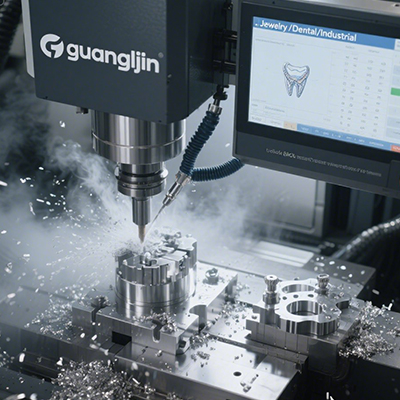
A rotary table is the heart of any five-axis milling setup. The machine frame matters, sure. The spindle matters. But the table decides whether the tool reaches the part at the right angle, every single time. A precision 5 axis CNC rotary table turns a three-axis mill into a multi-face machining center. The wrong one turns it into a scrap generator.
What Precision Really Means on a Rotary Table
Precision is not a marketing word. It is a number, measured in arc-seconds. A typical five-axis table holds indexing accuracy around ±15 to ±30 arc-seconds and repeatability near 4 to 6 arc-seconds [citation:9][citation:13]. Those numbers sound tiny. They are not.
At a 200 mm radius, 15 arc-seconds of error translates to roughly 0.015 mm of positional deviation. Double the radius, double the error. For mold work and aerospace brackets, that gap between pass and fail is razor thin.
Therefore, buyers must look past the “5-axis” label. Ask for the accuracy specification sheet. Compare indexing accuracy and repeatability across every model on the shortlist. A table that repeats to 4 arc-seconds will produce consistent parts. A table that drifts to 30 arc-seconds will fight you all day.
Project A vs. Project B: Two Rotary Table Choices, Two Outcomes
Two shops added five-axis capability to existing vertical mills. Their table selections diverged on drive type. The results after six months tell the story.
| Factor | Project A: Worm Gear Table | Project B: Roller Cam Table |
|---|---|---|
| Drive mechanism | Worm and worm gear | Roller gear cam |
| Backlash | Adjustable, wears over time | Near-zero, maintained by preload |
| Indexing accuracy | ±30 arc-sec typical | ±15 arc-sec or better |
| Repeatability | 6–8 arc-sec | 4 arc-sec or better [citation:13] |
| Best application | General multi-face work, moderate tolerances | Complex contours, tight-tolerance production |
| Maintenance demand | Periodic backlash adjustment | Minimal, sealed lubrication |
| Six-month scrap rate | 5% on ±0.02 mm work | 1.5% on the same work |
Worm gear tables dominate the market for good reason. They are mature, affordable, and handle most general machining [citation:12]. However, their backlash grows with wear. Roller cam tables cost more upfront. They hold accuracy longer. For shops running tight-tolerance production, the math favors the cam drive.
Direct-drive tables represent a third path. They offer the highest speed and accuracy but lower rigidity. They suit light cutting in aluminum and electronics, not heavy steel removal [citation:12]. Match the drive to the work, not the brochure.
How to Select and Install a 5-Axis Rotary Table: Step by Step
The table is a bolt-on component. Installation quality determines whether it performs. Follow this sequence.
Step 1: Verify Faceplate Diameter Against Your Parts
Workpiece diameter must fit within the table’s faceplate. A Ø200 mm part on a Ø160 mm table hangs off the edge. Centrifugal force and cutting loads then work against the clamp. Measure your largest part. Add fixture width. Select a table at least one size larger [citation:3].
Step 2: Calculate the Eccentric Load Moment
Table load capacity is not a single number. A 75 kg rating at 0° drops to 50 kg at 90° on some models [citation:9]. The moment created by an offset workpiece stresses the tilt axis brake. Ask for the load capacity at your actual tilt angles. Verify the brake torque exceeds the load moment by at least 30%.
Step 3: Confirm the Control Supports TCPC or DWO
Tool Center Point Control keeps the tool tip on path as the table rotates. Dynamic Work Offsets let you mount the part anywhere without reposting. Without these functions, five-axis programming becomes a manual trigonometry exercise. The Haas NGC control offers DWO/TCPC as an option [citation:8]. Confirm your control has it before buying the table.
Step 4: Level the A-Axis Before Recording Any Offsets
A dial indicator swept across the platter in Y confirms A-axis levelness. If the axis is off, every offset recorded afterward inherits the error. Haas documentation states that five-axis setups consume 5–10% of part tolerance in the setup alone [citation:7]. A tilted A-axis eats that budget before the first cut.
Step 5: Find the Pivot Distance and Store It
The pivot point is the intersection of the tilt and rotary axes. Its distance from the table face must be measured and stored in the control. CAM software uses this value to post correct rotational moves. A wrong pivot distance produces toolpaths that look right on screen and cut wrong on the part [citation:7].
⚠ Attention: Rotary Table Traps That Catch Careful Buyers
⚠ Buying a table without checking machine compatibility. A five-axis table needs drive amplifiers, servo motors, and control software already installed or available. A bargain table that requires a control upgrade is not a bargain. Confirm the machine supports the additional axes before purchase.
⚠ Ignoring fixture clearance at full tilt. A fixture perfect for three-axis work may collide with the spindle at 90° tilt. Lower-profile fixtures maximize usable tilt range. Mounting directly to the platter gives maximum rigidity. Adding a fixture plate raises part height and cuts clearance [citation:2].
⚠ Assuming a locked axis stays locked. The tilt axis brake holds the part against gravity and cutting force. A worn or undersized brake allows creep during heavy cuts. Test a heavy interrupted cut under power. Watch the axis position display for movement.
⚠ Skipping the warm-up on tight-tolerance work. Rotary tables generate heat in the drive and brake. Thermal growth moves the pivot point. A twenty-minute spindle and axis warm-up stabilizes the geometry. Shops that skip it chase offsets all morning [citation:6].
Real Numbers: What a Precision Rotary Table Adds to the Budget
Our team reviewed five-axis rotary table pricing and performance data through 2025 and early 2026. Entry-level tilting rotary tables from established brands started around $40,000 [citation:10]. Dual-axis trunnion models with higher rigidity and load capacity started near $47,000 [citation:14]. Premium roller cam and direct-drive tables from Japanese and European builders climbed well past $80,000 depending on size and accuracy grade.
One finding stood out. Shops that matched the drive type to their actual cutting loads reported 40% fewer accuracy-related rework events in the first year. Shops that bought on price alone often discovered within months that the table could not hold tolerance under production loads. The retrofit cost more than the original upgrade.
For buyers comparing options, the 5 axis CNC rotary table market rewards specification diligence. Request accuracy certificates. Ask for a test cut on a coupon that mirrors your hardest feature. Precision is measurable before you sign.
Frequently Asked Questions
What is the difference between a 4th axis and a 5 axis CNC rotary table?
A fourth-axis table adds one rotational axis for indexed or continuous rotation. A five-axis table adds tilt and rotation together, enabling compound angle positioning and simultaneous contouring. Five-axis tables support 3+2 machining and full simultaneous motion [citation:2].
How much does a precision 5 axis CNC rotary table cost?
Entry-level tilting tables start around $40,000. Dual-axis trunnions with higher capacity start near $47,000. Premium roller cam and direct-drive models with tighter accuracy exceed $80,000. Total cost includes servo drives, control options, and installation labor.
What accuracy should I expect from a 5-axis rotary table?
Standard tables hold indexing accuracy of ±15 to ±30 arc-seconds and repeatability of 4 to 6 arc-seconds [citation:9][citation:13]. High-precision options improve on these figures. Verify the specification sheet includes both indexing and repeatability values.
Can I add a 5-axis rotary table to my existing 3-axis mill?
Yes, if the mill’s control supports additional axes and the machine has mounting provisions. Haas mills with the NGC control and fourth/fifth-axis drive option accept plug-and-play rotary tables [citation:8]. Other brands vary. Confirm control compatibility before purchasing.
Rotary Table Milling Solution Checklist
☐ Faceplate diameter exceeds largest workpiece plus fixture width
☐ Load capacity verified at actual tilt angles (not just 0°)
☐ Brake torque exceeds eccentric load moment by 30%
☐ Control supports TCPC or DWO for simplified programming
☐ A-axis levelness confirmed with dial indicator before offsets
☐ Pivot distance measured and stored in control
☐ Fixture clearance checked at full tilt range
☐ Heavy test cut performed under power with position monitoring
☐ Warm-up cycle documented for tight-tolerance work
☐ Accuracy certificate and repeatability data on file