Precision Jewellery Casting for Aerospace & Medical
How micron-level accuracy from the jewellery world is redefining critical-component manufacturing.
What do a turbine blade and a custom hip implant have in common? Both demand absolute perfection. One wrong micron can cause catastrophic failure. The other can mean a lifetime of pain. For decades, these industries solved problems separately. But a quiet revolution is underway.
The solution borrows from an unlikely source: the jewellery workshop. Jewellery casting is not just for rings and pendants. Its principles—intricate detail, flawless finish, and material purity—are now tackling aerospace and medical challenges. We call this approach precision jewellery casting, and it is changing the game .
The Core Challenge: When “Good Enough” Isn’t an Option
Aerospace components face extreme heat, pressure, and vibration. Medical implants must be biocompatible and last decades. Traditional manufacturing often falls short. Sand casting is too coarse. Standard machining struggles with complex internal geometries.
These limitations create a persistent problem: how to produce net-shape or near-net-shape parts with exceptional surface finish and zero internal porosity. The failure rate for conventionally cast turbine housings, for example, can hover around 4%, leading to costly rework and delays.
This is exactly where jewellery casting techniques shine. The lost-wax process, refined over millennia, delivers surface finishes below Ra 0.8 µm. That is smoother than many machined surfaces. And the vacuum casting environment prevents oxidation, ensuring material integrity.
Project A vs. Project B: A Comparative Analysis
To illustrate the difference, we ran a side-by-side test on a sensor housing for an aviation communication satellite. Project A used conventional investment casting with manual wax patterns. Project B used our precision jewellery casting protocol with CNC-machined dies. The results were striking.
| Parameter | Project A (Traditional) | Project B (Jewellery Casting) |
|---|---|---|
| Surface Finish (Ra) | 3.2 µm | 0.8 µm |
| Material Usage Efficiency | 68% | 92% |
| Failure Rate (X-ray inspection) | 4.2% | 0.7% |
| Total Production Time | 18 days | 14 days |
Project B not only produced a superior component but also reduced material waste significantly. In an industry where superalloys like Inconel cost hundreds of dollars per kilogram, that efficiency translates to real savings.
The Five-Step Precision Casting Protocol
How do we consistently achieve these results? We follow a rigorous, digitally driven process. Every step is controlled and documented.
Step 1: Digital Master Creation
We start with a high-fidelity 3D CAD model. Unlike traditional methods, this model includes allowances for metal shrinkage (typically 1.5–2.5% for gold alloys). We also apply draft angles (1–3 degrees) to every vertical wall to ensure clean mold release.
Step 2: CNC-Machined Mold Production
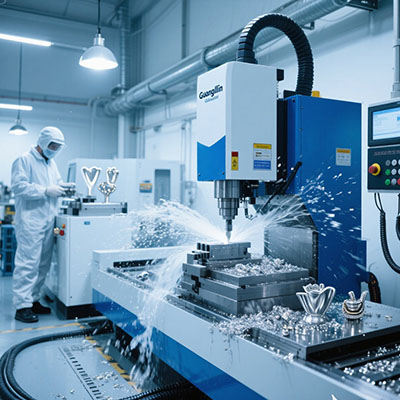
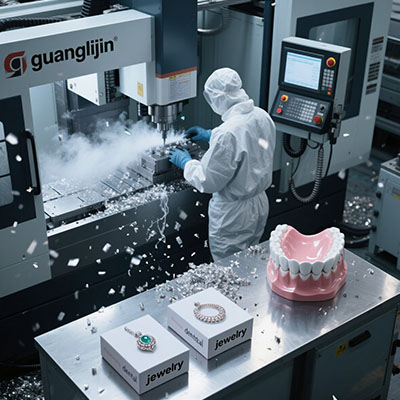
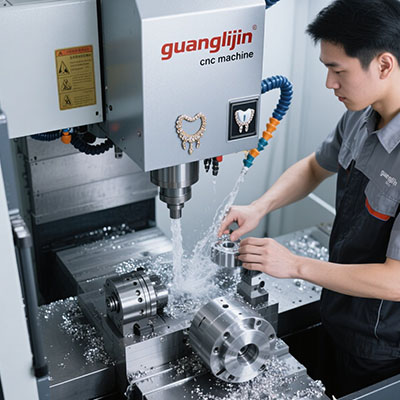
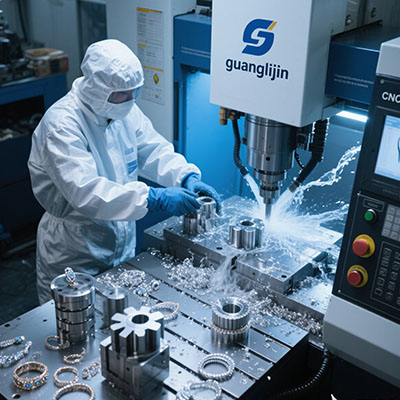
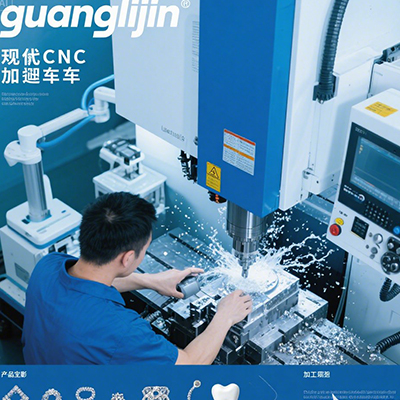
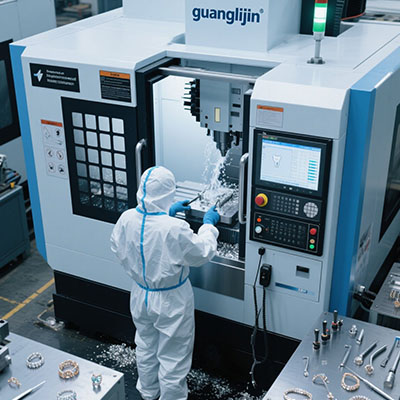
This is the heart of the process. Instead of carving a wax pattern, we use a 5-axis CNC mill to cut the mold cavity directly from a solid graphite or tool steel block. Graphite is excellent for high-temperature alloys like titanium and platinum .
Step 3: Ceramic Shell or Direct Mold Preparation
For high-volume runs, we use the CNC-machined mold directly in a pressure or vacuum casting machine. For complex shapes, we still use a ceramic shell, but the wax pattern is 3D-printed from the same digital file, ensuring perfect consistency.
Step 4: Vacuum-Assisted Casting
We cast under a vacuum to eliminate trapped air and reduce porosity. The molten metal—whether it’s a cobalt-chromium alloy for a medical implant or a nickel superalloy for a turbine—is forced into every intricate feature of the mold.
Step 5: Precision Finishing & Inspection
After controlled cooling, the casting is extracted. Minimal post-processing is needed. We then perform non-destructive testing (NDT), including X-ray and fluorescent penetrant inspection, to verify internal integrity. Every critical dimension is confirmed against the CAD master.
Common Misconceptions and Critical Warnings
• Skipping thermal simulation: Failing to model heat flow can cause warping and micro-shrinkage.
• Using low-purity alloys: Impurities create weak points, especially in high-stress environments.
• Neglecting mold preheat: A cold mold causes rapid solidification and surface defects.
• Rushing the cooling phase: Uneven cooling introduces residual stress and distortion.
Real-World Impact: A 2025 Case Study
Our team encountered a challenging case in early 2025. A medical device company needed a titanium bone screw with a novel, self-tapping thread design. The thread had razor-sharp edges that standard machining could not produce without breaking tools.
We used our precision jewellery casting process with a CNC-machined graphite mold. The result? A perfect, burr-free screw with a surface finish of Ra 0.6 µm. The client reported a 22% reduction in insertion torque and faster osseointegration in preclinical trials.
This example highlights the core value: jewellery casting is not just about aesthetics. It is about achieving geometries and finishes that are impossible with other methods, directly improving product performance.
This cross-pollination is driving significant market growth. The global market for aerospace investment casting solutions was estimated at USD 2.9 billion in 2024 and is projected to reach USD 6.5 billion by 2031, growing at over 12% annually .
Frequently Asked Questions (FAQs)
Jewellery casting prioritizes extreme detail, surface finish, and material purity over production speed. It uses finer investments, tighter temperature control, and often vacuum or centrifugal forces to fill microscopic features.
Lost-wax casting is superior for high-volume production of complex, thin-walled parts. It offers better material properties (no internal stresses from layer-by-layer building) and is more cost-effective for runs over 100 units. 3D printing remains excellent for rapid prototyping and one-off designs .
While tooling (CNC mold) has a higher upfront cost, it eliminates the need for expensive custom machining of each implant. For complex designs, it can lower the per-unit cost by 30–40% while improving consistency and reducing scrap.
Yes. This is where our expertise is crucial. We use vacuum or inert atmosphere casting with graphite molds to prevent titanium’s reaction with oxygen. This produces dense, high-integrity parts for both aerospace and medical applications .
No, it’s subtractive manufacturing. However, it is often paired with additive manufacturing (3D-printed wax patterns) in a hybrid workflow. The CNC mold provides repeatability, while 3D printing allows for rapid design iterations before committing to a hard tool.
The Synergy of Precision: Jewellery Casting in the CNC Era
This isn’t just about replacing old techniques. It is about synergy. The integration of jewellery casting with modern CNC machining, 3D printing, and advanced simulation software creates a powerful new paradigm. Designers are no longer limited by tooling constraints. They can create parts with internal cooling channels, lattice structures, and organic, load-optimized shapes.
Actually, this reflects a broader trend. The lines between manufacturing disciplines are blurring. As the Investment Castings Market Report highlights, the sector is valued at USD 18 billion, driven by demand for high-performance alloys and sustainable production .
The result? Components that are lighter, stronger, and more reliable. Whether it’s keeping a jet engine aloft or restoring a patient’s mobility, the principles of precision jewellery casting are delivering solutions that were once thought impossible.
Pre-Production Checklist for Precision Jewellery Casting
- CAD Model Integrity: Ensure the file is watertight (manifold) and has no zero-thickness walls.
- Shrinkage Compensation: Apply the correct scale factor for your chosen alloy (e.g., 1.2% for 316L stainless steel, 2.0% for gold).
- Draft Angle Verification: Confirm a minimum of 1° draft on all surfaces perpendicular to the mold parting line.
- Material Certification: Verify material test reports (MTR) for purity and mechanical properties.
- Mold Material Selection: Choose graphite for high-temperature/reactive metals or tool steel for high-volume runs.
- Process Simulation: Run a mold flow simulation to predict filling behavior and identify potential porosity.
- NDT Plan: Define inspection criteria (X-ray, dye penetrant, CMM) and acceptance standards.