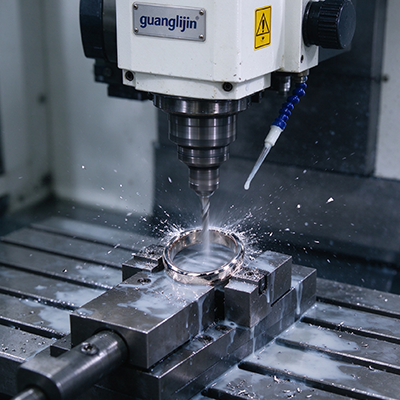
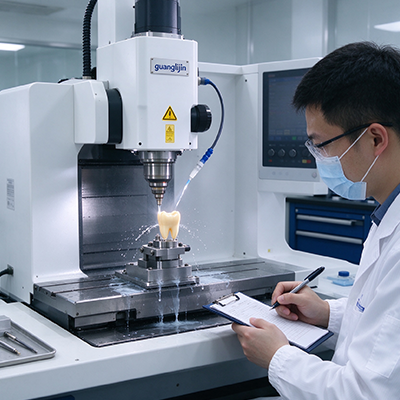
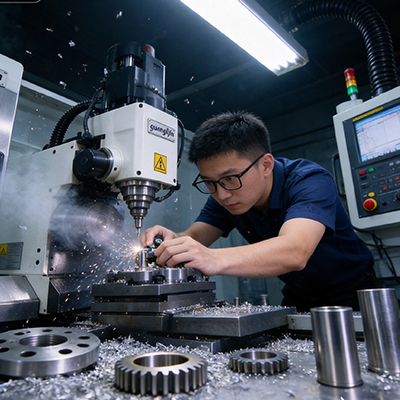
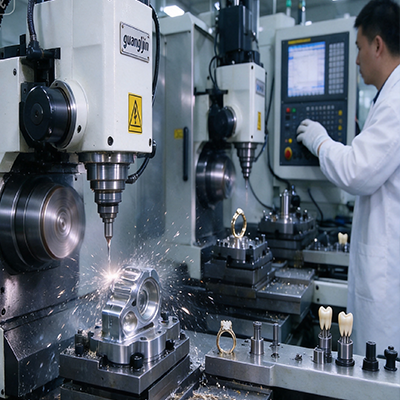
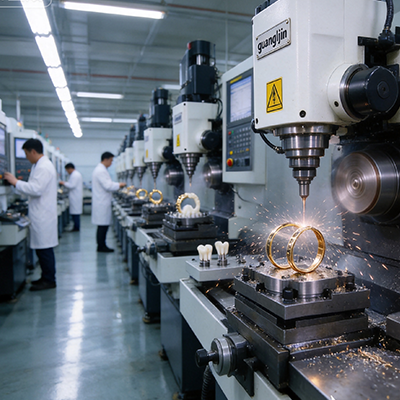
A dental lab shopping for a benchtop 5-axis mill faces a narrow market. Few machines fit on a bench, cut zirconia and titanium well, and fit a lab budget. Quotes vary widely. This guide explains what drives the number and how to read it without getting misled.
Why Dental Work Demands 5 Axes on a Benchtop Frame
Dental restorations have curved anatomy that a 3-axis mill cannot reach in one setup. Crowns, bridges, and implant bars all need access from multiple angles. Five axes let the tool approach the restoration from below and around the sides.
A benchtop frame shrinks the working envelope. That is fine for dental parts, which are small. The challenge is keeping rigidity in a compact frame while supporting two rotary axes. Cheaper benchtop mills sacrifice that rigidity, and the finish quality shows it.
Project A vs Project B: Two Dental Mill Quotes Compared
Two dental labs quoted benchtop 5-axis mills for zirconia and titanium work. Their selection criteria differed.
| Factor | Project A (Entry-Level Import) | Project B (Dental-Focused Machine) |
|---|---|---|
| Quoted price | $18,500 | $32,000 |
| Axes configuration | 5 axes, rotary table on B/C | 5 axes, trunnion with A/C |
| Spindle speed range | 3,000–24,000 RPM | 5,000–60,000 RPM |
| Coolant / dust extraction | Basic flood only | Dry milling with HEPA extraction |
| Zirconia crown fit (first batch) | 78% acceptance | 98% acceptance |
| Tool breakage per week | 4–6 tools | 1–2 tools |
| Downtime in first quarter | 11 days | 2 days |
Project A saved $13,500 upfront. The acceptance rate and downtime told a different story. Project B cost more and produced sellable crowns from week one. For dental labs, restoration acceptance is the real measure of value.
A Step-by-Step Dental Mill Quote Process
Follow this sequence before requesting a quote.
Step 1: Define Your Material Mix First
Zirconia and titanium need different spindle speeds, coolants, and tooling. A machine optimized for zirconia may struggle with titanium. List the materials you plan to cut in the next two years. Then match spindle specs to that mix.
Step 2: Confirm the Rotary Axis Configuration
Benchtop 5-axis mills use either a B/C rotary table or an A/C trunnion. Each has trade-offs in rigidity and access. A 2024 dental milling review found that trunnion-style designs offer better rigidity for titanium, while B/C tables suit zirconia crowns . Choose based on your heaviest material.
Step 3: Verify Dust and Coolant Handling
Zirconia milling generates abrasive dust. Titanium needs coolant. A machine that handles both must have dry dust extraction and wet coolant capability. Ask for the filtration spec and confirm the filters are affordable to replace.
Step 4: Request a Test Cut on Your Material
Send the supplier a sample restoration file and ask for a test cut in your material. Measure the fit and surface finish. A supplier who cannot provide a test cut is asking you to take a risk they will not take themselves.
Step 5: Price the Full Cost of Ownership
Add tooling, filters, maintenance, and training to the purchase price. A 2025 dental lab equipment survey reported that consumables and maintenance add 15% to 25% to the annual cost of a milling machine . Quote the full picture, not just the sticker.
⚠ Attention: Three Dental Mill Quote Traps
Trap 1: Spindle speed without rigidity. High RPM means little if the frame flexes. Chatter ruins zirconia margins. Ask about frame mass and linear guide stiffness, not just spindle RPM.
Trap 2: Undersized dust extraction. Zirconia dust damages bearings and guideways over time. A cheap extraction system saves money now and costs more in repairs later. Confirm the filtration rating before purchase.
Trap 3: No dental-specific CAM software included. A general CAM package requires manual toolpath setup for dental anatomy. Dental CAM software includes restoration libraries and margin detection. A 2025 dental workflow study found that integrated CAM reduces design-to-mill time by nearly 40% compared to generic CAM . Confirm software is included and trained.
What Drives the Price of a Benchtop Dental Mill
Spindle quality is the biggest cost driver. A high-speed spindle with ceramic bearings costs significantly more than a standard spindle. Rotary axis design comes next. A rigid trunnion costs more than a lightweight table.
Dust and coolant systems add cost. So does the control and software package. A machine with integrated dental CAM costs more than a bare controller. Therefore, compare quotes on total capability, not price alone.
We worked with a dental lab in 2025 that compared three benchtop 5-axis quotes. The lowest-priced machine lacked dust extraction for zirconia and included generic CAM. After adding the missing pieces, the total cost matched the mid-priced dental-focused machine. The quote comparison changed the decision.
How to Vet a Benchtop Mill Supplier for Dental Work
Ask for dental-specific references. A supplier who has installed machines in working labs can show real results. A general CNC dealer may not understand restoration workflows.
Check service response time. A dental mill that goes down stops lab output. Ask for the guaranteed response time and the nearest service technician’s location. Therefore, service access is a quote line item, not an afterthought.
Training matters too. Dental CAM software has a learning curve. A supplier who includes structured training shortens the path to first sellable restoration. Ask what training is included and where it takes place.
Questions Dental Labs Search For
How much does a 5 axis benchtop CNC mill for dental cost?
Entry-level benchtop 5-axis dental mills start around $15,000 to $20,000. Dental-focused machines with high-speed spindles and dust extraction run $28,000 to $40,000. Add consumables and maintenance to the annual budget .
Can a benchtop 5 axis CNC mill cut zirconia and titanium?
Yes, with the right spindle and dust/coolant handling. Zirconia needs high RPM and dry dust extraction. Titanium needs coolant and more spindle torque. Confirm both capabilities before buying.
What spindle speed is needed for dental zirconia milling?
Zirconia milling benefits from spindle speeds of 40,000 to 60,000 RPM with a rigid frame. Lower speeds can work but increase tool wear and surface roughness. Match spindle speed to your material mix.
What software comes with a dental 5 axis benchtop mill?
Dental-focused machines typically include CAM software with restoration libraries and margin detection. General machines may ship with generic CAM. Confirm software inclusion and training in the quote .
The Dental Mill Quote Checklist
- ☐ Material mix defined for the next two years
- ☐ Rotary axis configuration matched to materials
- ☐ Spindle speed and rigidity both verified
- ☐ Dust extraction rated for zirconia
- ☐ Coolant system confirmed for titanium
- ☐ Test cut requested in your material
- ☐ Dental CAM software and training included
- ☐ Service response time guaranteed
- ☐ Consumable and filter costs estimated
- ☐ Total cost of ownership calculated
Final Word on Dental Benchtop Mills
The 5 axis benchtop cnc mill you choose for a dental lab must match the materials you cut and the restorations you sell. A cheap machine that rejects one in five crowns is not cheap. A capable machine that delivers sellable restorations pays for itself.
Define the material mix. Demand a test cut. Price the full ownership cost. Do that and the quote becomes a real decision tool.