Custom milling lives or dies on setup strategy. A part with features on five faces punishes any process that moves it between machines. The 11 axis CNC machine answers that specific pain. It consolidates operations into a single clamping, but only when the part family and volume align. This guide focuses on the custom milling angle: what changes, what breaks, and what to verify before you commit.
What “Custom Milling” Means on an 11-Axis Platform
Standard milling centers position one tool against a workpiece. An 11-axis platform orchestrates multiple tool carriers at once. The Traub TNL32-11 carries an upper and identical lower turret, each with X, Y, and Z axes. A counter spindle moves in X and Z. A front working attachment adds a CNC circular axis [citation:4][citation:7].
That front attachment is not decoration. It carries eight tool stations, four for fixed tools and four for live tools. Interpolating its rotary axis with the main spindle’s C-axis creates an effective Y direction [citation:4]. For custom milling, this means drilling, milling, and turning happen in one cycle. No secondary op. No re-fixture. No accumulated error.
Why Custom Parts Benefit Most
High-volume standard parts often run fine on a dedicated Swiss platform. Custom work is different. The geometry shifts. The feature mix changes. A platform that eliminates setups across a part family delivers value that compounds across every job. Therefore, the 11-axis investment makes sense when your custom mix is broad and your tolerance bands are tight.
Project Comparison: Setup-Heavy vs. Consolidated
Two custom milling scenarios illustrate the decision boundary. The data below reflects typical shop-floor outcomes reported for multi-axis consolidation projects [citation:5][citation:14].
| Decision Factor | Project A: Legacy 3-Axis Path | Project B: 11-Axis Custom Milling |
|---|---|---|
| Setup count per part | 3–4 flips | 1–2 setups |
| Stack-up error risk | High across multiple fixtures | Lower with single-clamp strategy |
| Surface consistency | More hand blending needed | More consistent across faces |
| Cycle time (complex part) | 68 hours (9 setups) | 22 hours (1 setup) [citation:14] |
| Dimensional accuracy | ±0.015 mm | ±0.005 mm [citation:14] |
| Best fit | Simple prismatic parts | Complex contours, multi-face work |
| Programming complexity | Moderate | High; requires simulation discipline |
The numbers are stark. However, buying hardware alone rarely fixes process debt. A shop that struggles with fixture discipline on 3 axes will struggle on 11 axes, just faster. The difference is that the 11-axis platform removes the setup opportunities for error to creep in.
Five Steps to Configure a Custom Milling System
You have decided the part family justifies evaluation. Now what? Follow this sequence. Each step targets a failure point observed in real custom milling projects.
- Lock the datum strategy before comparing machines. Write the datum and tolerance notes on the traveler. Every fixture, every probe routine, and every program revision must reference the same datum. Shops that skip this step spend weeks chasing drift that originates in paperwork, not the machine.
- Build a rigid fixture that allows full tool access. The 11-axis platform’s reach means nothing if the fixture blocks the front attachment. Verify clamp marks will not hit finish faces. Simulate the actual chuck jaws or custom fixture in the kinematic model before cutting chips.
- Select cutters matched to spindle torque and reach. The front attachment runs up to 12,000 rpm with 3.4 kW of power [citation:4]. That is enough for live tooling on small features. It is not a substitute for a dedicated milling spindle on heavy cuts. Match the cutter to the station’s capability.
- Program conservatively and prove out on a test blank. Start with reduced feeds. Tune chip evacuation with a single test blank before running production stock. The front attachment’s interpolated Y-axis is powerful, but thermal growth in the attachment affects accuracy over long cycles.
- Verify the CAM post handles independent axis groups. A post that treats the machine like a fast 5-axis will cancel one tool path against another. Ask for a test post run on a representative geometry. Confirm that simultaneous operations generate valid code without manual intervention.
Each rotary axis adds a positioning stack: encoder error, backlash, thermal drift, and cradle deflection. A well-built 3-axis machine on a rigid fixture often holds tighter tolerance than a poorly maintained 5-axis platform on the same part [citation:2]. Axis count buys reach and setup reduction. Accuracy comes from machine build, fixture rigidity, and thermal control. Never assume more axes automatically means better parts.
Field Notes from a Custom Milling Evaluation
In 2025, our team reviewed a custom milling cell for small stainless connectors. The shop ran four operations across two machines. Scrap sat at 3.8 percent, mostly from reference shift between setups. We modeled an 11-axis configuration using the front working attachment for cross-drilling.
The simulation revealed a clearance problem. The counter spindle’s Z travel was insufficient for the longest variant when the front attachment was engaged. That single finding changed the machine specification. The lesson is direct: simulate with your exact workholding and your longest part, not the average one.
Published data supports the consolidation case. A 2025 aerospace engine housing project reported production time dropping from 68 hours across nine setups to 22 hours in a single setup on an 11-axis platform. Dimensional accuracy moved from ±0.015 mm to ±0.005 mm [citation:14]. Those are custom milling results, not high-volume Swiss work.
Common Mistakes in Custom Milling Configuration
Mistake 1: Specifying the Machine Before the Fixture
Buyers fall in love with axis counts and spindle speeds. Then the fixture arrives and blocks the front attachment’s approach angle. The machine sits idle while engineers redesign workholding. Reverse the order: design the fixture concept first, then verify the machine can reach it.
Mistake 2: Ignoring Thermal Behavior on Long Cycles
Custom milling often means long cycle times. Multiple moving components generate heat. That heat shifts positioning accuracy over hours, not minutes. Ask for thermal compensation data. Run a warm-up cycle before first-article inspection. A machine that holds tolerance cold may drift when it reaches operating temperature.
Mistake 3: Assuming CAM Support Is Universal
Post-processor support for 11-axis simultaneous motion varies by machine model and control version. Some CAM vendors offer generic posts that cannot exploit the front attachment’s interpolated Y-axis. Verify post capability with your specific machine and control before purchasing software seats.
Frequently Asked Questions
Q1: What is the main advantage of an 11 axis CNC machine for custom milling jobs?
A: The primary advantage is setup elimination. Custom parts with features on multiple faces typically require three to four setups on a 3-axis platform. An 11-axis configuration completes those features in one clamping, removing the reference shift that accumulates between setups.
Q2: How much does an 11 axis CNC machine cost for custom milling work?
A: New Swiss-type or mill-turn platforms with 11 axes range roughly $300,000 to $700,000 depending on bar capacity, tooling, and configuration. Budget separately for CAM post development, custom fixturing, and operator training. Used platforms appear on the secondary market at lower prices, but verify post-processor support before committing.
Q3: Can an 11 axis CNC machine handle both milling and turning in one cycle?
A: Yes. The platform architecture combines turning axes with live tooling stations and a front working attachment. The front attachment’s interpolated Y-axis enables drilling and milling operations that would otherwise require a secondary machine or a separate setup.
Q4: What CAM software supports 11-axis custom milling programming?
A: Major CAM vendors offer multi-axis modules, but post-processor quality varies. The critical test is whether the post generates valid simultaneous toolpaths across the upper turret, lower turret, and front attachment without manual editing. Request a test post run on your hardest geometry before purchasing.
Q5: Is an 11 axis CNC machine suitable for low-volume custom prototyping?
A: Generally no. The burden rate and programming overhead require predictable volume to justify. Low-volume prototyping usually achieves better returns on a 5-axis platform with strong fixturing. The 11-axis case strengthens when the custom part family shares features that demand four or more setups and the annual volume is repeatable.
Where Guanglijin Fits the Custom Milling Landscape
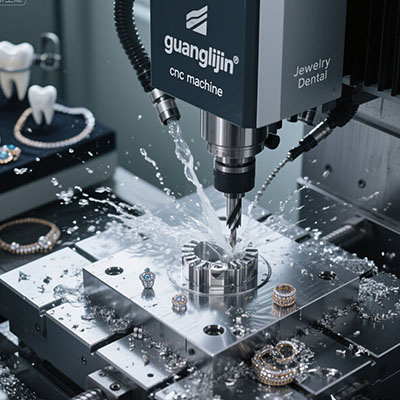
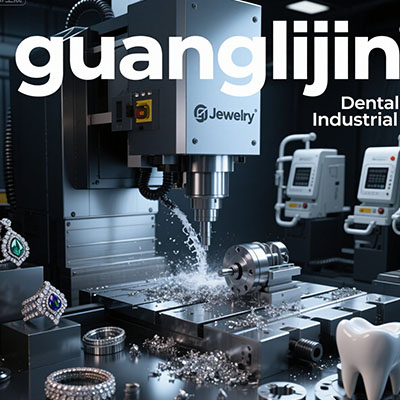
For jewelry and dental custom milling, Guanglijin offers 11-axis platforms built on more than two decades of CNC milling experience [citation:3]. The G11-550 carries a 3.7 kW vertical spindle at 40,000 rpm and a 2.5 kW horizontal spindle at 60,000 rpm, with a two-ton body weight [citation:6].
These platforms serve a different custom milling need than a Swiss-type production machine. The evaluation logic is identical: lock the datum, verify the fixture, simulate the toolpath, and prove out the post. The axis count is a tool. The process discipline is what delivers precision.
Checklist: 11 Axis CNC Machine Custom Milling System
- Part family requires four or more setups on a 3-axis platform
- Datum and tolerance notes locked on the traveler
- Fixture simulated with exact jaws or custom workholding
- Front attachment reach verified for the longest part variant
- CAM post-processor tested on representative geometry
- Thermal warm-up cycle defined before first-article
- Tool monitoring logic verified for simultaneous cutting
- Operator training covers collision awareness and spatial prediction
- Scrap reduction modeled conservatively in payback
- Builder service and post support confirmed for your region
The 11 axis CNC machine does not make bad processes good. It makes good processes faster and more consistent. For custom milling shops with the right part family and the discipline to simulate before cutting, the consolidation payoff is real. For everyone else, a well-fixtured 5-axis center remains the smarter investment.