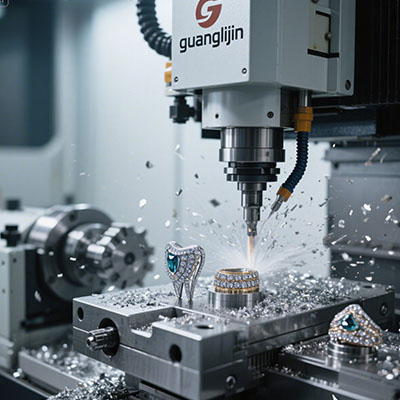
Aerospace components often hide their difficulty in one feature. A hydraulic manifold with cross-drilled passages. A turbine casing with angled bosses on a curved wall. A single setup can make or break the job. That is where a cnc machine 6 axis earns its place. This guide explains what six-axis capability delivers for aerospace component machining, which design details matter, and how to validate a platform before committing capital.
What Six Axes Add to Aerospace Machining
Five axes position the tool around the part. The sixth axis typically rotates the workpiece or adds a second rotary motion on a sub-spindle. Mill-turn platforms use this architecture to combine turning and milling in one footprint.
That combination eliminates secondary operations. A shaft with cross-drilled holes and milled flats can finish in one cycle. Setup count drops. Feature-to-feature alignment improves because the part stays clamped.
Therefore the value of six axes is process consolidation, not axis count. Fewer setups mean fewer chances for error. On expensive aerospace billets, that consolidation often pays for itself.
Our team reviewed a manifold program in 2025 where a shop moved work from two machines to one six-axis mill-turn platform. Cycle time dropped and alignment improved. The savings came from eliminating a re-fixture, not from faster cutting .
Project A vs Project B: Six-Axis Platform Comparison
Two aerospace suppliers invested in six-axis capability. Project A chose a 5+1 indexed platform. Project B selected a true six-axis mill-turn machine. Their part mixes differed, and so did their results.
| Factor | Project A — 5+1 Indexed | Project B — True Six-Axis Mill-Turn |
|---|---|---|
| Sixth-axis motion | Indexes between cuts | Interpolates during the cut |
| Best part type | Simple multi-face components | Manifolds, casings, shafts with cross features |
| Setup count | 2–3 per complex part | 1 setup for most parts |
| Sub-spindle capability | Positioning only | Full C-axis contouring |
| Typical price band | $150,000–$400,000 | $550,000–$850,000+ |
| Best fit | Prototyping, moderate complexity | Production aerospace components |
Project A handled simple multi-face work at a lower entry cost. Project B eliminated secondary operations on complex components. However, Project B demanded more programming skill and infrastructure. The comparison forces a practical question: does your geometry truly require simultaneous six-axis motion?
Five Steps to Validate a Six-Axis Machine
Do not accept a demo on aluminum scrap. Do not trust a calibration certificate alone. Run this sequence with your alloy and your most complex component.
Step 1: Confirm True Simultaneous Capability in Writing
Ask whether the sixth axis interpolates continuously or only indexes. Request sample G-code from a comparable aerospace part. Look for simultaneous rotary and linear commands. Indexed output disguised as multi-axis will fail complex geometry . Confirm the answer in the purchase contract.
Step 2: Demand a Test Cut on Your Hardest Alloy
Provide a test part with cross-drilled holes, milled flats, and a curved surface. Watch the tool tip on the control display. It should track without hesitation. Listen for spindle load spikes at direction changes. Titanium and Inconel expose weakness that aluminum hides. Measure true position and finish afterward.
Step 3: Verify RTCP and Sub-Spindle Contouring
Ask for a test that tilts the head through a continuous arc while cutting. Without RTCP, the tool tip drifts and the feature fails. Then confirm the sub-spindle offers full C-axis contouring, not just indexing. Contouring enables helical interpolation and off-center drilling without a second setup.
Step 4: Test Thermal Stability Over a Long Cycle
Run the machine at production load for four hours. Measure the same feature at the start and the end. Titanium expands about 8.6 microns per meter per degree Celsius . A drifting machine will fail tight callouts. Confirm thermal compensation on the B-axis head and spindle cooling before purchase.
Step 5: Audit Coolant, Tool Capacity, and Programming Support
Deep-cavity work demands high-pressure coolant. Specify 70 bar minimum for titanium. Confirm the tool magazine holds 80+ tools for complex parts. Then assess programming. Six-axis CAM requires collision simulation and kinematic expertise. Budget for training or turnkey support if the skill is not in-house.
Common Mistakes in Six-Axis Aerospace Machining
⚠Attention: Do not confuse 5+1 indexing with true six-axis interpolation. The capability gap is real. A machine that indexes only cannot hold complex aerospace surfaces.
⚠Attention: Do not skip high-pressure coolant on titanium and Inconel work. Deep pockets trap chips where flood coolant cannot reach. Recutting damages tools and surfaces .
⚠Attention: Never authorize production without a first-article review. A new six-axis setup introduces variables that a demo cannot reveal. Verify the first article before running the lot.
Another quiet error involves programming time. A poorly optimized six-axis program can run slower than a well-optimized five-axis process. The savings appear only when the programmer understands the machine’s kinematics and the part’s critical features.
Frequently Asked Questions
What is a 6 axis CNC machine used for in aerospace?
Six-axis mill-turn platforms combine turning and milling in one setup. They suit manifolds, casings, and shafts with cross-drilled holes and milled flats. The sixth axis eliminates secondary operations .
What is the difference between 5+1 and true 6-axis machining?
A 5+1 machine interpolates five axes and indexes the sixth between cuts. True six-axis machines move all six axes during the cut. The latter handles complex geometry but costs significantly more .
What tolerance can a 6 axis CNC machine hold for aerospace components?
Precision six-axis machines can hold ±0.001 inch or tighter under controlled conditions. Achievable results depend on thermal control, RTCP performance, and probing discipline. Request a test cut on your alloy .
How much does a 6 axis CNC machine cost for aerospace?
5+1 indexed platforms start around $150,000–$400,000. True six-axis mill-turn machines configured for aerospace run $550,000–$850,000 or more. Price tracks envelope, spindle power, and control options.
What coolant pressure is required for six-axis aerospace machining?
Deep-cavity titanium and Inconel work requires 70 bar minimum, with 100–150 bar preferred. High-pressure coolant evacuates chips and prevents recutting .
Pre-Purchase Checklist
- ☐ Part geometry and six-axis requirement documented
- ☐ True simultaneous capability confirmed in writing
- ☐ Sample G-code reviewed for continuous output
- ☐ Test cut observed on your hardest alloy
- ☐ RTCP verified under continuous motion
- ☐ Sub-spindle contouring capability confirmed
- ☐ Thermal stability measured over a four-hour run
- ☐ Coolant pressure specified at 70 bar minimum
- ☐ Tool magazine sized for 80+ tools
- ☐ Programming talent and training budget assessed
- ☐ Floor space and power infrastructure confirmed
- ☐ Service access and spare spindle lead time verified
Six-axis machining is a process decision: geometry, coolant, programming, and thermal control working together. Start with your most complex component, survive a live cut test, and end with a checklist on the floor. Everything else is brochure noise.