Precision shops face a hard truth. Some parts cannot be made economically on a 5-axis platform. The setup count climbs. Error stacks up. An 11 axis CNC machine changes that math, but only if you match the platform to the part. This guide cuts through the marketing and focuses on what actually determines success.
Why Eleven Axes Exist in the First Place
The axis count sounds like a spec-sheet race. It is not. The extra axes exist to enable simultaneous cutting from multiple directions. The STAR SW-20, for example, carries front and rear tool carriers with up to four turning and three rotary tools on the primary side, plus six turning and three rotary on the secondary side [citation:1]. Three tools can cut at once.
That architecture compresses cycle time. It also reduces the number of times a part must be repositioned. Every repositioning introduces a new chance for error. Therefore, the real value of an 11-axis platform is not reach. It is consistency across features that would otherwise require four or more setups.
Where the Axes Sit on a Typical Platform
Take the Traub TNL31-11. It has a headstock moving in Z, upper and lower turrets with X, Y, and Z axes, and a counter spindle moving in X and Z [citation:7]. A front working attachment adds a CNC circular axis. Interpolating that rotary axis with the main spindle’s C-axis creates an effective Y direction [citation:2].
That front attachment carries eight tool stations, four for fixed tools and four for live tools. It can run at 12,000 rpm with 3.4 kW of power [citation:7]. When you hear “11 axes,” this is the kind of hardware that delivers the capability.
Platform Comparison: Swiss-Type vs. Jewelry-Focused
Not every 11-axis machine solves the same problem. Two distinct categories dominate the market, and buying the wrong one wastes money. We compared them side by side using published specifications and market pricing.
| Decision Factor | Project A: Swiss-Type Production | Project B: Jewelry / Micro Milling |
|---|---|---|
| Representative model | STAR SW-20 or Eurotech Blitz | Guanglijin G11-550 |
| Primary application | Small precision components, medical, aerospace | Gold, silver, platinum jewelry engraving |
| Bar capacity | Up to 0.780 inch (SW-20) [citation:1] | Not bar-fed; block or blank workholding |
| Max spindle speed | 10,000 rpm main spindle [citation:1] | 40,000 rpm vertical / 60,000 rpm horizontal [citation:9] |
| Simultaneous tool count | Up to 3 cutting tools [citation:1] | Dual spindle (vertical + horizontal) design [citation:9] |
| Control system | FANUC 31i-B5 [citation:1] | SYNTEC system [citation:9] |
| Weight | ~3,400 kg [citation:1] | ~2,000 kg [citation:9] |
| Price band | $300k–$700k (new, configured) | ~$98,800 listed [citation:8] |
| Best fit | High-mix, tight-tolerance metal parts | Intricate precious-metal designs at volume |
The takeaway is simple. A jewelry-focused 11-axis platform will not cut stainless steel hydraulic fittings. A Swiss-type will not deliver the 40,000 rpm spindle speeds needed for fine gold engraving. Match the category before you compare individual models.
A Five-Step Verification Process Before You Buy
You have narrowed the category. Now you need to prove the platform actually fits your work. Follow this sequence. Each step targets a failure mode we have seen in real evaluations.
- Map every setup your current process requires. Write down each fixture, each repositioning, and each inspection between operations. If the list has fewer than four setups, an 11-axis platform rarely pays back. The value comes from collapsing setups, not from axis count alone.
- Run a kinematic simulation with your exact workholding. The machine’s reach means nothing if your fixture blocks the tool path. Load the actual chuck jaws, collets, or custom fixtures into the simulation. Check clearance at every angle the part requires.
- Verify simultaneous tool collision detection. Three tools cutting at once means three collision bodies. The control must prevent interference between the upper turret, lower turret, and front attachment. Ask for a live demonstration on a part geometry similar to yours.
- Confirm the CAM post handles independent axis groups. Some post-processors treat the machine like a faster 5-axis. They cannot generate code where one tool path does not cancel the other. A shop in Maine spent roughly six months developing a post for a dual-head Mazak Integrex before simultaneous cutting worked correctly [citation:15]. Budget time and money for post development.
- Calculate the burden rate against your actual volumes. An 11-axis machine carries a higher hourly rate than a 5-axis center. The payback depends on cycle time reduction and scrap elimination. If your monthly volume per part is low, the math fails. Run the numbers with conservative cycle time estimates.
On platforms like the Traub TNL series, the front working attachment is not a nice-to-have. It carries eight tool stations and enables interpolated Y-axis motion through the main spindle’s C-axis [citation:2][citation:7]. Shops that skip it pay for axis capability they never use. During quoting, map your part features to the attachment’s specific capabilities. If you cannot name three features that require it, reconsider the configuration.
Field Notes from a Real Evaluation
In 2025, our team reviewed a production cell for small stainless steel connectors. The shop ran four operations across two machines. Scrap sat at 3.8 percent, mostly from reference shift between setups. We modeled an 11-axis Swiss-type platform for the part family.
The simulation revealed a fixture clearance problem that the shop had not anticipated. The counter spindle’s Z travel was insufficient for the longest variant. That single finding changed the machine specification. The lesson: simulate before you sign, not after the machine lands on your floor.
Market data supports the broader trend. The Eurotech Blitz 12/16 SY2-B, an 11-axis Swiss-type, targets aerospace, medical, automotive, and firearms components with dual C-axes and dual B-axes [citation:4]. These are not niche applications. They are the core of precision manufacturing.
Common Mistakes That Sink 11-Axis Projects
Mistake 1: Assuming Programmers Can Transition Without Training
The mental model shifts from positioning one tool to orchestrating multiple tools in parallel. Spatial prediction becomes critical. A programmer who excels on 5-axis may still crash an 11-axis platform in the first week. Training must cover collision awareness, not just G-code syntax.
Mistake 2: Underestimating Tool Monitoring Needs
With three tools cutting simultaneously, a broken drill in one station does not always stop the cycle immediately in another. The control must detect abnormal load and retract safely. Verify this logic during acceptance testing. Ask the builder to demonstrate a simulated tool failure.
Mistake 3: Buying Used Without Support Verification
The secondary market carries 11-axis platforms at attractive prices. A 2021 Tsugami BW329ZE with 11 axes listed around €149,000. However, used machines often lack post-processor support for current CAM versions. Verify that your CAM vendor can generate code for the specific model and control before you commit.
Frequently Asked Questions
Q1: What is the main difference between an 11 axis CNC machine and a 5-axis machining center?
A: An 11-axis platform enables simultaneous cutting from multiple tool carriers. A 5-axis center positions one tool at a time. The difference matters for parts requiring features on multiple faces with tight tolerances. The 11-axis approach eliminates setups that would otherwise introduce error.
Q2: How much does an 11 axis CNC machine cost for high-precision work?
A: New Swiss-type platforms run roughly $300,000 to $700,000 depending on bar capacity, tooling, and configuration. Jewelry-focused 11-axis machines list lower, around $98,800 for a dual-spindle model [citation:8]. Budget separately for CAM seats, post development, fixturing, and training.
Q3: Can an 11 axis CNC machine reduce scrap rate on complex parts?
A: Yes, primarily by eliminating repositioning errors. Every time a part moves to a new fixture, the reference can shift. Consolidating operations into one clamping reduces that risk. The magnitude of improvement depends on how many setups you eliminate and how tightly the original process held tolerances.
Q4: What CAM software supports 11-axis simultaneous programming?
A: Major CAM vendors offer mill-turn modules, but post-processor support varies by machine model. Verify that the post can generate independent tool paths without one canceling the other. Ask for a test post run on a representative part geometry before finalizing the software purchase.
Q5: Is an 11 axis CNC machine suitable for small job shops?
A: Rarely. The burden rate and programming complexity require consistent volume to justify. Small shops with low-volume, high-mix work usually achieve better returns with a 5-axis platform. The 11-axis investment makes sense when a specific part family demands four or more setups and the annual volume is predictable.
Where Guanglijin Fits the Landscape
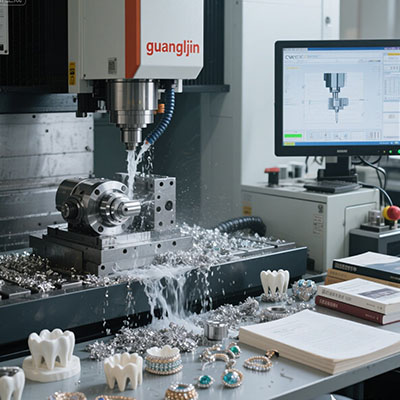
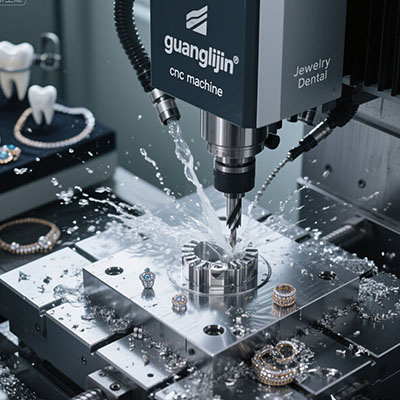
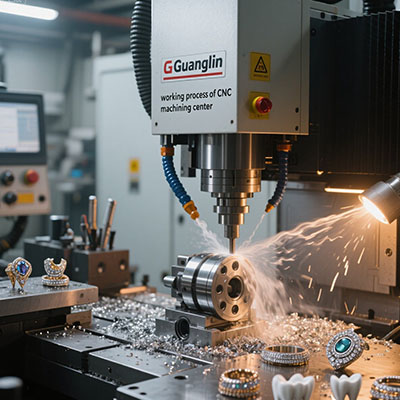
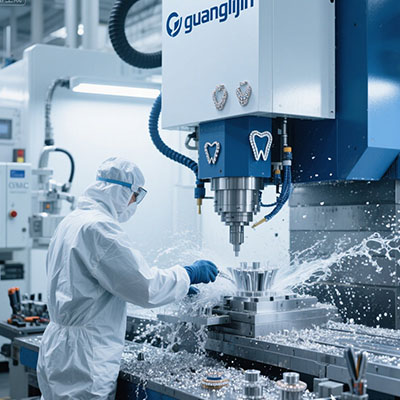
For jewelry and dental applications, Guanglijin offers 11-axis platforms starting from 5-axis configurations. The G11-550 carries a 3.7 kW vertical spindle at 40,000 rpm and a 2.5 kW horizontal spindle at 60,000 rpm, with a listed weight of two tons [citation:9]. The company has manufactured CNC milling machines since 2004 [citation:5].
These platforms serve a different need than a Swiss-type production machine. The evaluation logic remains the same: map the setups, simulate the workholding, and verify the post-processor. Axis count alone does not guarantee precision. The match between machine, part, and process does.
Checklist: 11 Axis CNC Machine Advanced Solution Verification
- Part family requires four or more setups on a 3-axis platform
- Annual volume justifies the higher burden rate
- Workholding simulated with exact chuck jaws or fixtures
- Collision detection verified across all tool carriers
- CAM post-processor tested on representative geometry
- Tool monitoring logic demonstrated under simulated failure
- Operator training includes spatial collision awareness
- Scrap reduction modeled conservatively in payback
- Used market evaluated against new with support
- Builder service coverage confirmed for your region
The 11 axis CNC machine is not a default upgrade. It is a targeted answer to a specific manufacturing problem. When the problem fits, the results justify the investment. When it does not, a well-configured 5-axis center will outperform a poorly utilized 11-axis platform every time.