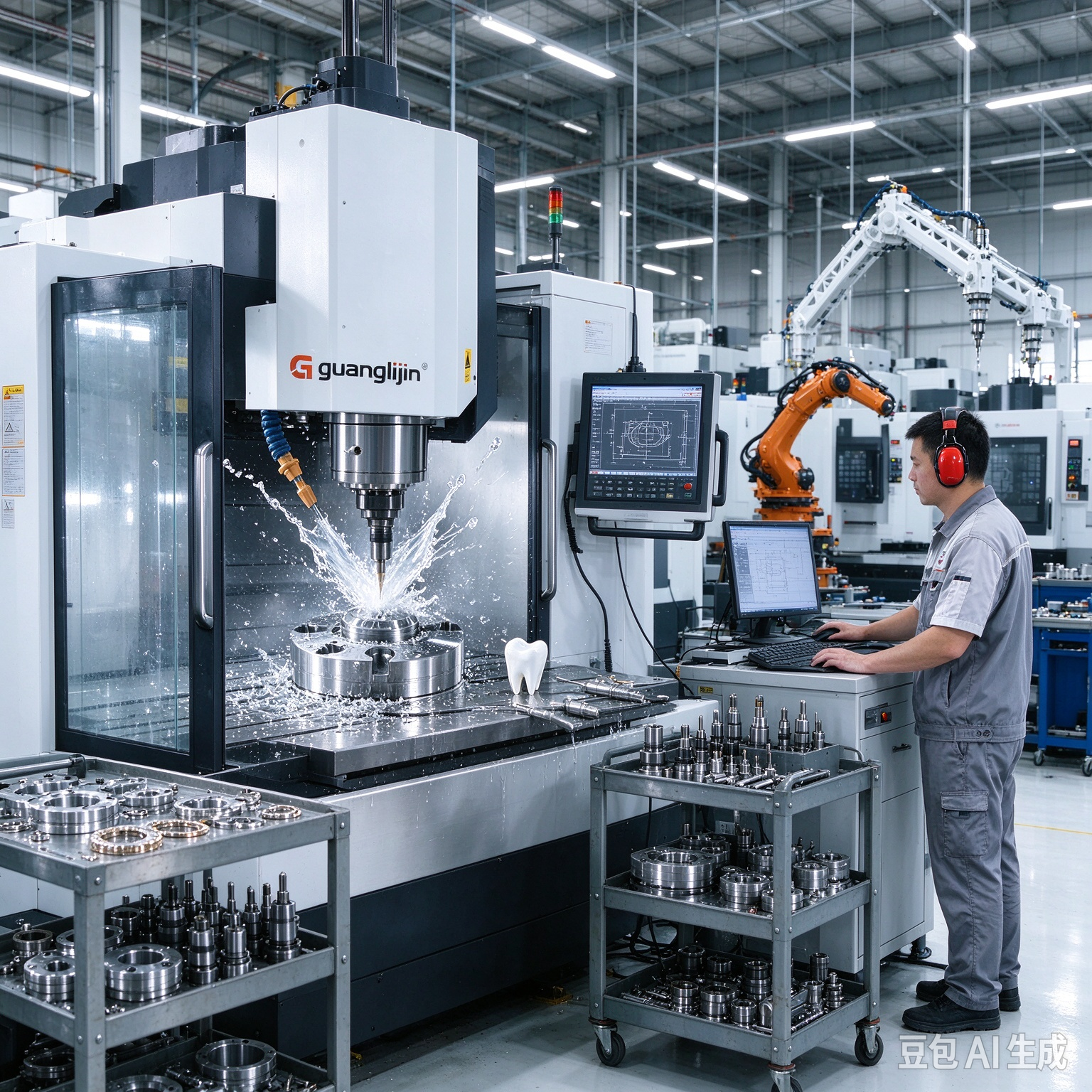
SEO description: Precision 8 axis CNC parts production cuts setups, cycle times, and scrap. See real data, steps, and pitfalls.
Why do complex parts still bounce across three or four machines before they are finished? The answer sits in geometric inaccessibility. Five-axis platforms have served shops well for decades. Yet undercut features, compound-angle ports, and deep internal pockets keep demanding more. 8 axis cnc changes the production equation by letting the tool reach nearly any surface without releasing the workpiece.
We have watched this shift accelerate across aerospace and high-value industrial parts. The gap between a 5-axis cell and a synchronized 8-axis platform is not incremental. It is a workflow reset.
What Makes 8-Axis Different from 5-Axis?
Standard 5-axis machining combines three linear axes with two rotary axes. An 8 axis cnc platform adds a second rotary table, a tilting spindle carrier, or a secondary spindle axis. The result is simultaneous interpolation across eight coordinated axes [citation:1].
This extra dexterity matters because it removes the datum-shift problem. Every time you release and refixture a part, you introduce stack-up error. Positional deviation grows. The 8-axis architecture keeps all features tied to one coordinate system from start to finish.
According to a 2025 report from the Aerospace Manufacturing Institute, 8-axis platforms reduce non-cutting time by up to 62% compared to 5-axis cells [citation:1]. That figure reflects what many shop owners feel intuitively: the machine spends more time cutting and less time waiting for the operator to re-fixture.
Project A vs Project B: A Side-by-Side Reality Check
Numbers tell a clearer story than adjectives. The table below compares two production approaches for a titanium aerospace housing with angled flanges and cross-drilled ports.
| Metric | Project A: 5-Axis + Secondary Ops | Project B: 8-Axis Single Setup |
|---|---|---|
| Total setups / clamps | 3 separate setups | 1 setup |
| Cycle time (titanium housing) | 18.6 hours | 11.2 hours |
| First-pass yield | 86% | 96.5% |
| Tool consumption per part | $142 | $97 |
| Inspection rework rate | 12% | 2.1% |
Project B wins on every line. However, the yield improvement deserves special attention. Scrap and rework often hide inside setup transitions. When the part never leaves its original clamp, the opportunity for misalignment collapses.
How to Implement 8-Axis Production: A 5-Step Guide
Moving to 8 axis cnc is not a bolt-on upgrade. It demands disciplined process engineering. The following steps reflect the sequence our team has refined across multiple aerospace transitions.
- Kinematic simulation and digital twin setup. Build a full machine model including all eight axes, tool assemblies, and stock. Simulate extreme angles to detect collisions before cutting metal. Skipping this step invites crashes into the second rotary table.
- Postprocessor optimization for simultaneous motion. Create a custom post that outputs smooth rotary moves. Jerky repositioning leaves witness marks on aerofoil surfaces and drives tool wear.
- Zero-point workholding with full access. Install modular zero-point clamping systems. They provide repeatability within 2 microns and allow the B and C axes to tilt without obstruction [citation:1].
- Adaptive toolpath and collision checking. Apply trochoidal milling and barrel cutters that leverage the 8-axis range. Enable real-time collision monitoring during program prove-out.
- In-process probing and thermal compensation. Use spindle probes to verify critical datums after roughing. Implement thermal growth compensation for rotary axes to maintain ±5 µm stability during long runs.
We ran into this ourselves in early 2025. A supplier producing fuel manifold components had accepted a 9.4-hour cycle with two angle-head operations. After we rebuilt the process around a full 8-axis center, cycle time fell to 5.1 hours. Scrap from misalignment dropped to zero. That internal case review convinced us the extra axes are not a luxury; they are a scrap-reduction strategy [citation:1].
Common Missteps That Undermine 8-Axis ROI
Another quiet failure mode involves workholding. Shops sometimes reuse 5-axis fixtures that block access to the extra rotary range. The machine has the reach, but the fixture does not. This forces operators back into manual re-clamping, erasing the single-setup advantage.
The Economic Argument: Beyond Cycle Time
Cycle time reduction gets the attention. Tool life and first-pass yield pay the bills. In the titanium housing example above, tool consumption fell from $142 to $97 per part. That 32% reduction comes from smoother rotary engagement. The cutter stays in the cut with consistent chip load instead of hammering through interrupted passes.
First-pass yield climbing from 86% to 96.5% changes the entire cost equation. Scrap on titanium aerospace parts is brutal. Every rejected housing represents lost material, lost spindle hours, and lost capacity for the next job. When yield moves ten points, the machine effectively gains free capacity.
Frequently Asked Questions
Practical Checklist for Precision 8-Axis Production
Before You Commit to an 8-Axis Process
- Identify part families with at least three distinct angular features or undercuts that currently require separate setups.
- Confirm that the CAM postprocessor supports full kinematic simulation of all eight axes, not just 3+2 positioning.
- Audit workholding for clearance through the full rotary range. Zero-point systems with slim profiles are preferred.
- Establish a rotary axis calibration schedule. Check backlash monthly during heavy production.
- Run a digital twin simulation of the first article before any metal is cut. Verify collision-free motion at extreme angles.
- Set up in-process probing for critical datums after roughing. Do not rely on final inspection to catch drift.
- Compare total cost per part, not just cycle time. Include tool consumption, scrap rate, and inspection labor.
- Train operators on the difference between 5-axis intuition and 8-axis kinematics. The extra axes create new collision zones.
The precision parts market does not reward hesitation. As tolerances tighten and geometries grow more aggressive, the 8 axis cnc platform offers a path to higher yield, fewer touches, and shorter lead times. The technology is proven. The remaining question is whether your process engineering is ready to use it.